You have no items in your shopping cart.
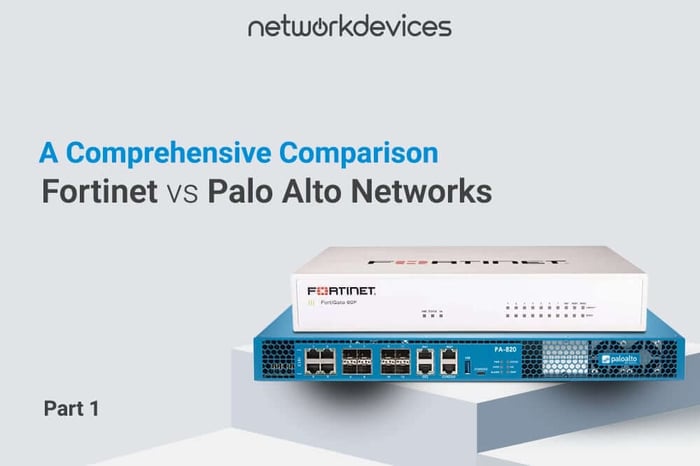
Fortinet vs. Palo Alto Firewall Platform Comparison (2025)

Introduction: Choosing the Right Firewall for Modern IT Infrastructures
With increasingly complex network environments and a surge in sophisticated cyber threats, selecting the right enterprise firewall has never been more critical. Two leading solutions dominate the market: Fortinet firewalls and Palo Alto Networks firewalls. While both offer high-performing next-generation firewalls (NGFWs), their technologies, deployment philosophies, and cost structures differ significantly.
In short:
- Choose Fortinet if you're seeking top-tier performance-per-dollar, simplified licensing, and a unified, easy-to-manage security fabric — especially ideal for small to medium-sized businesses (SMBs) and hybrid networks.
- Choose Palo Alto Networks if you need industry-leading application control, deep cloud-native security, and AI-driven threat intelligence — perfect for large, cloud-first enterprises with complex needs.
This in-depth guide compares Fortinet and Palo Alto across critical criteria:
- Core technology and architecture
- Security capabilities
- Performance benchmarks
- Cloud and hybrid compatibility
- Usability and management
- Compliance and cost efficiency
Whether you're an IT manager, network architect, or procurement specialist, this comparison aims to help you make informed and strategic decisions about firewall investments.
Company Overview
Fortinet was founded in 2000 and is renowned for its FortiGate NGFW series, built on a unified Security Fabric approach. Its strategy centers on integration, performance, and affordability, using purpose-built ASIC hardware to power its solutions.
Palo Alto Networks, established in 2005, revolutionized firewall design by introducing App-ID and user-based policies. Their NGFWs use a software-defined SP3 architecture and are well-regarded for their threat intelligence and precision traffic control.
Core Technology and Architecture
| Feature | Fortinet (FortiGate) | Palo Alto Networks (PA Series) |
|---|---|---|
| Operating System | FortiOS | PAN-OS |
| Management Console | FortiManager / Analyzer | Panorama |
| Security Processing | ASIC hardware | SP3 (Single-Pass Parallel) |
| Cloud Integration | FortiSASE, FortiGate VM | Prisma Access, Prisma Cloud |
| Zero Trust Support | Native ZTNA in FortiOS | Advanced ZTNA via Prisma |
👉 Swipe left to see more
Fortinet emphasizes high throughput, low latency, and simplified policy consolidation with ASIC acceleration. Palo Alto offers a flexible software-based model optimized for deep packet inspection, policy orchestration, and application visibility.
Security Features Comparison
While architecture differs, both platforms offer a comprehensive security suite. Here’s how they stack up on key features:
| Security Capability | Fortinet | Palo Alto Networks |
|---|---|---|
| Threat Intelligence | FortiGuard Labs | Unit 42 / WildFire |
| Intrusion Prevention | Integrated IPS | Advanced Threat Prevention |
| SSL Inspection | ASIC-accelerated | CPU-based; effective, higher overhead |
| App Control | AppControl (3,000+ apps) | App-ID (dynamic identification) |
| Malware Detection | FortiSandbox | WildFire (cloud sandboxing) |
| Web Filtering | URL database, DNS filters | DNS Security with advanced filtering |
| Data Loss Prevention (DLP) | Add-on modules | Native, advanced options |
| CASB | FortiCASB | Integrated into Prisma Access |
👉 Swipe left to see more
Performance and Throughput
Fortinet uses custom processors (e.g., NP7) to support high-speed threat inspection and secure SD-WAN without compromising performance. This results in superior cost-per-gigabit throughput, particularly attractive for SMBs and branch offices.
Palo Alto’s performance relies more heavily on CPU resources, which can lead to bottlenecks during intensive operations, such as SSL decryption or deep packet inspection, in large environments.
Ease of Management and Usability
Fortinet:
- Centralized via FortiManager
- FortiAnalyzer for logs and analytics
- Designed for simplicity and rapid deployment
Palo Alto Networks:
- Managed through Panorama
- Fine-grained policy management
- Higher learning curve but more control
Fortinet benefits smaller teams through its ease of use, while Palo Alto excels for large enterprises that need advanced policy controls.
Ecosystem and Integration
Fortinet:
- Native integration via Security Fabric
- Fabric Connectors for tools like Splunk, Azure AD
- REST API support for automation
Palo Alto Networks:
- Deep third-party integration via Cortex XSOAR
- XML/JSON APIs for flexible orchestration
- Strong support for Okta, VMware, CrowdStrike
Choose Fortinet for a plug-and-play unified environment; select Palo Alto for complex, heterogeneous infrastructures.
Compliance and Regulatory Alignment
In addition to securing traffic, firewall platforms must assist businesses operating in regulated sectors, such as healthcare, finance, or government, in maintaining compliance with regulations like HIPAA, PCI-DSS, GDPR, SOX, and NIST 800-53.
Fortinet:
- HIPAA, PCI-DSS, GDPR, NIST support
- Audit-ready reporting with FortiAnalyzer
- Compliance templates and checklists
Palo Alto Networks:
- FIPS 140-2 encryption support
- Prisma Cloud for cloud compliance
- Trusted in regulated industries like finance and defense
Both vendors meet compliance demands, but Palo Alto offers deeper tools for high-security enterprises.
Zero Trust and SASE
Fortinet integrates ZTNA into FortiGate and FortiClient, offering a simple, cohesive deployment. FortiSASE consolidates SD-WAN, ZTNA, and CASB for remote access security.
Palo Alto Networks delivers ZTNA 2.0 via Prisma Access, including continuous trust verification, granular control, and real-time risk scoring—ideal for cloud-native deployments.
Support and Training
The availability of training materials and the caliber of vendor assistance are critical to successfully deploying a firewall platform. Fortinet and Palo Alto Networks both offer worldwide technical support. However, they differ in their organizational designs and accessibility levels.
Fortinet:
- 24/7 support tiers via FortiCare
- Widely recognized NSE certification path
- Strong MSP and SMB adoption
Palo Alto Networks:
- Enterprise-grade support (Standard to Platinum)
- PCNSA and PCNSE certifications
- Preferred for large-scale, mission-critical rollouts
Fortinet provides affordable and accessible support, while Palo Alto is tailored for complex enterprise operations.
Migration and Vendor Lock-In
Deciding to switch firewall systems might be very important! It frequently involves expenses, downtime, and employee retraining. Because of this, it's critical to comprehend the degree of flexibility offered by each vendor's migration process and to consider the possibility of becoming locked into a vendor. This is crucial in developing your long-term IT plan.
Fortinet:
- Simplified transition tools and templates
- Easier for those already using the Fortinet ecosystem
- Some lock-in via Security Fabric
Palo Alto Networks:
- Detailed but rigid configurations
- Requires advanced training to migrate
- App-ID and policy sets are tightly coupled to PAN-OS
Fortinet offers greater migration flexibility, whereas Palo Alto demands more effort but rewards with control.
Cost and Licensing
Palo Alto employs a modular licensing model that offers flexibility but may raise total cost of ownership, while Fortinet offers simplified, bundled pricing. Cost and licensing are essential considerations when choosing an enterprise firewall because they directly impact both initial investment and long-term scalability.
Fortinet:
- Bundled pricing with predictable TCO
- Lower entry point for SMBs and distributed teams
Palo Alto Networks:
- Modular licensing (pay-per-feature)
- Scalable, but higher total cost over time
Organizations seeking cost efficiency prefer Fortinet, while those wanting customized security investments may opt for Palo Alto.
Cloud and Hybrid Deployment Readiness
Fortinet:
- Strong hybrid integration with AWS, Azure, GCP
- FortiGate VM, FortiCASB, FortiSASE
- Seamless policy enforcement across hybrid environments
Palo Alto:
- Cloud-native architecture: Prisma Cloud and Access
- Rich features for containers, APIs, DevOps
- Full CNAPP, CWPP, and CSPM capabilities
Choose Fortinet for high-performance hybrid networks. Select Palo Alto for cloud-first strategies and DevSecOps alignment.
Summary: Which Enterprise Firewall is Right for You?
- Choose Fortinet if you prioritize performance, cost-effectiveness, and integrated security across a unified infrastructure.
- Choose Palo Alto Networks if you need sophisticated application control, cloud-native scalability, and advanced threat detection.
Palo Alto Networks leads in AI-driven threat prevention, cloud-native architecture, and precision control, making it ideal for complex, enterprise-grade environments.
Fortinet emphasizes high performance and integration through ASIC-powered hardware and a unified security fabric suitable for SMBs and hybrid deployments. Because this is a long and comprehensive topic, a second part of the document has been created. Follow the second part for more information.
In Part 2 of this comparison, we explore real-world deployments, use case mapping, and how to choose the right firewall based on your enterprise needs.