


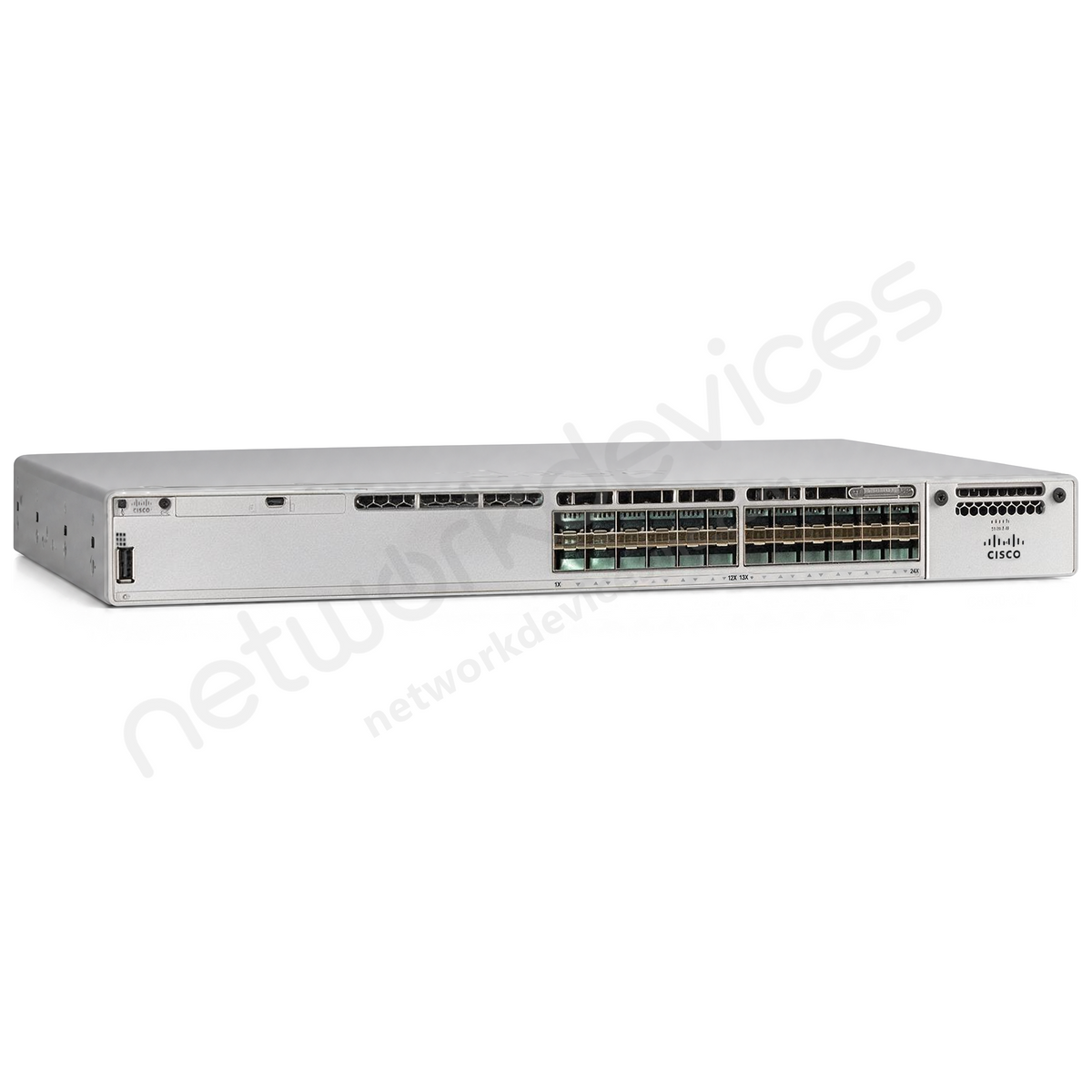
Cisco Catalyst C9300-24S-E 24-Port 1G SFP Switch with Modular Uplinks, Network Essentials
The Cisco Catalyst C9300-24S-E is a 24-port 1G SFP Layer 3 managed switch with modular uplinks. It supports StackWise-480 stacking and ships with Network Essentials.

Overview
The Cisco Catalyst 9300 Series is Cisco's lead stackable enterprise access platform in the Catalyst 9000 family, built on the UADP 2.0 ASIC for investment protection and high-density stacking. The modular-uplink C9300 takes a field-installable network module for 1G, multigigabit, 10G, 25G, or 40G uplinks, and Cisco positions it as the successor to the end-of-sale Catalyst 3850. The C9300-24S-E is the 24-port 1G SFP fiber configuration at the Network Essentials tier, aimed at fiber aggregation rather than copper endpoint access, and its tier is what separates it from the otherwise closely matched Network Advantage C9300-24S-A. Network Essentials covers Layer 2 switching with routed access for a single-tier campus design. Three field-replaceable fans and dual power supplies keep it serviceable in always-on deployments.
Technical Details
The Cisco Catalyst C9300-24S-E is a Layer 3 managed 1U rackmount switch with 24 1G SFP fiber ports and a modular uplink slot, running Cisco IOS XE with the perpetual Network Essentials license. Switching capacity is 208 Gbps and forwarding rate is 154.76 Mpps. The access ports are fiber SFP, so they carry no Power over Ethernet. It supports Cisco StackWise-480 data stacking of up to eight members at 480 Gbps, plus Cisco StackPower for shared power across a stack. It aggregates fiber links from downstream switches and fiber-attached endpoints in campus and branch networks.

 Enterprise Network
 Corporate Campus
 Branch Office


Best For
The C9300-24S-E suits campus and branch fiber aggregation, connecting fiber links from downstream switches and fiber-attached endpoints where the run length or media calls for SFP rather than copper. It stacks with StackWise-480, and the Network Essentials license fits sites whose routing stays within static routes, RIP, or a small OSPF footprint.
Not suitable if:
- you need copper RJ-45 access ports, since these are 1G SFP fiber ports; the C9300-24T or C9300-24P provide copper
- you need to power endpoints over Ethernet, since fiber SFP ports carry no PoE
- you need 10G or 25G access ports, since these are 1G SFP ports
- you need full dynamic routing, BGP, or SGT-based segmentation, since those require the Network Advantage tier
C9300-24S-E Specifications
| Class & Licensing | |
|---|---|
| License Tier | Network Essentials |
| License Detail / MTBF | Network Essentials; MTBF 284,130 hours |
| Ports & Uplinks | |
| Port Speed | Gigabit |
| Uplink Configuration | Modular uplinks (1G/10G/25G/40G network modules) |
| Performance & Scale | |
| Stacking | StackWise-480 |
| Switching Capacity | 208 Gbps |
| Forwarding Rate | 154.76 Mpps |
| MAC Table | 32,000 entries |
| Stacking Bandwidth | 480 Gbps |
| Max Stack Members | 8 |
| IPv4 Routes | 32,000 (24,000 direct, 8,000 indirect) |
| Hardware & Memory | |
| DRAM | 8 GB |
| ASIC | UADP 2.0 |
| Flash | 16 GB |
| Power & Thermal | |
| Power Input / PSU | 715 W AC (PWR-C1-715WAC-P) default, 100-240 VAC auto-ranging |
| Redundant PSU | Yes (1+1; ships with one, second optional) |
| Cooling | Redundant fans (3 field-replaceable) |
| Physical & Environmental | |
| Dimensions (H x W x D) | 1.73 x 17.5 x 17.7 in (4.3 x 44.4 x 44.9 cm) |
| Weight | 16.84 lbs (7.64 kg) |
| Operating Temperature | 23 to 113 °F (-5 to 45 °C), up to 5000 ft (1500 m); minimum cold-start ambient 32 °F (0 °C) |
| Software | |
| Routing Protocols | RIP, OSPF (Routed Access, 1000-route limit), EIGRP Stub, PBR, VRRP, PIM Stub Multicast |
| Operating System | Cisco IOS XE |
Part Number Decode
- C9300 — C9300 is the platform prefix, identifying the modular-uplink Cisco Catalyst 9300 Series.
- 24 — 24 is the port count, indicating 24 access ports.
- S — S is the port-type marker, indicating 1G SFP fiber ports for aggregation, with no Power over Ethernet.
- E — E is the license suffix for the perpetual Network Essentials tier.
Add-ons


FAQ
What kind of ports does the Cisco Catalyst C9300-24S-E have?
The Cisco Catalyst C9300-24S-E has 24 1G SFP fiber access ports, intended for fiber aggregation rather than copper endpoint connectivity. Because they are fiber SFP ports, they carry no Power over Ethernet and cannot power wireless access points, IP phones, or IP cameras. For copper access, the C9300-24T is the data-only copper model and the C9300-24P adds PoE+.
What transceivers do the ports on the C9300-24S-E use?
The C9300-24S-E has 24 1G SFP access ports plus a modular uplink slot. The SFP access ports accept 1G SFP optics; the uplink module adds higher-speed options up to 40G. Specific transceiver compatibility should be verified against the manufacturer's transceiver compatibility matrix at tmgmatrix.cisco.com. Transceivers are sold separately.
How many C9300-24S-E switches can you stack?
The C9300-24S-E supports Cisco StackWise-480 data stacking of up to eight members at 480 Gbps of stack bandwidth, and Cisco StackPower for shared power and power redundancy across the stack. It stacks with other C9300 models, including mixed stacks with C9300X, and does not stack with C9300L, Catalyst 9200, or other series. StackWise and StackPower cables are ordered separately.
What is the difference between the C9300-24S-E and the C9300-48S-E?
The two switches are the same modular-uplink platform, license tier, and stacking, and differ in fiber-port count and throughput. The 24S-E has 24 1G SFP ports with 208 Gbps of switching capacity and a 154.76 Mpps forwarding rate. The 48S-E has 48 1G SFP ports with 256 Gbps of switching capacity and a 190.47 Mpps forwarding rate. Choose the 48S for denser fiber aggregation.
What is the difference between the C9300-24S-E and the C9300-24S-A?
The two switches are closely matched in hardware and differ in license tier. The -E model ships with perpetual Network Essentials, which covers Layer 2 plus basic routed access such as static routing, RIP, EIGRP stub, OSPF for up to 1,000 routes, PBR, PIM stub multicast, and VRRP. The -A model ships with perpetual Network Advantage, which adds full OSPF, EIGRP, BGP, IS-IS, HSRP, VRF, VXLAN, LISP, and SGT segmentation. SD-Access is enabled by the term-based Cisco Catalyst subscription rather than the perpetual tier.
Does the C9300-24S-E require a subscription to operate?
No. The switch runs on its included perpetual base license indefinitely. Under Cisco's ordering model, new switch orders include a term-based Cisco DNA or Cisco Catalyst software subscription of the same tier as the network license; that subscription unlocks Cisco Catalyst Center and cloud-managed features. When the subscription term ends, the switch continues operating on the perpetual base license capabilities after a reload.
Does the Cisco Catalyst 9300 replace an older switch?
Yes. Cisco's migration guidance positions the Catalyst 9300 as the successor to the end-of-sale Catalyst 3850. Migrating from a 3850 to the C9300-24S-E moves the aggregation layer to Cisco IOS XE, StackWise-480 stacking, and StackPower, and existing Catalyst 3850 network modules remain compatible with the 9300.
Is the C9300-24S-E still current, and where is its lifecycle status published?
Network Devices Inc. sells the C9300-24S-E as current, new, factory-sealed stock. Cisco publishes End-of-Sale and End-of-Life status for every Catalyst 9300 Series part number on its official End-of-Life and End-of-Sale Notices page for the series, which is the authoritative source for a specific SKU. Buyers standardizing on a platform for a multi-year refresh should confirm the current status there before ordering.
What condition is the C9300-24S-E sold in, and what warranty applies?
The C9300-24S-E is sold new and factory-sealed. It is covered by a Network Devices Inc. one-year warranty and a 30-day return policy.
