


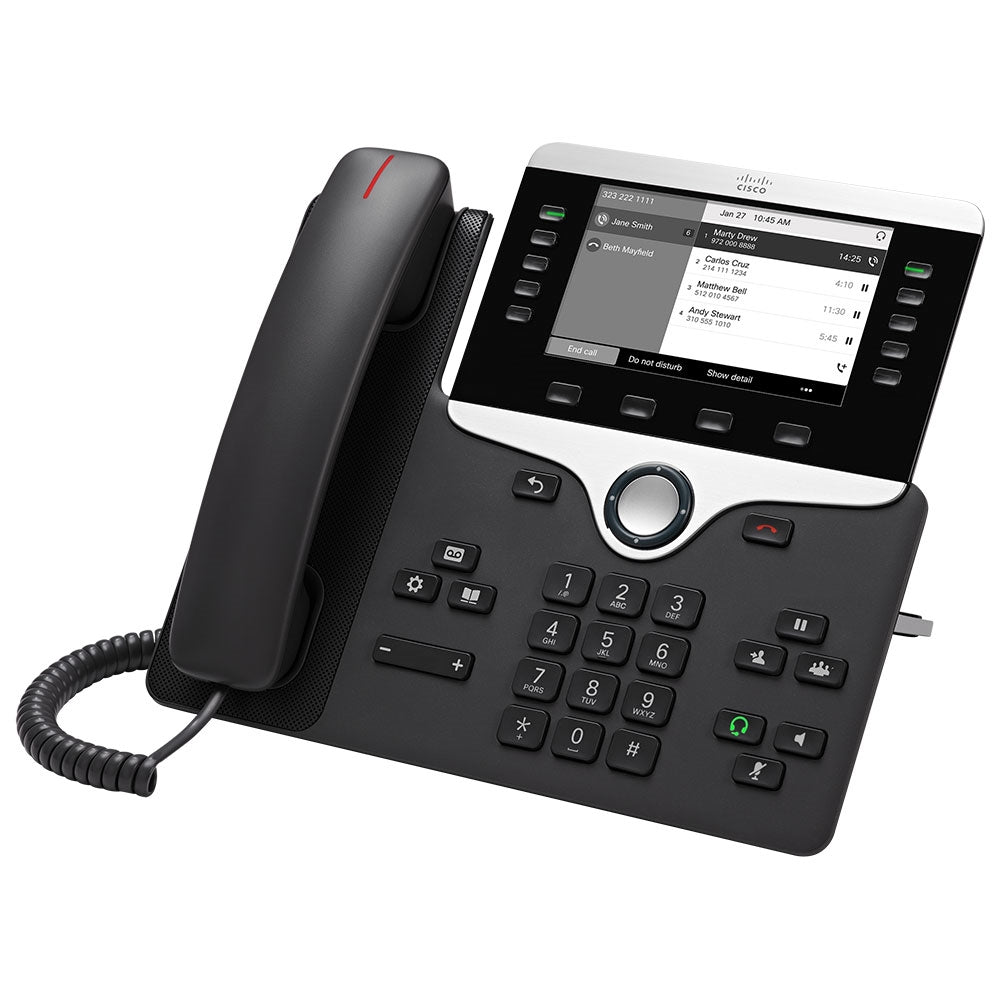
Cisco CP-8811-3PCC-K9= IP Phone
- VoIP phone
- 3rd Party Call Control
- SIP
- RTCP
- RTP
- SRTP
- SDP
- 5 lines
$552.00
$195.00
Instant Savings
$357.00

The Cisco IP Phone 8811 is a cost-effective, business-class collaboration endpoint that delivers high-fidelity, reliable, secure and scalable voice communications for midsize to large enterprise businesses.
With the Cisco IP Phone 8811, you can increase personal productivity through an engaging user experience that is both powerful and easy to use. The IP Phone 8811 combines an attractive ergonomic design with wideband audio for crystal clear voice communications, "always-on" reliability, encrypted voice communications to enhance security and access to a comprehensive suite of unified communications features from Cisco communication servers.
The Cisco IP Phone 8811 supports five programmable line keys. You can configure keys to support either multiple directory numbers or calling features such as speed dial. You can also boost productivity by handling multiple calls for each directory number, using the multicall-per-line feature. Fixed-function keys give you one-touch access to applications, messaging, and directory, as well as often-used calling features such as hold/resume, transfer, and conference. Backlit acoustic keys provide flexibility for audio path selection and switching.
The Cisco IP Phone 8811 offers a 5-in. high-resolution (800 x 480) widescreen backlit grayscale display. Localized language support, including right-to-left on-screen text, meets the needs of global users.
The phone supports a built-in Gigabit Ethernet switch for your PC connection.
With the Cisco IP Phone 8811, you can increase personal productivity through an engaging user experience that is both powerful and easy to use. The IP Phone 8811 combines an attractive ergonomic design with wideband audio for crystal clear voice communications, "always-on" reliability, encrypted voice communications to enhance security and access to a comprehensive suite of unified communications features from Cisco communication servers.
The Cisco IP Phone 8811 supports five programmable line keys. You can configure keys to support either multiple directory numbers or calling features such as speed dial. You can also boost productivity by handling multiple calls for each directory number, using the multicall-per-line feature. Fixed-function keys give you one-touch access to applications, messaging, and directory, as well as often-used calling features such as hold/resume, transfer, and conference. Backlit acoustic keys provide flexibility for audio path selection and switching.
The Cisco IP Phone 8811 offers a 5-in. high-resolution (800 x 480) widescreen backlit grayscale display. Localized language support, including right-to-left on-screen text, meets the needs of global users.
The phone supports a built-in Gigabit Ethernet switch for your PC connection.
| Properties | Cisco CP-8811-3PCC-K9= IP Phone |
| Description | Cisco 8811 with MPP firmware for Trade Agreement Act customers only |
| Product Family | Cisco IP Phone 8800 Series |
| Product Type | IP Phones |
| Hardware Features | |
| Graphical display | ● The 5-in., 800 × 480 resolution, grayscale display provides scrollable access to calling features and |
| text-based XML applications. | |
| Audio | ● Automatic Gain Control |
| ● Comfort Noise Generation | |
| ● Silence Suppression/Voice Activity Detection | |
| ● Acoustic Echo Cancellation (AEC) | |
| ● Dynamic Noise Reduction | |
| Audio codec support | ● G.711 a-law and mu-law, G.722, G.729a/b, Internet Low Bitrate Codec (iLBC), and Internet Speech Audio Codec (iSAC), G.722.1, G.772.2, OPUS |
| Handset | ● The handset is a standard wideband-capable audio handset (connects through an RJ-9 port). |
| ● The standard coiled cord has a custom end for concealed cable routing beneath the phone (cord | |
| length is approximately 21 in. [55 cm] coiled and up to 72 in. (183 cm) extended). | |
| ● The handset is hearing aid-compatible (HAC) and meets Federal Communications Commission (FCC) | |
| loudness requirements for the Americans with Disabilities Act (ADA). You can achieve Section 508 | |
| loudness requirements using industry-standard inline handset amplifiers such as Walker Equipment | |
| W-10 or CE-100 amplifiers. The dial pad is also ADA-compliant. | |
| Analog headset | ● The analog headset jack is a standard wideband-capable RJ-9 audio port |
| AUX port | ● You can use an auxiliary port to support electronic hookswitch control with a third-party headset connected to it |
| Ethernet switch | ● An internal 2-port Cisco Ethernet switch allows for a direct connection to a 10/100/1000BASE-T Ethernet network (IEEE 802.3i/802.3u/802.3ab) through an RJ-45 interface with single LAN connectivity for both the phone and a co-located PC |
| ● The system administrator can designate separate VLANs (IEEE 802.1Q) for the PC and phone, providing improved security and reliability of voice and data traffic | |
| Keys | ● The phone has the following keys: |
| ◦ Line keys | |
| ◦ Soft keys | |
| ◦ Back and release keys | |
| ◦ Four-way navigation and select keys | |
| ◦ Hold/Resume, Transfer, and Conference keys | |
| ◦ Messaging, Application, and Directory keys | |
| ◦ Standard keypad | |
| ◦ Volume-control toggle key | |
| ◦ Speakerphone, headset, and mute keys | |
| Backlit indicator | ● The phone supports backlit indicators for the audio path keys (Handset, Headset, and Speakerphone), select key, line keys, and message waiting |
| Replaceable bezel | ● The phone includes a black bezel; an optional silver bezel is also orderable separately |
| Dual-position foot stand | ● The display is easy-to-view and the buttons and keys are easy-to-use. The two-position foot stand supports viewing angles of 35 and 50 degrees; you can remove the foot stand for wall mounting, with mounting holes located on the base of the phone |
| Wall-mountable | ● You can install the phone on a wall using an optional wall-mount kit (orderable separately). |
| Physical security | ● The phone is compatible with the Kensington Security Slot (K-Slot) antitheft system |
| IEEE Power over Ethernet (PoE) | ● IEEE Power over Ethernet class 2. The phone is compatible with both IEEE 802.3af and 802.3at switch |
| blades and supports both Cisco Discovery Protocol and Link Layer Discovery Protocol - Power over | |
| Ethernet (LLDP-PoE). | |
| Cisco IP Phone Power Cube 4 | ● This optional power cube is used as an AC-to-DC (48V) power supply for non-PoE |
| deployments. Use of the power cube 4 also requires the use of one of the corresponding AC | |
| country cords | |
| Cisco Unified Communications Manager | ● 8.5.1 (non-secured mode only) |
| ● 8.6.2 | |
| ● 9.1.2 | |
| ● 10.5.2 | |
| ● 11.0 and later | |
| Cisco Unified Communications Manager Express | ● 10.0 and later through fast track |
| (Unified CME) | |
| Cisco Business Edition 6000 (BE 6000) | ● 8.6.2 |
| ● 9.1.2 | |
| ● 10.5.2 | |
| ● 11.0 and later | |
| Cisco Hosted Collaboration Solution (HCS) | ● 8.6.2 and later |
| Audio codec support | ● G.711a-law and mu-law, G.722, G.729a/b, Internet Low Bitrate Codec (iLBC), and Internet Speech Audio Codec (iSAC), G.722.1, G.772.2, OPUS |
| Call features | ● + Dialing ● Abbreviated dialing ● Adjustable ring tones and volume levels ● Adjustable display brightness ● Agent greeting ● Auto-answer ● Auto-detection of headset ● cBarge ● Busy Lamp Field (BLF) ● Busy Lamp Field (BLF) Pickup ● Busy Lamp Field (BLF) speed dial ● Callback ● Call forward ● Call forward notification ● Call filter ● Call history lists ● Call park ● Call pickup ● Call timer ● Call waiting ● Call chaperone ● Caller ID ● Corporate directory ● Conference, including traditional Join feature ● Cross Cluster Extension Mobility (EMCC) ● Direct transfer ● Extension mobility ● Fast-dial service ● Forced access codes and client matter codes ● Group call pickup ● Hold ● Intercom ● Immediate divert ● Malicious-caller ID ● Message-waiting indicator (MWI) ● Meet-me conference ● Mobility ● Music on hold (MoH) ● Mute ● Network profiles (automatic) ● On- and off-network distinctive ringing ● Personal directory ● PickUp ● Predialing before sending ● Privacy ● Private Line Automated Ringdown (PLAR) ● Redial ● Ring tone per line appearance ● Service Uniform Resource Locator (URL) ● Shared line ● Silent monitoring and recording ● Speed dial ● Time and date display ● Transfer ● Uniform Resource Identifier (URI) dialing ● Visual voice mail ● Voice mail ● Whisper coaching |
| Electronic hookswitch | ● You can control the hookswitch electronically with a third-party headset connected to an auxiliary port. |
| Cisco Intelligent Proximity | ● Audio path moving sends audio through the phone for a mobile device-connected call ● Call-history synchronization allows you to view placed and missed calls of your mobile device from the 8865 ● Contact synchronization allows you to synchronize the contact objects from your mobile device to your 8865 |
| Quality-of-Service (QoS) options | ● The phone supports Cisco Discovery Protocol and 802.1Q/p standards, and you can configure it with an 801.1Q VLAN header containing the VLAN ID overrides configured by the Admin VLAN ID |
| Network features | ● Session Initiation Protocol (SIP) for signaling ● Session Description Protocol (SDP) ● IPv4 and IPv6 ● User Datagram Protocol (UDP) (used only for Real-Time Transport Protocol [RTP] streams) ● Dynamic Host Configuration Protocol (DHCP) client or static configuration ● Gratuitous Address Resolution Protocol (GARP) ● Domain Name System (DNS) ● Trivial File Transfer Protocol (TFTP) ● Secure Hypertext Transfer Protocol (HTTPS) ● VLAN ● Real-Time Transport Protocol (RTP) ● Real-Time Control Protocol (RTCP) ● Cisco Peer-to-Peer Distribution Protocol (PPDP) ● Cisco Discovery Protocol ● LLDP (including LLDP-MED) ● Switch speed auto-negotiation |
| Security features | ● Secure boot ● Secure credential storage ● Device authentication ● Configuration file authentication and encryption ● Image authentication ● Random bit generation ● Hardware cryptographic acceleration ● Certificate Authority Proxy Function (CAPF) ● Manufacturer-Installed Certificates (MIC) ● Locally Significant Certificates (LSC) ● Ethernet 802.1x supplicant options: Extensible Authentication Protocol-Flexible Authentication via Secure Tunneling (EAP-FAST) and Extensible Authentication Protocol-Transport Layer Security (EAP-TLS) ● Signaling authentication and encryption using TLS ● Media authentication and encryption using SRTP ● HTTPS for client and server ● Secure Shell (SSH) Protocol server ● Secure Sockets Layer (SSL)-based VPN client |
| Physical dimensions (H × W × D) | ● 9.02 x 10.13 x 1.57 in. (229.1 x 257.34 x 40 mm) (excluding foot stand) |
| Phone-casing composition | ● Polycarbonate acrylonitrile butadiene styrene (ABS) textured plastic; Cosmetic class A |
| Operating temperature | ● 32 to 104°F (0 to 40°C) |
| Language support | ● Arabic (Arabic Area) ● Bulgarian (Bulgaria) ● Catalan (Spain) ● Chinese (China) ● Chinese (Hong Kong) ● Chinese (Taiwan) ● Croatian (Croatia) ● Czech (Czech Republic) ● Danish (Denmark) ● Dutch (Netherlands) ● English (United Kingdom) ● Estonian (Estonia) ● French (France) ● French (Canada) ● Finnish (Finland) ● German (Germany) ● Greek (Greece) ● Hebrew (Israel) ● Hungarian (Hungary) ● Italian (Italy) ● Japanese (Japan) ● Latvian (Latvia) ● Lithuanian (Lithuania) ● Korean (Korea Republic) ● Norwegian (Norway) ● Polish (Poland) ● Portuguese (Portugal) ● Portuguese (Brazil) ● Romanian (Romania) ● Russian (Russian Federation) ● Spanish (Columbia) ● Spanish (Spain) ● Slovak (Slovakia) ● Swedish (Sweden) ● Serbian (Republic of Serbia) ● Serbian (Republic of Montenegro) ● Slovenian (Slovenia) ● Thai (Thailand) ● Turkish (Turkey) |
| Certification and compliance | ● Regulatory compliance ◦ CE Markings per directives 2004/108/EC and 2006/95/EC ● Safety ◦ UL 60950 Second Edition ◦ CAN/CSA-C22.2 No. 60950 Second Edition ◦ EN 60950 Second Edition (including A11 and A12) ◦ IEC 60950 Second Edition (including A11 and A12) ◦ AS/NZS 60950 ◦ GB4943 ● EMC - Emissions ◦ 47CFR Part 15 (CFR 47) Class B ◦ AS/NZS CISPR22 Class B ◦ CISPR22: 2005 w/Amendment 1: 2005 Class B ◦ EN55022: 2006 w/Amendment 1: 2007 Class B ◦ ICES003 Class B ◦ VCCI Class B ◦ EN61000-3-2 ◦ EN61000-3-3 ◦ KN22 Class B ● EMC - Immunity ◦ EN55024 ◦ CISPR24 ◦ EN60601-1-2 ◦ KN24 ◦ Armadillo Light ● Telecom ◦ FCC Part 68 HAC ◦ CS-03-HAC ◦ AS/ACIF S004 ◦ AS/ACIF S040 ◦ NZ PTC 220 ◦ Industry Standards: TIA 810 and TIA 920 ◦ Industry Standards: IEEE 802.3 Ethernet, IEEE 802.3af and 802.3at ◦ Korea (RRA Public Notification 2010-36, Nov. 1, 2010) ◦ Korea (RRA Announce 2011-2, Feb. 28, 2011) ● Radio ◦ FCC Part 15.247 (CFR 47) ◦ FCC Part 2.1093 (BT RF Exposure TR) ◦ RSS-102 (BT RF Exposure TR) ◦ RSS-210 ◦ EN 300.328 ◦ EN50385 (BT RF Exposure TR) ◦ EN 301-489-1 ◦ EN 301-489-17 ◦ EN 301-893 ◦ NCC LP0002 ◦ Korea (RRL No. 2006-128, RRL No. 2006-129) ● Japan Bluetooth GFSK/EDR |
| Protocols | IEEE 802.11a, 802.11b, 802.11g, 802.11n, and 802.11ac |
| Frequency bands and operating channels | ● 2.412-2.472 GHz (channels 1-13) ● 5.180-5.240 GHz (channels 36-48) ● 5.260-5.320 GHz (channels 52-64) ● 5.500-5.700 GHz (channels 100-140) ● 5.745-5.825 GHz (channels 149-161) IEEE 802.11d is used to identify available channels. |
| Non-overlapping channels | ● 2.4 GHz (20-MHz channels): Up to 3 channels ● 5 GHz (20-MHz channels): Up to 24 channels ● 5 GHz (40-MHz channels): Up to 9 channels ● 5 GHz (80-MHz channels): Up to 4 channels |
| Operating modes | ● Auto (default), preference to strongest RSSI for 2.4 or 5 GHz ● 2.4 GHz only ● 5 GHz only |
| Data rates | ● 802.11a: 6, 9, 12, 18, 24, 36, 48, and 54 Mbps ● 802.11b: 1, 2, 5.5, and 11 Mbps ● 802.11g: 6, 9, 12, 18, 24, 36, 48, and 54 Mbps ● 802.11n: HT MCS 0, MCS 1, MCS 2, MCS 3, MCS 4, MCS 5, MCS 6, and MCS 7 ● 802.11ac: VHT MCS 0, MCS1, MCS 2, MCS 3, MCS 4, MCS 5, MCS 6, MCS 7, MCS 8, and MCS 9 (MCS9 available with VHT40 and VHT80 only) |
| 2.4-GHz receiver sensitivity | IEEE 802.11b: ● 1 Mbps: -98 dBm ● 2 Mbps: -96 dBm ● 5.5 Mbps: -93 dBm ● 11 Mbps: -91 dBm IEEE 802.11g: ● 6 Mbps: -95 dBm ● 9 Mbps: -94 dBm ● 12 Mbps: -93 dBm ● 18 Mbps: -90 dBm ● 24 Mbps: -87 dBm ● 36 Mbps: -84 dBm ● 48 Mbps: -79 dBm ● 54 Mbps: -77 dBm IEEE 802.11n HT20: ● MCS 0: -95 dBm ● MCS 1: -92 dBm ● MCS 2: -90 dBm ● MCS 3: -87 dBm ● MCS 4: -83 dBm ● MCS 5: -78 dBm ● MCS 6: -77 dBm ● MCS 7: -75 dBm |
| 5-GHz receiver sensitivity | IEEE 802.11a: ● 6 Mbps: -94 dBm ● 9 Mbps: -93 dBm ● 12 Mbps: -92 dBm ● 18 Mbps: -89 dBm ● 24 Mbps: -86 dBm ● 36 Mbps: -83 dBm ● 48 Mbps: -78 dBm ● 54 Mbps: -76 dBm IEEE 802.11n HT20: ● MCS 0: -94 dBm ● MCS 1: -91 dBm ● MCS 2: -89 dBm ● MCS 3: -86 dBm ● MCS 4: -82 dBm ● MCS 5: -77 dBm ● MCS 6: -76 dBm ● MCS 7: -74 dBm IEEE 802.11n HT40: ● MCS 0: -91 dBm ● MCS 1: -88 dBm ● MCS 2: -86 dBm ● MCS 3: -83 dBm ● MCS 4: -79 dBm ● MCS 5: -75 dBm ● MCS 6: -73 dBm ● MCS 7: -72 dBm |
| IEEE 802.11ac VHT20: ● MCS 0: -93 dBm ● MCS 1: -90 dBm ● MCS 2: -87 dBm ● MCS 3: -84 dBm ● MCS 4: -81 dBm ● MCS 5: -76 dBm ● MCS 6: -75 dBm ● MCS 7: -74 dBm ● MCS 8: -70 dBm IEEE 802.11ac VHT40: ● MCS 0: -90 dBm ● MCS 1: -87 dBm ● MCS 2: -85 dBm ● MCS 3: -82 dBm ● MCS 4: -79 dBm ● MCS 5: -73 dBm ● MCS 6: -72 dBm ● MCS 7: -72 dBm ● MCS 8: -67dBm ● MCS 9: -66 dBm IEEE 802.11ac VHT80: ● MCS 0: -87 dBm ● MCS 1: -83 dBm ● MCS 2: -81 dBm ● MCS 3: -78 dBm ● MCS 4: -75 dBm ● MCS 5: -73 dBm ● MCS 6: -68 dBm ● MCS 7: -68 dBm ● MCS 8: -64 dBm ● MCS 9: -62 dBm |
|
| Transmitter output power | 2.4 GHz: ● 802.11b: Up to 17 dBm ● 802.11g: Up to 16 dBm ● 802.11n HT20: Up to 13 dBm 5 GHz: ● 802.11a: Up to 16 dBm ● 802.11n HT20: Up to 13 dBm ● 802.11n HT40: Up to 13 dBm ● 802.11ac VHT20: Up to 12 dBm ● 802.11ac VHT40: Up to 12 dBm ● 802.11ac VHT80: Up to 12 dBm |
| Antenna | ● 2.4 GHz: 2.08-dBi peak gain ● 5 GHz: 1.88-dBi peak gain |
| Access point support | ● Cisco Unified Access Points ◦ Minimum: 7.0.240.0 ◦ Recommended: 7.4.121.0, 7.6.110.0, or later ● Cisco Autonomous Access Points ◦ Minimum: 12.4(21a)JY ◦ Recommended: 12.4(25d)JA2 or later ● Cisco Meraki® Access Points |
| Wireless security | Authentication: ● Wi-Fi Protected Access (WPA) Versions 1 and 2 Personal and Enterprise ● Extensible Authentication Protocol - Flexible Authentication via Secure Tunneling (EAP-FAST) ● Protected Extensible Authentication Protocol - Microsoft Challenge Handshake Authentication Protocol Version 2 (PEAP-MSCHAPv2) Encryption: ● 40-bit and 128-bit static Wired Equivalent Privacy (WEP) and Message Integrity Check (MIC) ● Advanced Encryption Standard (AES) |
| Fast secure roaming | ● 802.11r (FT) ● Cisco Centralized Key Management (Cisco CKM) |
| QoS | ● IEEE 802.11e and Wi-Fi Multimedia (WMM) ● Traffic Specification (TSPEC) ● Traffic Classification (TCLAS) ● Enhanced Distributed Channel Access (EDCA) ● QoS Basic Service Set (QBSS) |
| Radar detection | Dynamic Frequency Selection (DFS) and Transmit Power Control (TPC) according to IEEE 802.11h |
