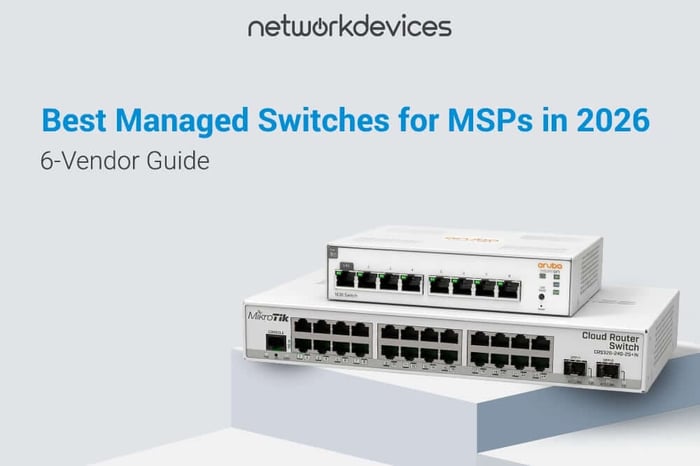

If you manage 20 client networks or 500, your managed switch platform is the single biggest factor in how much technician time you burn per site. The wrong choice costs you truck rolls, licensing surprises, and margin erosion. The right one gives you zero-touch provisioning, one dashboard for every client, and predictable costs.
Here is the short answer. Cisco Meraki MS remains the benchmark for high-volume MSPs seeking the cleanest cloud management and willing to pay the subscription fee. Ubiquiti UniFi is the best no-license option for cost-conscious MSPs serving SMBs. Aruba Instant On hits the middle ground with HPE-quality ethernet switches at SMB pricing. Juniper Mist is the premium pick for compliance-heavy and white-glove environments. MikroTik CRS gives engineering-led MSPs maximum margin with zero recurring fees. TP-Link Omada is the budget entry point with surprisingly solid cloud management.
None of these is universally "best." Your service model, client mix, and margin targets determine the right platform. This guide compares all six across the criteria that actually matter to MSPs: multi-tenant management, zero-touch provisioning, PoE budget, TCO over five years, API access, and scalability from small business deployments to large managed networks. We also map three MSP deployment archetypes to specific platform recommendations so you can skip the guesswork.
Why MSPs Need a Different Switch Than Enterprises
A single enterprise campus can justify a dedicated network engineer managing one complex switching environment. MSPs cannot. You are running lean teams across dozens or hundreds of client sites, each with different VLAN configurations, PoE requirements, and uplink needs.
This is not a theoretical problem. ScalePad's 2026 MSP Trends Report, based on over 1,100 respondents, found that 26 percent of MSPs lack sufficient staff to take on more clients. When you are already understaffed, every minute spent on manual switch configuration, firmware updates, or on-site troubleshooting is a minute that does not generate revenue.
That is why MSPs should evaluate network switches differently from enterprises. The priority is not raw port switch performance or advanced routing features. It is operational efficiency at scale.
The Five Non-Negotiable MSP Switch Requirements
Before comparing vendors, establish your baseline. Any managed switch platform you standardize on must deliver these five capabilities:
Multi-tenant management: One cloud dashboard that separates every client environment. You should never need to log into individual switch GUIs site by site. If a platform cannot give you a single pane of glass across all customer sites, disqualify it immediately.
Zero-touch provisioning (ZTP): ZTP means you ship a switch directly to a client site, power it on, and claim it remotely from your cloud management portal. No engineer on-site. No manual CLI configuration. For MSPs deploying dozens of sites per quarter, this eliminates truck rolls and compresses onboarding from days to hours.
PoE-first design: Every client site runs access points, VoIP phones, and increasingly IP cameras. Your PoE switches need enough power budget to handle all of these without external injectors. At minimum, look for gigabit PoE across all access ports, with total PoE wattage that matches real-world device loads, not just the spec-sheet number.
Licensing clarity: Subscription licensing is fine if the cost is predictable and can be bundled into client contracts. What kills margins is surprise renewal pricing, per-switch licensing that scales badly, or features locked behind higher tiers. Know exactly what you pay per port switch per year before you commit.
Remote troubleshooting: Port-level visibility, event logs, topology maps, alerting, and firmware control from the cloud. If you need to SSH into a switch to diagnose a VLAN issue at a client site, the platform has failed the MSP test.
How Switch Selection Impacts MSP Margins
Switch selection is a margin decision, not just a technical one. A platform that saves 30 minutes per deployment across 100 client sites saves you 50 hours per year in technician time. Multiply that by your loaded labor cost, and the math gets obvious fast.
The hidden cost is the platform that almost works. Unreliable plug-and-play provisioning that fails 20 percent of the time. A cloud portal that lacks alerting, forcing reactive site visits. Firmware updates that require manual scheduling per device. These operational frictions do not appear on a vendor quote, but they erode profitability over a five-year lifecycle.
Six Cloud-Managed Switch Platforms Evaluated for MSP Use
We evaluate six platforms below. For each, we call out the best MSP fit, core strengths, and specific model recommendations at 8-port, 24-port, and 48-port tiers so you can match hardware to client site size.
1. Cisco Meraki MS: The Industry Benchmark
Cisco Meraki remains the most polished cloud-managed switch platform for MSPs. The dashboard is mature, templates scale cleanly across hundreds of sites, and ZTP is genuinely turnkey. Cisco's documentation confirms centralized management, switch port profiles, and advanced cloud features across all MS licensing tiers.
The trade-off is cost. Meraki requires active subscription licensing for every switch. Without a license, the hardware stops forwarding traffic. For MSPs that can bundle this into client contracts as recurring revenue, it works. For MSPs competing on price in cost-effective SMB deals, the licensing overhead can squeeze margins.
Best for: High-volume MSPs running 50+ client sites on standardized stacks.
Strengths:
- Excellent multi-tenant dashboard.
- Industry-best ZTP workflow.
- Strong API ecosystem for automation and PSA/RMM integration.
- Mature alerting and remote troubleshooting.
- Consistent firmware management across the fleet.
Suggested models:
- 8-port: MS130 compact.
- 24-port: MS130-24 or MS150-24.
- 48-port: MS130-48 or MS150-48.
2. Ubiquiti UniFi: Zero Licensing, Maximum Margin
UniFi's economics are the main draw. Ubiquiti's official documentation states that UniFi OS is completely license-free. No subscription, no per-device fee, no renewal surprises. You buy the hardware and manage it forever through the UniFi controller, self-hosted or cloud-hosted.
For MSPs serving small business clients where every dollar of margin matters, this is significant. The UniFi dashboard handles multi-site management well, the hardware price-to-feature ratio is strong, and the full UniFi ecosystem (switches, access points, gateways) runs on one controller.
The limitation is enterprise depth. QoS configuration is more basic than Cisco or Juniper. Stacking is absent. SFP+ port options are limited at lower tiers. If your clients need complex routing, high-performance multi-gigabit uplinks, or granular QoS policies for voice and video traffic, UniFi will feel thin.
Best for: Cost-conscious MSPs building standardized SMB stacks where margin protection is the priority.
Strengths:
- No recurring licensing.
- Strong single-pane management.
- Self-hosted or cloud controller flexibility.
- Very competitive gigabit PoE pricing.
- Clean ecosystem alignment with UniFi APs and gateways.
Suggested models:
- 8-port: USW Lite 8 PoE.
- 24-port: USW Pro 24 PoE.
- 48-port: USW Pro 48 PoE or USW Enterprise 48 PoE.
3. Aruba Instant On: HPE Quality at SMB Pricing
Aruba Instant On is the overlooked middle ground. It carries the HPE/Aruba enterprise pedigree but targets the SMB and small networks segment with simplified cloud management and competitive pricing. Licensing overhead is minimal. The cloud portal is included.
The app-based and web management experience is clean. Deployment is straightforward. For MSPs serving small-business clients who want something more polished than UniFi but less expensive than Meraki, Instant On fits well. The switch and access point alignment within the Instant On family simplifies the stack.
One consideration: HPE's announced divestiture of its networking business (including Aruba) to Juniper's parent entity creates long-term platform uncertainty. This does not affect current hardware or cloud service, but MSPs planning a five-year standardization should monitor this closely.
Best for: MSPs serving SMBs that want an enterprise-backed platform without enterprise pricing.
Strengths:
- Clean cloud portal.
- Good business networking fit for AP + switch bundles.
- No heavy licensing overhead.
- Strong build quality.
- Solid PoE budgets at each tier.
Suggested models:
- 8-port: Instant On 1830 8G or 1930 8G.
- 24-port: Instant On 1930 24G.
- 48-port: Instant On 1930 48G or 1960 48G where higher bandwidth and SFP+ uplinks are needed.
4. Juniper Mist: AI-Driven Premium
Juniper Mist is the high-end option. Mist Wired Assurance is a subscription-based cloud service supporting EX and QFX ethernet switches, designed to automate Day 0 through Day 2 operations. The AI-driven engine provides root cause analysis, proactive anomaly detection, and deep visibility that no other platform on this list matches.
For MSPs serving compliance-driven clients in healthcare, finance, and government, Mist's telemetry and audit capabilities justify the premium. The wired and wireless integration between EX switches and Mist APs is tight, and the managed network visibility is exceptional.
The cost is real. Juniper hardware is priced above the other five platforms, and Mist subscriptions add to TCO. Scalability is excellent, but this is not a margin-first play. It is a value-first play for MSPs that charge premium rates.
Best for: White-glove MSPs, compliance-heavy environments, and clients that pay for premium outcomes.
Strengths:
- Best-in-class visibility and telemetry.
- AI-assisted troubleshooting.
- Enterprise-grade switching with Juniper EX hardware.
- Strong wired + wireless integration.
- Excellent API access for automation.
Suggested models:
- 24-port: EX2300-24P.
- 48-port: EX2300-48P or EX3400-48P for higher-complexity sites.
5. MikroTik CRS: Maximum Margin for Technical Teams
MikroTik is not for everyone. The cloud management experience is not as polished as Meraki or Mist. There is no turnkey multi-tenant dashboard. Configuration requires RouterOS knowledge, and the GUI is functional rather than pretty.
But the economy is unbeatable. MikroTik hardware is significantly cheaper per port than any competitor on this list, and there is zero recurring licensing. For MSPs with strong technical teams that do not mind hands-on configuration, MikroTik CRS switches deliver exceptional gigabit and multi-gigabit performance at a fraction of the cost.
The margin math is simple. Where a Meraki MS130-48 with licensing might cost several thousand dollars over five years, a MikroTik CRS328 costs a few hundred at acquisition with nothing after. If your MSP deploys 100+ switches per year, that difference is massive.
Best for: Engineering-led MSPs, custom deployments, and any MSP where margin optimization is the top priority.
Strengths:
- Best hardware value per port.
- No licensing.
- Deep configuration flexibility via RouterOS.
- Fanless options available for noise-sensitive deployments.
- Strong rackmount options at every tier.
- Excellent bandwidth throughput for the price.
- Good SFP and SFP+ uplink options on CRS326 and CRS328 models.
Suggested models:
- 8-port: CRS112 or smaller CRS edge models.
- 24-port: CRS326-24G-2S+.
- 48-port: CRS328-24P-4S+ for PoE deployments.
6. TP-Link Omada: The Budget Cloud Contender
TP-Link Omada has matured significantly. The Omada Cloud-Based Controller now provides centralized management for switches, access points, and routers with explicit ZTP support. For budget-first MSPs building standardized packages for price-sensitive SMBs, Omada is a legitimate option.
The cloud controller handles multi-site management, the hardware is cost-effective, and the full Omada ecosystem (switches, APs, routers) operates under one umbrella. It is not as deep as Meraki or Mist in telemetry, and the API is less mature, but for straightforward SMB deployments, it covers the fundamentals.
Omada is also a reasonable secondary stack for MSPs that standardize on a premium vendor for most clients but need a budget option for cost-sensitive accounts.
Best for: Budget-first MSPs and as a secondary stack for price-sensitive client segments.
Strengths:
- Very competitive pricing.
- Solid cloud management with ZTP.
- Multi-site support.
- Clean AP + switch + router ecosystem.
- Good enough for standardized small business deployments.
Suggested models:
- 8-port: TL-SG2008P or Omada equivalent.
- 24-port: TL-SG3428MP.
- 48-port: TL-SG3452P.
Head-to-Head Comparison Across MSP-Critical Criteria
| Platform | Multi-Tenant Mgmt | ZTP Quality | Licensing Model | PoE Options | API / Automation | 5-Year TCO Tier | Best MSP Fit |
|---|---|---|---|---|---|---|---|
| Cisco Meraki MS | Excellent | Excellent | Subscription (required) | Strong across all tiers | Strong | Premium | High-volume, standardized |
| Ubiquiti UniFi | Very Good | Very Good | No license | Good, varies by model | Good | Low | Cost-efficient SMB |
| Aruba Instant On | Good | Good | Minimal/none | Strong at SMB tiers | Moderate | Balanced | SMB-focused |
| Juniper Mist | Excellent | Excellent | Subscription | Enterprise-grade | Strong | Premium | Compliance / white-glove |
| MikroTik CRS | Limited native | Fair | No license | Good on select models | Moderate | Lowest | Engineering-led |
| TP-Link Omada | Good | Good | Minimal/none | Good at budget tiers | Moderate | Low | Budget SMB |
TCO Analysis: Licensing, Hardware, and 5-Year Cost Per Client Site
Over a five-year lifecycle, total cost of ownership breaks into three clear tiers. Premium TCO platforms are Meraki and Juniper Mist. Higher upfront hardware, mandatory subscriptions, but lower operational hours due to superior automation and troubleshooting tools. Balanced TCO falls to Aruba Instant On. Moderate hardware cost, minimal licensing, decent automation. Low TCO and margin-first platforms are UniFi, MikroTik, and Omada. Cheapest hardware, no or minimal licensing, but potentially higher technician time for configuration and troubleshooting.
The right tier depends on your business model. If you bill clients for managed services at a premium and your value proposition is uptime and fast resolution, Meraki and Mist can deliver better net margins despite higher switch costs because they reduce labor. If your clients are price-sensitive SMBs and you compete on cost-effective packages, UniFi and MikroTik protect gross margins better.
Do not compare just the acquisition cost. Compare acquisition plus licensing plus estimated technician hours per site per year. That is the real number.
Scalability: From 10 to 500 Client Sites
Meraki and Mist scale the cleanest to 500+ sites because their cloud platforms were architected for large multi-tenant deployments from day one. UniFi scales well to a few hundred sites, but the self-hosted controller requires infrastructure planning. Aruba Instant On and Omada handle SMB-scale MSPs (up to around 100 sites) comfortably. MikroTik requires more manual effort as the site count grows since it lacks a native multi-tenant cloud dashboard.
API Access and RMM Integration
For MSPs running ConnectWise, Datto, or similar PSA/RMM platforms, API quality matters. Meraki's API is the most mature and best documented. Juniper Mist's API is strong and well-structured. UniFi offers a functional API but with less official documentation. Aruba, MikroTik, and TP-Link have more limited integration capabilities, which may mean more manual monitoring workflows.
Three MSP Deployment Archetypes and the Right Switch for Each
High-Volume, Low-Touch MSP (50+ Clients, Standardized Stacks)
Best platform: Cisco Meraki MS. When you are deploying the same network switch configuration across 50, 100, or 200 client sites, template-driven operations and flawless ZTP matter more than hardware cost. Meraki's dashboard was built for this model. The subscription is a cost of doing business. Bundle it into contracts and treat it as a recurring revenue line.
White-Glove MSP (10–30 Clients, Custom Deployments)
Best platform: Juniper Mist or Ubiquiti UniFi.
Choose Mist if your clients pay for premium outcomes and expect deep visibility. Choose UniFi if you want deployment flexibility without subscription drag. Both work for custom environments where each client site is different.
Security-Focused MSP (Compliance-Driven Clients)
Best platform: Juniper Mist. For regulated environments in healthcare, finance, and government, Mist's telemetry, AI-driven root cause analysis, and enterprise-class EX switching provide the audit trail and network visibility that compliance demands. Meraki is the simpler alternative if operational ease matters more than deep telemetry, but Mist is the stronger compliance story.
Building a Profitable MSP Networking Stack in 2026
A switch is never a standalone decision. Your MSP networking stack in 2026 should align switches, firewalls, and access points to maximize operational simplicity and minimize vendor friction.
Vendor Alignment Strategies
The cleanest stacks align within one ecosystem. Meraki switch, Meraki MX firewall, and Meraki AP give you one dashboard and one support channel. UniFi switch, UniFi gateway, and UniFi AP are the best-value full stack. Aruba Instant On switch + Instant On AP is a clean SMB bundle. Juniper EX + Mist AP + a dedicated security stack (like Fortinet firewalls for MSP-focused Security Fabric) delivers the premium architecture.
Cross-vendor stacks work too, but they add complexity. A common MSP pattern is UniFi or Meraki switching with Fortinet firewalls, combining strong cloud management for switches and Wi-Fi with Fortinet's security depth. The key is limiting your active vendors to two or three, not six.
Subscription Licensing as Recurring Revenue
Do not treat switch licensing as a cost center. Treat it as a recurring revenue line item. Bundle Meraki or Mist subscriptions into client contracts with markup. Align renewal dates across the client base. Position it as proactive lifecycle management and network assurance. This turns a vendor expense into predictable monthly income, strengthening client retention.
Avoiding Vendor Lock-In (Intentionally)
Total vendor independence is a myth for MSPs. Training, documentation, spare inventory, and operational playbooks all favor standardization. The goal is to lock in intentionally: pick one primary stack for 80 percent of clients and one secondary stack for exceptions. This reduces training time, speeds onboarding, and ensures consistent service quality without betting everything on a single vendor's roadmap.


FAQs
1. What is the best managed switch for MSPs in 2026?
It depends on your service model. Cisco Meraki MS is best for high-volume MSPs that prioritize automation and clean multi-site management. Ubiquiti UniFi is best for cost-conscious MSPs that want zero licensing fees. Juniper Mist is best for premium and compliance-focused MSPs.
2. What is zero-touch provisioning (ZTP) and why does it matter for MSPs?
Zero-touch provisioning is a feature that allows a network switch to be shipped to a client site, powered on, and automatically configured from a cloud management portal without an engineer on-site. For MSPs, ZTP eliminates truck rolls and dramatically speeds up client onboarding.
3. Is Ubiquiti UniFi good enough for MSP deployments?
Yes, for SMB-focused MSPs. UniFi has no recurring licensing, strong multi-site management, and competitive gigabit PoE hardware. It is less suitable for compliance-heavy or enterprise-grade environments where Meraki or Juniper Mist offer deeper telemetry and support.
4. How does Meraki licensing affect MSP margins?
Meraki requires an active subscription for every switch. This increases TCO but can be bundled into client contracts as recurring revenue. MSPs that position Meraki licensing as a managed service line item often maintain or improve margins compared to no-license platforms where labor costs are higher.
5. Should MSPs use one switch vendor or mix vendors?
Standardize on one primary vendor for most clients and keep a secondary option for exceptions. Single-vendor stacks reduce training, simplify spare inventory, and improve documentation. Complete vendor independence adds operational complexity that most MSPs cannot afford.
6. What is the difference between a managed switch and an unmanaged switch for MSPs?
An unmanaged switch has no configuration interface. It forwards traffic without VLAN support, QoS, monitoring, or remote access. Brands like Netgear sell unmanaged switches that work fine for a home network or a basic office with five devices. But MSPs should never deploy unmanaged switches at client sites because they eliminate visibility and control. A managed switch provides VLAN segmentation, PoE control, traffic prioritization, QoS policies, remote management, and firmware updates. That is the baseline for any professional deployment.
7. Which cloud-managed switch has the lowest total cost of ownership?
MikroTik CRS and Ubiquiti UniFi have the lowest five-year TCO because they combine inexpensive hardware with zero recurring licensing. TP-Link Omada is close behind. However, the lowest TCO platform is not always the most profitable. Factor in technician hours and operational complexity before deciding.