
In the world of real-time data, automation, and Industry 4.0, uninterrupted network uptime is essential for efficiency and safety.
In harsh environments like offshore oil rigs, remote wind farms, or busy factory floors, standard networking gear simply can’t survive. This is where industrial Ethernet switches—also called hardened or rugged switches—deliver the high-reliability connectivity that keeps critical systems running.
Unlike their commercial-grade counterparts, these switches are purpose-built for the extreme conditions found in operational technology (OT).
This guide provides a complete overview of the industrial network switch. We will explore the critical differences from office-grade gear, detail key performance features and certifications, explain how to choose between Layer 2 and Layer 3 models, and review top solutions from Cisco for factory automation and other demanding applications.
Why Standard Switches Fail: The Case for Industrial-Grade Ethernet
Before examining specifications, consider this: why not use a standard IT switch inside a protective enclosure? The answer is that in OT environments, a network failure is a catastrophic event, not a minor inconvenience.
These networks control robotic arms, manage assembly lines, and operate critical safety systems. A hardened, industrial-grade Ethernet switch reflects a design philosophy rooted in resilience and long-term reliability—where failure is not an option.
The differences are not trivial, as this table illustrates:
| Feature | Standard Commercial Switch | Industrial Ethernet Switch | Why It Matters for OT |
| Temperature Range | 0°C to 40°C (32°F to 104°F) | -40°C to +75°C (-40°F to +167°F) | Prevents failure from extreme heat/cold. |
| Housing & Design | Plastic, Vented (for cooling) | Metal, Passively Cooled, Fanless | Resists shock, vibration, dust, and moisture. |
| Mounting | Desktop / Rackmount | DIN Rail / Panel Mount | Integrates securely into industrial control cabinets. |
| Power Input | Single AC Power Supply | Dual DC Power Inputs w/ Alarms | Ensures 100% uptime during a power supply failure. |
| EMI Shielding | Basic (FCC Class A/B) | Hardened (IEC/EN Standards) | Protects data integrity in electrically noisy sites. |
| Expected Lifespan | 3-5 Years | 10+ Years | Reduces Total Cost of Ownership (TCO). |
What Makes a Switch Industrial? Core Features & Specifications
The following features define a rugged industrial switch and are non-negotiable for reliable performance.
1. Extended Operating Temperature Range
The ability to operate flawlessly from -40°C to +75°C is a defining characteristic of a hardened Ethernet switch. This ensures reliability in frozen transport hubs or next to high-heat industrial furnaces.
2. Ruggedized, Fanless Enclosure
To maximize reliability, industrial switches eliminate moving parts. Their fanless, passively cooled design prevents the intake of dust and moisture, while the durable metal housing protects internal components from constant vibration and physical shock.
3. DIN Rail and Panel Mounting
A quality DIN rail switch is the standard, allowing it to be snapped securely onto a rail inside a control cabinet. This secure mounting is critical for resisting vibration-induced disconnects.
4. Redundant Power Inputs & Alarms
Continuous operation is paramount. Industrial switches feature dual DC power inputs, allowing connection to two independent power sources. If one fails, the other takes over instantly for zero downtime.
Beyond the Basics: Key Standards, Protocols, and Certifications
True industrial-grade hardware is defined by its certifications and protocol support. Looking for this separate, genuinely rugged equipment from imitators.
Key Certifications
- Ingress Protection (IP Ratings): This classifies resistance to dust and water. A switch inside a cabinet might only need an IP30 rating, while a switch on a machine exposed to washdowns would require an IP67 rating.
- NEMA Ratings: A U.S. standard for industrial enclosures. A traffic control cabinet would typically use a NEMA Type 4 enclosure and require a switch rated to operate within it.
- Hazardous Location (ATEX/IECEx): A switch deployed on an oil rig or chemical plant requires ATEX or IECEx certification to ensure it cannot ignite flammable gases.
- Industry-Specific: Power substations require IEC 61850-3 compliance for EMI immunity. Railway applications demand EN 50155 to withstand constant shock and vibration.
Future-Proofing Protocols
Network Redundancy Protocols: Managed switches use protocols like Spanning Tree (STP) and Resilient Ethernet Protocol (REP) to create self-healing network rings.
Time-Sensitive Networking (TSN): This emerging set of standards provides deterministic messaging on standard Ethernet, critical for high-precision robotic and motion control applications.
The Core Decision: Managed vs. Unmanaged Industrial Switches
Choosing between a managed and unmanaged switch is a critical decision that impacts your network's intelligence, security, and scalability.
Unmanaged Switches: These are simple plug-and-play devices. They are suitable only for small, isolated networks with no need for security or traffic control.
Managed Industrial Switches (also known as smart switches): A managed industrial switch is the standard for any critical network. It provides a command-line interface (CLI) or web UI that gives you full control. It is essential when you need:
- Cybersecurity for OT Networks: Implement 802.1X, Access Control Lists (ACLs), and MACsec encryption to block unauthorized devices.
- Traffic Control: Configure VLANs to segment traffic and use Quality of Service (QoS) to prioritize real-time control systems.
- Redundancy: Configure network ring protocols for sub-second failover.
- Visibility: Monitor and diagnose problems remotely using protocols like SNMP.
Choose UNMANAGED if: You have a small, isolated network with no need for security, traffic prioritization, or remote monitoring.
Choose MANAGED if: Your network is critical and requires security, guaranteed performance for control traffic, or high-availability redundancy.
How to Choose the Right Industrial Switch: A Checklist
1. Environment & Certifications: What are the temperature extremes and potential for moisture? Do you need specific ratings like IP67, ATEX, or IEC 61850?
2. Managed or Unmanaged: Do you require the security and control features of a managed switch?
3. Layer 2 vs. Layer 3: Do you need to route traffic between different VLANs or subnets (Layer 3), or is simple network segmentation sufficient (Layer 2)?
4. Mounting: Is a DIN rail-mounted PoE switch required, or do you need a panel or rack mount?
5. Connectivity & PoE: How many ports? Are industrial PoE switch capabilities needed? Do you need fiber SFP uplinks?
6. Redundancy: Are dual power inputs and redundant ring topology required?
Use Cases & Top Cisco Solutions
Industrial Ethernet switches are the backbone of OT networks in manufacturing, energy, and transportation. Cisco offers proven solutions ideal for IT/OT convergence.
Cisco Catalyst IE3200/IE3300 Rugged Series
The evolution of the classic IE-3000, these models offer a superb balance of rugged design, modularity, and affordability.
- Best For: Factory floor automation, traffic cabinets, and utility substations.
- Modular design for copper or fiber ports.
- PoE/PoE+ options are available to power cameras and sensors.
- View the Cisco IE-3200 Collection and Cisco IE-3300 Collection.
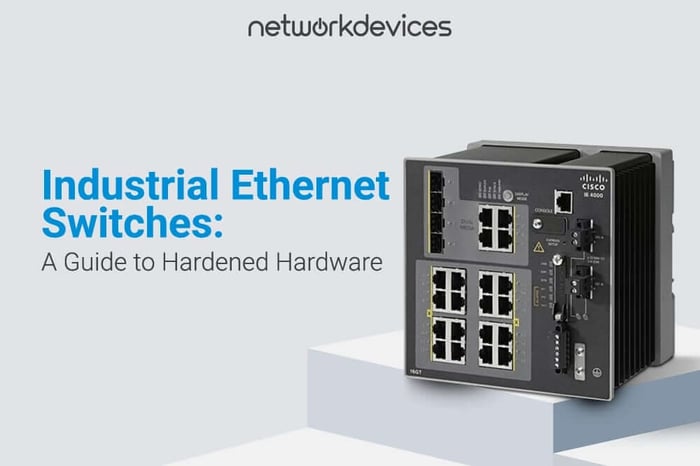
Cisco Catalyst IE4000 Series: High-Performance & Security
The IE4000 Series delivers superior performance, high port density, and advanced Layer 3 industrial switch capabilities for the most complex networks.
- Best For: Being the best industrial switch for factory automation backbones, transportation control rooms, and large-scale IoT.
- Industrial switch with SFP uplink ports for long-distance fiber.
- Advanced security and Layer 3 routing protocols.
- See a Cisco industrial Ethernet switch comparison here.
FAQs
Q1: What is the difference between an industrial and a commercial switch?
The main differences are environmental resilience and reliability. A quality managed industrial switch also includes key OT features like dual power inputs and DIN rail mounting, which are absent in commercial switches.
Q2: Can I use PoE on an industrial Ethernet switch?
Yes, many models are available as an industrial PoE switch. They offer Power over Ethernet (PoE/PoE+) to power devices like IP cameras and wireless access points directly over the network cable.
Q3: What is a DIN rail switch used for?
A DIN rail switch is designed to mount securely inside an industrial control panel on a standardized metal rail. This allows for organized and vibration-resistant installation alongside other automation equipment.
Q4: What is a network ring and why is it important?
A network ring connects switches in a circular topology. Its primary purpose is to provide redundancy.
If one cable or switch in the ring fails, protocols like STP or REP automatically redirect traffic in the opposite direction around the loop in milliseconds. This rapid failover prevents downtime, which is critical for continuous processes in manufacturing and utilities.
Q5: What is the difference between Layer 2 and Layer 3 in industrial switches?
A Layer 2 industrial switch operates like a traditional switch, forwarding traffic based on MAC addresses within a single network or VLAN.
A Layer 3 industrial switch has built-in routing capabilities. This allows it to forward traffic between different VLANs or subnets without needing an external router, which is essential for larger, segmented industrial networks.
Conclusion
A commercial switch in a harsh environment is a failure waiting to happen.
An industrial Ethernet switch is not a hardware choice; it's a foundational investment in uptime, reliability, and safety. By understanding the core features, demanding the right certifications, and choosing a proven platform, you can build a network that forms the resilient backbone of your entire operation.
Ready to build a more reliable network? Talk to our industrial Ethernet experts.