
The Verdict First: Your Final Answer is Here
Let’s end the debate. For any SMB, MSP, or IT manager comparing Ubiquiti UniFi and Cisco Meraki, the decision comes down to a fundamental business choice: do you prioritize long-term cost and control, or operational simplicity and guaranteed support?
Choose Ubiquiti UniFi if your goal is to build a powerful, highly customizable network with the lowest possible Total Cost of Ownership (TCO). It is the undisputed champion for budget-conscious organizations with the technical skill to manage their own systems, delivering scalable hardware with zero mandatory recurring fees.
Choose Cisco Meraki if your goal is an ironclad, "it just works" solution that minimizes IT overhead. It is the premier choice for multi-site businesses and MSPs who bill against an SLA. The premium price buys you unparalleled simplicity, robust cloud-native security, and enterprise-grade support that a hands-on UniFi approach cannot match.
This guide provides the final breakdown of every critical factor—hardware, management, TCO, and security—to help you invest with absolute confidence.
The Hardware Divide: UniFi’s Raw Power vs. Meraki’s Integrated Ecosystem
Your hardware defines your network's arsenal. UniFi offers powerful, cost-effective components for a custom-built toolkit, while Meraki provides a seamlessly integrated system where every component is designed to work together in the cloud.
Ubiquiti UniFi: Maximum Power for Your Budget
UniFi’s hardware allows you to build an enterprise-grade network without the enterprise price tag.
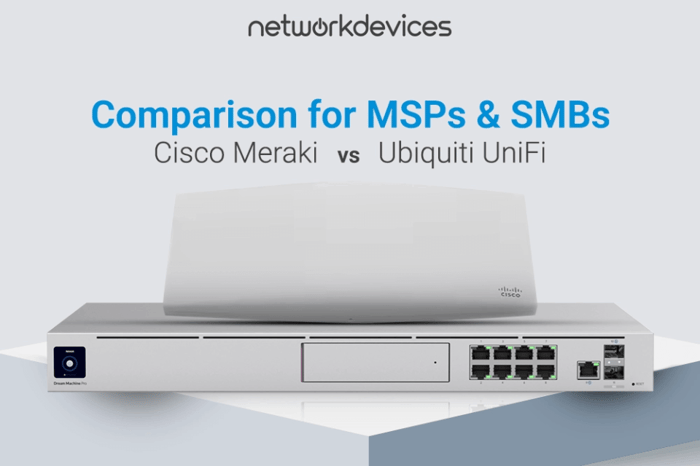
- UniFi Dream Machine Pro (UDM Pro): An all-in-one appliance acting as a security gateway, switch, NVR, and the UniFi Network Controller. It's the powerful, license-free centerpiece for any SMB.
- UniFi 6 Access Points (U6 Series): Delivers high-throughput Wi-Fi 6, ideal for office and high-density environments, with mesh support for easy expansion.
- UniFi Switch Pro 48 (USW-Pro-48): For larger networks, models like the USW-Pro-48 serve as an ideal core switch, featuring 48 Gigabit ports and four 10G SFP+ uplinks for high-throughput aggregation, all managed with advanced Layer 3 capabilities like inter-VLAN routing.
Cisco Meraki: Reliability Engineered for the Cloud
Meraki hardware is purpose-built for 100% cloud management, ensuring reliability and seamless remote deployment.
- Meraki MX Security Appliances (e.g., MX67/MX68): These are true all-in-one UTM devices, featuring SD-WAN, Auto VPN, and Advanced Malware Protection (AMP) powered by Cisco Talos threat intelligence. They enforce application-aware, Layer 7 firewall rules and require a valid license to operate.
- Meraki MR Access Points (e.g., MR36/MR46): Perfect for dense environments like retail or schools, these cloud-managed Wi-Fi 6 APs provide rich location analytics, real-time spectrum analysis, and Bluetooth Low Energy (BLE) beacons directly in the dashboard.
- Meraki MS Switches: Offering Layer 2/3 support and PoE/PoE+, these switches deliver full end-to-end network visibility and deep health telemetry into the Meraki Dashboard, making them a favorite for MSPs who need to troubleshoot client issues remotely.
The Management Battleground: UniFi's Deep Control vs. Meraki's Seamless Convenience
How you command your network is a critical front in the daily IT war. UniFi gives you the tactical, hands-on control of a field general, while Meraki provides the effortless strategic oversight of a command center.
The UniFi Network Controller: Full Ownership
The UniFi Network Controller is about ownership. It’s powerful software you can host yourself, on-premise, in a private data center, or on a public cloud. For an MSP, its multi-tenant capabilities are a key feature for managing multiple clients affordably.
The Meraki Dashboard: Automated Efficiency
The Cisco Meraki Dashboard is about efficiency. It is the industry benchmark for simplicity, famous for its zero-touch provisioning. An MSP can have hardware shipped directly to a site, and once connected to the internet, it configures itself automatically. This dramatically reduces truck rolls and operational costs.
The Wallet War: UniFi's One-Time Cost vs. Meraki's All-Inclusive Subscription
This is where the battle hits the budget. It’s a classic conflict between a significant one-time investment that saves money over time versus a recurring operational expense that offers predictability and bundled services.
UniFi: One-Time Cost, No Surprises
UniFi’s financial model is straightforward and highly attractive to any organization that scrutinizes its operational expenses.
- No License Fees: You purchase the hardware and own it outright. The management software and all its features are free.
- Low TCO: The lack of recurring costs makes UniFi the undisputed champion for long-term value.
- Predictable Budgeting: Finance departments love UniFi because there are no mandatory annual renewals to worry about.
Meraki: Predictable Subscription, All-Inclusive
Meraki’s value is bundled into its subscription, converting a large capital expense into a predictable operational expense.
- Mandatory Licensing: Every device requires a 1, 3, 5, or 10-year license to function.
- All-Inclusive: The license includes hardware warranty, 24/7 SLA-backed phone support, all firmware updates, and access to the cloud dashboard.
- MSP-Friendly: MSPs can easily wrap the predictable licensing cost into their monthly managed service fees.
A Clash of Security Philosophies
Both platforms are secure, but they cater to different compliance and threat management needs. UniFi provides a shield; Meraki provides a fortress with armed guards.
UniFi Security: Delivers a robust suite for most SMBs, including a stateful firewall, VLAN segmentation, VPN access, and IDS/IPS for threat detection. It’s powerful protection without the premium cost.
Cisco Meraki Security: Offers an enterprise-grade stack built for compliance. With Cisco Talos-powered malware protection, AutoVPN for secure branch meshing, and advanced content filtering, it’s designed for regulated industries like healthcare (HIPAA) and finance.
Final Verdict: Your Actionable Choice
To eliminate any remaining doubt, here is your final action plan.
Choose Ubiquiti UniFi if:
- Your number one priority is a low Total Cost of Ownership (TCO).
- You have a technically proficient IT team that values granular control.
- You want to avoid vendor lock-in and mandatory subscriptions at all costs.
Choose Cisco Meraki if:
- Operational simplicity and reduced IT staff hours are more valuable than the hardware cost.
- You require enterprise-grade security, compliance, and guaranteed uptime via an SLA.
- You are an MSP managing multiple clients and need maximum remote visibility and efficiency.
Not sure which solution fits your needs? Talk to a certified hardware expert or shop our best-selling UniFi and Meraki kits—optimized for MSPs and SMBs.