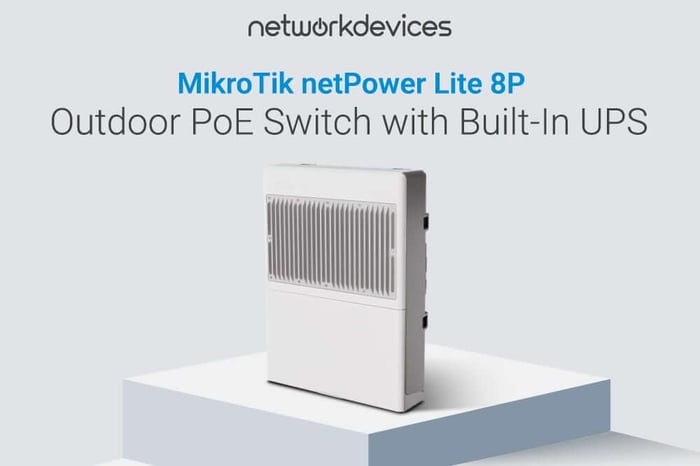

Power cuts and unstable feeds are common at the network edge. Outdoor cameras, access points, and pole-mounted radios still need power when the grid drops. The MikroTik netPower Lite 8P (CSS610-8P-2S+OUT) addresses that by combining an outdoor PoE+ switch with an integrated UPS function and a smart 24V battery charger.
This unit fits WISPs feeding multiple radios, security installers powering camera clusters, and IT teams extending switching to parking lots, stadiums, and remote buildings. Three details drive the value: 120W total PoE budget across eight Gigabit ports, two 10G SFP+ uplinks for high-throughput backhaul, and a voltage boost that maintains full 802.3af/at PoE output even when running from a 24V nominal battery source.
This review covers hardware specs, PoE planning, the UPS and charging system, the critical battery wiring rules, outdoor durability, SwOS Lite management, common deployments, and a comparison with the Ubiquiti USW-Flex.
Key Specifications and Hardware Overview
The CSS610-8P-2S+OUT is an IP54-rated outdoor switch designed for pole and wall mounting. It uses a Marvell 88E6193 switch chip and runs SwOS Lite for fast, focused Layer 2 configuration.
The port layout is built for edge aggregation:
- 8x Gigabit Ethernet PoE-out ports for endpoints (802.3af/at)
- 2x 10G SFP+ uplink ports for backhaul
Power input accepts 24–57V DC via a 2-pin terminal. The enclosure is rated from -40°C to +70°C, covering hot rooftops and cold poles.
Specifications Table
| Attribute | Specification |
| Product name | MikroTik netPower Lite 8P |
| Model number | CSS610-8P-2S+OUT |
| Product category | Outdoor PoE+ switch with integrated UPS |
| Ethernet ports | 8x 1GbE PoE-out |
| Uplink ports | 2x 10G SFP+ |
| PoE standard | 802.3af/at |
| Total PoE budget | 120W |
| Switching capacity | 56 Gbps |
| Forwarding rate | 41.7 Mpps |
| Switch chip | Marvell 88E6193 |
| Enclosure rating | IP54 |
| Operating temperature | -40°C to +70°C |
| Management | SwOS Lite (web GUI) |
| Power input | 24–57V DC (2-pin terminal) |
| Max power draw | 181W (full PoE load + charging) |
| Power consumption (no attachments) | 9W |
| Storage | 64 KB Flash |
| Dimensions | 303 x 212 x 78 mm |
| Included accessories | Hose clamps (x2), K-66 fastening set, temperature sensor |
PoE Capabilities and Power Budget
This outdoor PoE switch provides eight 802.3af/at PoE-out ports with a 120W total budget shared across all ports. Plan power per endpoint and leave headroom for cold starts and higher-draw moments (camera IR and radio transmit ramp are common examples).
Real-World PoE Budget Examples
- 8 × 15W endpoints = 120W (full budget; reserve margin if possible)
- 6 × 15W endpoints = 90W (room for cable loss and transient peaks)
- 4 × 25W higher-power devices = 100W (room for startup surges)
Maximum draw reaches 181W under full PoE load with battery charging active. That matters when sizing upstream DC supplies, and it matters even more in solar systems where conversion loss impacts runtime.
Power Prioritization Under Limited Input
When incoming power is constrained, the power logic prioritizes uptime. PoE stays online first, and battery charging slows automatically. This avoids the common failure mode in which the charging load starves active PoE ports during brownouts.
Integrated UPS and Battery Charging System
Connect a 24V nominal battery (typically two 12V batteries in series), and the switch operates as a compact UPS. When utility power fails, it keeps powering PoE devices without requiring a separate inverter or AC UPS at the pole.
Voltage Boost During Battery Operation
Many battery-backed outdoor designs fail because a 24V battery bus cannot sustain the voltage required by standard PoE devices. This model addresses that by boosting output internally. It can deliver high-voltage PoE-out even from a low-voltage DC source, so 802.3af/at devices remain powered during battery operation.
Battery Types and Charger Behavior
The charger supports flooded, AGM, and gel lead-acid batteries, plus LiFePO₄ packs with a proper external BMS.
- Charge current: 0.2–1.6A
- Battery voltage range: 20–31.7V
- Charging stages: Bulk (rapid), Absorption (top-off), Float (maintenance)
An included temperature sensor adjusts charging behavior for lead-acid batteries and blocks charging outside safe temperature limits, which helps battery life in outdoor installations.
Critical Battery Installation Notes
Battery-backed outdoor switching works only when wiring and grounding are correct. Follow these rules exactly.
Negative Terminal Isolation (Critical)
The battery negative terminal must not be connected to the board or DC supply ground potential. It must remain isolated for current measurement and charger feedback. Grounding it causes incorrect battery readings and abnormal charger behavior.
LiFePO₄ Requires an External BMS
The pack must provide cell balancing and voltage/current/temperature protection. The internal charger does not replace those functions.
Flooded Batteries Require Ventilation
Flooded lead-acid batteries release small amounts of hydrogen during charging. Use a vented enclosure and follow the battery manufacturer’s guidance.
Cabling, Polarity, and Charge Rates
Use short, thick cabling and confirm polarity for all connections before energizing. Configure charging behavior to match your battery chemistry and vendor recommendations.
Outdoor Deployment: Weatherproofing and Durability
SwOS Lite provides web-based Layer 2 configuration without the complexity of RouterOS. It is designed for switching tasks where you want quick deployment and predictable behavior.
Common Switching Features in the Field
- VLAN configuration for separating camera, wireless, and management traffic
- Port mirroring for troubleshooting
- Bandwidth limits for edge policing
- MAC-level controls and port restrictions
- Per-port PoE management, including power cycling endpoints
Tamper Detection and Alarm Input
The alarm input accepts a two-wire contact and reports status through SwOS Lite and SNMP. Wire an enclosure sensor for visibility when a cabinet is opened. For advanced automation, pair the switch with a RouterOS device upstream that consumes SNMP and triggers alerts or scripts.
What SwOS Lite Does Not Do
SwOS Lite is not a routing stack. For Layer 3 routing, VPN termination, or firewalling, use a dedicated router and treat this device as the powered edge switch.
Ideal Use Cases
WISPs and Outdoor Wireless
Power multiple radios, aggregate traffic over 10G uplinks, and ride through outages.
IP Surveillance and CCTV
Battery backup keeps cameras recording when the main power fails, without adding a separate UPS at every pole.
Smart-City and IoT
Sensors stay online without an AC UPS at each node.
Apartment Buildings and MDU Deployments
Weatherproof edge switching for rooftop gear and perimeter cameras, with battery runtime for brief outages.
Solar and Off-Grid Installations
Direct DC input plus integrated charging simplifies DC-first designs.
Parking Lots, Stadiums, and Campus Distribution
Create edge PoE islands with stable uplinks and local power continuity.
MikroTik netPower Lite 8P vs. Ubiquiti USW-Flex
Both products support outdoor switching, but they operate under different models. The USW-Flex is attractive for UniFi controller management in small outdoor expansion builds. The MikroTik unit targets higher PoE power, faster uplinks, and battery-backed uptime without requiring a controller.
Comparison Table
| Feature | MikroTik netPower Lite 8P | Ubiquiti USW-Flex |
| PoE ports | 8x Gigabit (802.3af/at out) | 4x Gigabit (802.3af out) |
| PoE budget | 120W | 46W (with PoE++ input) |
| Uplinks | 2x 10G SFP+ | None (Gigabit only) |
| Integrated UPS | Yes (24V battery support) | No |
| Voltage boost | Yes (high-voltage PoE from low-voltage DC) | N/A |
| Battery charger | Yes (3-stage) | No |
| IP rating | IP54 | Weatherproof (similar) |
| Operating temp | -40°C to +70°C | -40°C to +55°C |
| Management | SwOS Lite (standalone) | UniFi Controller required |
How to Choose Between Them
If you want single-pane UniFi visibility, the USW-Flex integrates cleanly. If you need more PoE power, 10G uplinks, and battery-backed uptime, the MikroTik unit meets those requirements.
Who Should Buy This (And Who Shouldn’t)
Ideal For
- WISPs powering outdoor radios and needing uptime through power instability
- Security installers who need 24/7 camera uptime at poles and perimeters
- Smart-city deployments with distributed outdoor nodes
- Off-grid and solar installs using DC power and batteries
- Teams that want standalone management without a controller requirement
Not Ideal For
- Buyers who need Layer 3 routing in the same device
- UniFi-first operators who want all switching managed by the UniFi Controller
- Indoor-only deployments where battery backup is unnecessary
Final verdict: The MikroTik netPower Lite 8P combines outdoor PoE+, dual 10G uplinks, and integrated battery-backed operation in one enclosure, at a price point that often requires multiple boxes.
You can watch the official video from here:
FAQs
1. What is the best outdoor PoE switch for CCTV when uptime matters?
A PoE switch with integrated UPS support is the right design. The MikroTik netPower Lite 8P supports a 24V battery system and continues powering 802.3af/at cameras during outages using a voltage boost.
2. Does the CSS610-8P-2S+OUT work on battery power?
Yes. Connect a 24V nominal battery (typically two 12V units in series) and it keeps PoE devices online during outages without requiring an AC UPS at the pole.
3. Can I use 48V batteries with this switch?
No. The battery input is designed for a 24V nominal battery system (20–31.7V range). A 48V battery bank is not supported and may damage the charging subsystem.
4. Can I build a solar powered PoE switch site with this unit?
Yes. It accepts 24–57V DC input and includes battery charging, which fits DC-first solar designs. Size panels and batteries based on total PoE load plus the 181W maximum draw under full load with charging.