
Bottom Line Up Front
The MikroTik hAP ax S is a specialized edge router that sacrifices raw compute power and standard PoE compatibility to deliver 2.5G fiber connectivity and improved 3x3 Wi-Fi 6 at a budget price point.
It is an excellent CPE for fiber-to-the-home (FTTH) deployments and home labs, but a poor choice for enterprise environments requiring 48V PoE or heavy application hosting. Buy this only if you specifically need the SFP cage; otherwise, the hAP ax² offers superior processing headroom.
Introduction
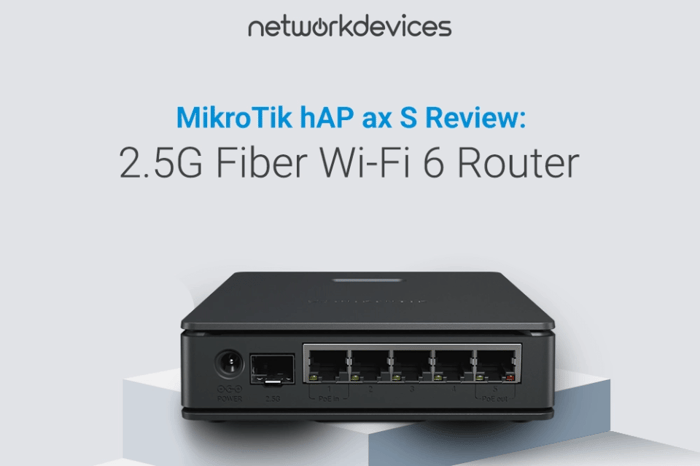
The MikroTik hAP ax S (model E62iUGS-2axD5axT) occupies a confusing but critical niche in the "hAP" lineup. While the naming convention suggests it sits alongside the popular hAP ax², the internal architecture reveals it is less of a direct upgrade and more of a strategic side-grade. The "S" designation here carries significant weight: it indicates the inclusion of an SFP cage for fiber modules, a feature notably absent from the standard ax² and ax³ models.
However, specifications on paper rarely tell the whole story with RouterOS hardware. For network engineers and IT managers, the critical questions surround the chipset architecture, the "passive" nature of the PoE implementation, and whether the Wi-Fi 6 radio can actually deliver on its throughput promises. This review dissects the datasheet to separate the marketing claims from the deployment reality.
Technical Deep Dive
What Hardware Powers the MikroTik hAP ax S?
The hAP ax S uses a dual-core MediaTek EN7562CT (ARM 32-bit) clocked at 950 MHz, a significant step down in raw compute power compared to the quad-core ARM 64-bit processor in the hAP ax².
While the hAP ax² boasts 1GB of RAM and a 64-bit architecture, the hAP ax S is limited to 512 MB of DDR3 RAM and a 32-bit architecture. This effectively rules out running heavy Docker containers or memory-intensive RouterOS packages, as the 32-bit environment limits available container images and system resources.
Furthermore, a critical architectural detail noted in the block diagram is the switch topology. The 2.5G SFP cage and Ether1 (Gigabit) port are connected directly to the CPU, not the switch chip. While acceptable for a gateway/router acting as a NAT boundary, this configuration creates a CPU bottleneck for Layer 2 switching if you intend to use these ports purely for LAN bridging.
What Real-World Wi-Fi Speeds Can You Expect?
Expect real-world TCP throughput to peak at 600-800 Mbps on the 5GHz band, despite the "AX2400" class marketing and theoretical link rates of 1800 Mbps.
The standout feature of the hAP ax S is the radio configuration. Unlike the hAP ax², the hAP ax S features a triple-chain (3x3) 5GHz radio. This addition of a third chain significantly improves receive sensitivity and beamforming capabilities, which are helpful in crowded RF environments.
However, users must temper expectations regarding channel width. The datasheet indicates a maximum PHY rate of 1800 Mbps at 5 GHz, which typically implies support for 80 MHz channel widths, not the 160 MHz required for multi-gigabit wireless speeds. While 3x3 MIMO improves density and range, the lack of official 160 MHz support means single-client throughput will likely not break the gigabit barrier.
Why Does the SFP Port Matter?
The 2.5G SFP cage is the primary selling point of this device, allowing for the elimination of ISP-provided ONTs (Optical Network Terminals) or media converters in favor of a direct fiber uplink.
For WISP client deployments or residential fiber (FTTH), this allows the router to negotiate directly at 2.5 Gbps with the provider's equipment, provided you have the correct GPON module. Alternatively, this port can serve as a high-speed uplink to a local NAS.
What Can the PoE-Out Port Power?
The PoE-out functionality on Ether5 is strictly Passive PoE (up to ~30V) and cannot power standard 802.3af/at devices like modern VoIP phones or enterprise IP cameras.
This is a critical limitation for corporate environments. The hAP ax S uses a 24V 1.5A power adapter (included). Consequently, the PoE-out port passes this voltage through with a 0.6A limit. It is suitable for powering other MikroTik devices (like a wAP or a Cap Lite) or older passive PoE gear.
If you plug in a standard 48V security camera, it simply will not power on. For deployments requiring standard 48V active PoE, we strongly recommend utilizing a dedicated PoE switch or active injectors downstream.
What RouterOS v7 Features Does It Support?
The hAP ax S runs the full RouterOS v7 (Level 4 license), supporting modern features like WireGuard VPN, ZeroTier, and the new Wave2 Wi-Fi drivers, though heavy tasks will strain the CPU.
The transition to the ARM platform (even 32-bit) enables better performance with modern encryption ciphers than older MIPS-based units. You can comfortably run complex firewall rules, queue trees (QoS), and script automation. However, unlike the ax² or ax³, the 32-bit architecture and lower RAM suggest this device is better suited for pure routing and wireless tasks rather than acting as a virtualization host.
Pros and Cons
| Pros | Cons |
| Fiber Ready: 2.5G SFP cage eliminates need for media converters | Passive PoE Only: Incompatible with standard 802.3af/at (48V) cameras |
| Radio Density: 3x3 MIMO on 5GHz improves signal stability/beamforming | Weaker CPU: Dual-core 32-bit CPU trails the Quad-core 64-bit hAP ax² |
| Value: Highly competitive pricing for a router with an SFP interface | Architecture Bottleneck: SFP and Ether1 connect to the CPU, not the switch chip |
| USB Support: Includes USB 2.0 port for LTE modems or external storage | Limited Containers: 32-bit architecture limits Docker support |
| Aesthetics: New enclosure design blends well in home/office settings | No 160MHz: Wi-Fi throughput capped by 80MHz channel width limits |
Use Cases
The Home Lab Enthusiast
For the enthusiast with a 1Gbps+ fiber connection, the hAP ax S offers a cheap entry point into 2.5G routing. It is ideal for those who want to bypass ISP hardware using a GPON SFP module. However, be aware that you cannot use this node to host heavy containers due to the 512MB RAM and 32-bit architecture limits.
The Small Office / SOHO Deployment
This unit serves well as a primary gateway for a small office with fewer than 20 users, provided you do not need to power VoIP phones directly from the router. The 3x3 Wi-Fi configuration helps manage simultaneous Zoom calls better than 2x2 equivalents by handling multiple devices more efficiently.
The WISP/ISP Edge Node
For Internet Service Providers, this is the target "CPE" (Customer Premises Equipment). The combination of SFP for fiber termination and TR-069 management support in RouterOS makes it a deploy-and-forget device for residential clients who need reliable, managed connectivity.
Verdict
The MikroTik hAP ax S is a specialized edge device, not a general-purpose all-rounder. It is recommended for users who specifically require an integrated SFP port for direct fiber termination or 2.5G NAS connectivity without breaking the bank. The 3x3 Wi-Fi radio is a welcome reception upgrade over the standard 2x2 fare.
However, for general power users, the hAP ax² remains the superior router due to its quad-core 64-bit CPU and standard 48V PoE support. If you require standard PoE to power cameras or phones, skip the hAP ax S and look toward dedicated PoE switches to handle the power delivery while letting the router handle the routing.
About This Review
This analysis was compiled by a Senior Network Engineer using data from the official MikroTik hAP ax S datasheet (E62iUGS-2axD5axT) and technical discussions from the MikroTik Community Forums. No hands-on testing was performed on this specific unit.