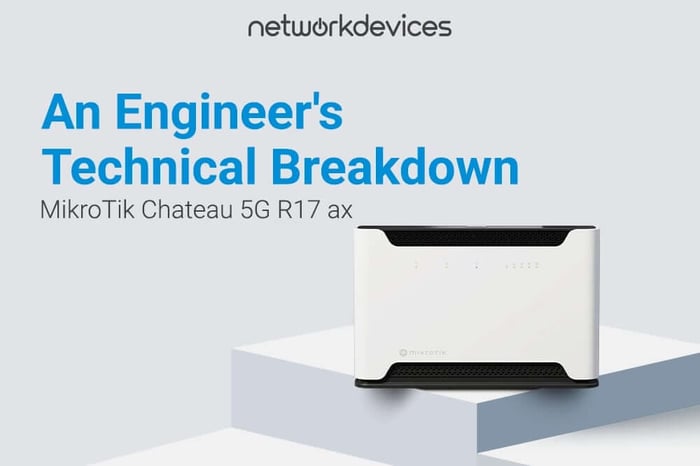

For network professionals, finding a router that strikes a balance between raw power and deployment flexibility is a constant challenge. We often have to choose between consumer-grade devices that lack control and enterprise gear with prohibitive costs. The MikroTik Chateau 5G R17 ax aims to bridge this gap. As a next-generation MikroTik 5G router, its spec sheet warrants a close look.
It’s worth noting that, although I am an engineer, I have not yet had this specific model on my test bench. This article serves as a detailed technical analysis based on the official documentation and specifications released by MikroTik.
This analysis will break down the hardware capabilities, the practical implications of its key features, and the deployment scenarios where this device could prove most effective.
A First-Look Analysis
At its core, the Chateau 5G R17 ax is built on a quad-core IPQ-6010 ARM 64-bit CPU and is equipped with 1 GB of RAM.
This hardware combination is significant because it provides the necessary throughput for routing and IPsec hardware acceleration, as well as sufficient overhead to run containerized services directly on the device.
The entire system is powered by RouterOS v7, MikroTik's industrial-grade operating system. As a powerful RouterOS v7 router, it provides professionals with granular control over routing, security, and traffic management, far beyond typical consumer-grade firmware.
Key Hardware & Software Highlights
Let's dissect the components that define this router's capabilities.
Flexible Cellular Connectivity: eSIM and Micro-SIM
The Chateau offers both a built-in eSIM and a traditional Micro SIM slot. This dual-mode functionality offers tangible benefits, including rapid deployment and redundancy. You can provision the device instantly with a third-party eSIM profile or use MikroTik's own connectivity service without needing to source a physical SIM card.
The Necessary 2.5 GbE Port
The device includes one 2.5G Ethernet port alongside four standard 1G Ethernet ports. This is not a luxury; it’s a necessity. With 5G speeds that can exceed 1 Gbps, the 2.5 GbE port is crucial in preventing a LAN-side bottleneck and fully utilizing the modem's capacity.
Wi-Fi 6 for Modern Device Density
The Chateau features dual-band Wi-Fi 6 (802.11ax). This is critical for modern environments because Wi-Fi 6 is designed to handle a high density of connected devices more efficiently than previous standards, improving stability in crowded wireless spaces.
RouterOS v7 and Container Support
Running RouterOS v7 is a key advantage, providing access to advanced routing, VPNs, and VLANs without requiring subscriptions.
The ARM architecture and 1GB of RAM enable container support, allowing you to run lightweight services like Pi-hole or Home Assistant directly on the router, which can help reduce hardware sprawl in a small office or home lab.
Ideal Deployment Scenarios
1. Remote and Hybrid Workers
For professionals working from home or in remote locations, this device offers a robust solution. The combination of a high-speed 5G WAN and the powerful VPN capabilities built into RouterOS v7 ensures fast and secure connectivity to corporate networks.
2. SMBs and Branch Offices
The Chateau 5G R17 ax is well-suited for small business deployments. Its eSIM functionality allows for rapid, zero-touch provisioning of internet service. Furthermore, RouterOS v7 offers advanced routing features essential for establishing a seamless and reliable LTE failover connection.
3. Mobile ISPs and Resellers
Internet Service Providers will find this device particularly valuable. It offers TR-069 support for remote client management, a critical feature for large-scale deployments. MikroTik also offers special pricing and branding options for mobile operators.
4. Home Power Users and Gamers
This router addresses the needs of demanding home users. The potential for low latency with a 5G connection, combined with a 2.5G LAN port for high-speed workstations or NAS, makes it ideal for seamless cloud gaming and high-resolution streaming. The granular QoS controls in RouterOS allow for precise traffic prioritization.
5. IoT and Smart Home Gateways
The device functions as an excellent smart home gateway. Its container support allows running automation hubs, such as Home Assistant, directly on the router.
This, combined with Wi-Fi 6's ability to handle a high density of wireless devices, makes it a powerful and centralized core for a smart home ecosystem.
Setup and Management Approach
While a full deployment guide is a topic for another article, the initial setup is accessible via the standard RouterOS web UI, a mobile app for simpler setups, or a full command-line interface for advanced users.
Final Analysis
Based on this technical breakdown, the MikroTik Chateau 5G R17 ax is not just a router; it's a versatile networking platform. Its strength lies in combining modern, high-speed hardware with a mature, feature-rich operating system.
The inclusion of forward-thinking features, such as a 2.5 GbE port and the flexibility of eSIM, makes it a compelling option for a wide range of professional and prosumer applications.
While a full hands-on review is necessary to validate real-world performance, the specifications suggest that this is a highly capable device, engineered to solve real-world connectivity challenges.