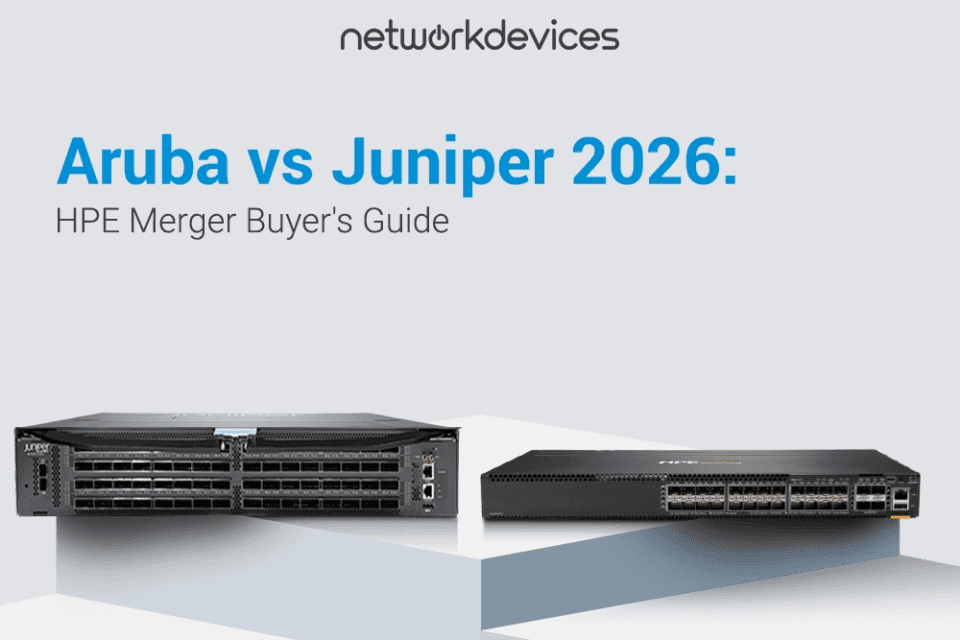

If you are navigating the Aruba vs. Juniper decision following the HPE merger in 2026, the short answer is this: buy Aruba for campus environments and buy Juniper for data center fabrics.
HPE closed its $14 billion Juniper Networks acquisition in July 2025. Since then, the company has moved faster than most expected. Networking revenue hit $2.8 billion in HPE's fiscal Q4 2025, up 150% year over year. New cross-platform Wi-Fi 7 access points, the 102.4 Tbps QFX5250 data center switch, and a "build once, deploy twice" AIOps strategy all signal that HPE is investing in both product lines, not killing one to save the other.
That said, real uncertainty remains. The DOJ-mandated Instant On divestiture is struggling to find a buyer. Thirteen state attorneys general are challenging the merger settlement, and the question of whether Aruba Central or Juniper Mist becomes the long-term centralized management platform remains unanswered.
This guide covers what HPE has confirmed about the integration roadmap, a head-to-head comparison of Aruba CX vs. Juniper EX/QFX switching platforms, the Aruba Central vs. Juniper Mist management platform battle, three scenario-based buying recommendations, and what the merger means for competitive alternatives like Cisco, Ubiquiti, and MikroTik.
Here is what you need to know.
Key Takeaways
- Buy Aruba CX for campus switching if your team already runs HPE Aruba Networking wireless and you need a refresh within 12 to 24 months.
- Buy Juniper EX/QFX if your priority is data center fabric, cloud-native AIOps through Mist, or multi-site MSP standardization.
- HPE is running both Aruba Central and Juniper Mist in parallel. Expect a dual-platform era lasting at least 24 to 36 months, with Mist likely setting the long-term AI direction.
- Do not buy HPE Instant On for new deployments. The product line is being divested under the DOJ mandate, and its future ownership is unclear.
- The Juniper QFX5250, built on Broadcom Tomahawk 6 with 102.4 Tbps throughput, positions Juniper as HPE's flagship for AI-ready data center switching.
- Greenfield buyers should shortlist both HPE platforms against Cisco if roadmap stability matters more than innovation speed.
What HPE Has Confirmed About the Integration Roadmap
HPE moved past generic merger messaging within five months of closing the acquisition. By HPE Discover Barcelona in December 2025, the company had already shipped tangible integration milestones.
The "Build Once, Deploy Twice" Strategy
HPE's integration approach is straightforward: take the strongest functionality from each platform and make it available on the other. Mist's Large Experience Model (LEM), which uses app-aware telemetry from Zoom and Teams to detect video quality issues, is now coming to Aruba Central. Aruba's Agentic Mesh anomaly-detection and root-cause-reasoning engine is coming to Mist.
This confirms that the HPE Juniper acquisition impact is a phased convergence, not a rip-and-replace event. Rami Rahim, the former Juniper CEO who now runs all of HPE Networking, confirmed at MWC Barcelona 2026 that the integration is past the planning phase and into execution.
Cross-Platform Wi-Fi 7 Access Points
HPE's newest Wi-Fi 7 access points work with both Aruba Central and Juniper Mist. This is the clearest investment protection signal in the entire merger: you can buy new hardware today without locking into a single cloud-based management platform.
Key models include the Aruba 720/740/760 series and Juniper Mist APs. Compatibility varies by model, so validate controller support before deployment. These dual-platform APs also support IoT device onboarding and location services across both management planes.
The Instant On Divestiture: What SMB Buyers Need to Know
The HPE Instant On divestiture is one of the messiest parts of this merger. The DOJ settlement (June 28, 2025) requires HPE to divest the global Instant On campus and branch WLAN business within 180 days to a DOJ-approved buyer. It also requires an auction to license Juniper's Mist AIOps source code to competitors.
Here is the problem: HPE is struggling to sell Instant On. Extreme Networks and Tech Mahindra both declined to bid, and Fortinet offered only $5 million to $15 million. A separate group of investors offered $1 in exchange for spinning the business into a standalone entity.
On top of the buyer crisis, thirteen state attorneys general have filed motions challenging the settlement as insufficient to protect. A federal judge ruled in January 2026 that HPE can continue integrating Juniper Networks while the states' challenge is reviewed.
For SMB buyers, the guidance is clear: do not build new deployments on Instant On. If you are buying for growth into enterprise network features, Aruba CX with Aruba Central is the safer path. If you need a low-cost SMB line, expect branding or ownership changes on Instant On and plan accordingly.
New Hardware: QFX5250, MX301, and CX 6300M
HPE is investing in new hardware across both Aruba and Juniper, which signals that the HPE networking portfolio 2026 is genuinely dual-platform.
The Juniper QFX5250 is a 102.4 Tbps data center switch built on Broadcom Tomahawk 6 silicon, with 64 ports of 1.6 Tbps Ethernet, full liquid cooling, and Ultra Ethernet Transport readiness. It is HPE's flagship for AI-scale data center fabrics and became available in Q1 2026.
The Juniper MX301 is a compact 1RU multiservice edge router delivering 1.6 Tbps and 400G connectivity, targeting inference workloads and high-performance routing at the edge.
The Aruba CX 6300M series targets campus access and aggregation with scalable, stackable Layer 3 switching. It supports VSF stacking for up to 10 members, BGP/EVPN/VXLAN capability, HPE Smart Rate multi-gigabit ports with up to 90W PoE, and built-in security features including MACsec 256 encryption.
The takeaway: Juniper owns the data center and edge routing story. Aruba owns the campus. Both product lines are getting active R&D investment.
Aruba CX vs. Juniper EX and QFX: Which Switching Platform Should You Choose Today?
This is where budgets are decided. The Aruba switches vs. Juniper switches decision matters more than the merger headlines for most buyers evaluating a purchase in 2026.
AOS-CX vs. Junos: Operating System Philosophy and Automation
The operating system is the foundation of this decision. Both AOS-CX and Junos are mature, but they reflect different design philosophies around CLI workflow, config management, and automation.
AOS-CX is state-based and REST-native. Configuration changes are applied through a checkpoint model, and every switch exposes a full REST API for programmatic access. Ansible support is available through the aoscx collection, and the AOS-CX Python SDK allows direct scripting against the switch datastore. The CLI is streamlined and intentionally simpler than legacy ProVision or Comware syntax.
Junos uses a candidate configuration model with explicit commit checks. You stage changes, validate them with commit check, and apply them atomically with commit confirmed (which auto-rolls back if you do not confirm within a timer). This workflow prevents partial config errors from reaching production.
Junos automation runs deep: PyEZ, Ansible (via junos collection), NAPALM, gRPC/gNMI through OpenConfig, and Apstra for intent-based fabric management
Simple rule: if your team is campus-first and values lower operational complexity, AOS-CX is easier to adopt. If your team already knows Junos, runs mixed environments (campus plus data center plus WAN), or needs commit-confirmed safety in production, Juniper wins.
Campus Switching: Aruba CX 6200/6300/6400 vs. Juniper EX2300/EX3400/EX4400
For campus access and distribution layers, both platforms are mature and widely deployed across enterprise networks.
Aruba CX 6200/6300/6400 switches align tightly with HPE Aruba Networking wireless infrastructure. VSF and VSX provide stacking and redundancy, and Dynamic Segmentation enforces consistent wired/wireless access control policies through Aruba Central.
The CX 6300M in particular supports BGP, EVPN, VXLAN, and VRF at the access layer, which gives Aruba a credible path into micro-segmentation at the edge. For organizations running ClearPass for network access control, the Aruba CX line provides native integration.
Juniper EX2300/EX3400/EX4400 switches pair naturally with Mist cloud management. The EX4400 supports Virtual Chassis for multi-switch stacking and integrates with Mist's Wired Assurance for proactive monitoring and automated troubleshooting. For MSPs managing dozens of client sites, the Mist dashboard provides stronger multi-site visibility than Aruba Central's current interface.
| Use Case | Better Fit in 2026 | Why |
|---|---|---|
| Existing Aruba campus | Aruba CX 6200/6300/6400 | Lowest migration friction, strong wired/wireless alignment |
| Existing Mist-managed campus | Juniper EX4400 | Deepest Mist AI automation integration |
| New enterprise campus, strong WLAN focus | Slight edge to Aruba | Tighter wireless/wired policy consistency with ClearPass |
| Multi-site MSP standardization | Juniper EX + Mist | Stronger multi-site cloud-native workflows |
Data Center and Aggregation: Aruba CX 8325/8400 vs. Juniper QFX5120/QFX5220
In the data center, the balance shifts toward Juniper.
Aruba CX 8325/8400 switches handle enterprise data center and aggregation workloads well. They support EVPN-VXLAN fabrics with AOS-CX and integrate with Aruba NetEdit for config validation. However, Aruba's EVPN-VXLAN implementation is newer and has a smaller footprint in production data centers than Juniper's.
Juniper QFX5120/QFX5220 switches are the established choice for EVPN-VXLAN leaf-spine fabrics. Junos EVPN-VXLAN support is battle-tested in large-scale deployments, and Apstra provides intent-based fabric automation that validates the entire fabric state against a reference design. For AI and 400G workloads, the QFX5250 (102.4 Tbps, Broadcom Tomahawk 6) is HPE's clear flagship for scalable, high-performance data center switching.
Bottom line: Juniper QFX is the safer long-term bet for modern, AI-ready data centers. Aruba CX 8325/8400 remains solid for enterprise aggregation where data center scale is moderate.
Licensing and TCO: What Each Platform Actually Costs Over 5 Years
Do not compare the switch price alone. A real 5-year TCO calculation includes hardware, software tier licensing, support contracts, migration labor, training, and operational efficiency gains from automation. Both platforms offer subscription and perpetual licensing options, and the total cost difference often depends more on your team's existing skills than on the hardware's list price.
| Cost Factor | Aruba Tends to Win When | Juniper Tends to Win When |
|---|---|---|
| Existing skills | Team already runs Aruba | Team already runs Junos/Mist |
| Campus refresh | Aruba APs and ClearPass NAC are deployed | Mist is already standard |
| Operations | Simpler campus workflows matter most | AIOps and automation savings matter more |
| Expansion scope | Campus-first growth | Campus plus data center growth |
The pattern is consistent: if your investment is campus-only, Aruba typically costs less over five years because you avoid retraining and retooling. If your investment spans campus and data center, Juniper's unified Mist management and stronger data center portfolio reduce total cost by consolidating operational platforms.
Aruba Central vs. Juniper Mist: Management Platform Comparison
The Aruba Central vs Juniper Mist decision may be the most important software choice in this merger. Whichever platform HPE ultimately positions as the long-term unified centralized management plane will shape your operational workflows for the next decade.
AI Capabilities: Marvis Virtual Network Assistant vs. Aruba AIOps
Juniper Mist Marvis vs Aruba Central is not a close contest on AI maturity today. Mist, combined with its Marvis Virtual Network Assistant, leads in proactive root-cause analysis, user experience scoring, and natural-language troubleshooting. The fact that HPE is bringing Mist's LEM capabilities into Aruba Central (not the other way around for AI) confirms which platform sets the AI direction.
Aruba AIOps is improving and already provides useful anomaly detection and client health monitoring through its cloud-based dashboard. But Mist AI's advantage is architectural: its microservices-based data pipeline was designed for machine learning workloads from day one, while Aruba Central's AI features were added incrementally to an existing platform.
Multi-Site Management, Provisioning Workflows, and API Ecosystem
For multi-site operations, Mist provides a single cloud-native dashboard with site-level segmentation, template-based provisioning, and role-based access control across hundreds of locations. Its REST API is well-documented, and the Mist SDK supports Python-based automation for bulk operations like firmware upgrades and config pushes.
Aruba Central offers comparable provisioning through templates, groups, and labels. Its REST API covers most management operations, and it supports Zero Touch Provisioning (ZTP) for new switch deployments. Where Central currently falls behind is in multi-tenant management for MSPs: Mist's multi-organization architecture was purpose-built for service providers managing distinct client environments.
On the switch side, Juniper supports gRPC and OpenConfig for telemetry streaming and programmatic configuration. Aruba's AOS-CX REST API is strong for campus workflows but does not yet match Junos/gNMI for streaming telemetry in high-frequency data center monitoring scenarios.
Which Platform Is More Likely to Be the Long-Term Survivor?
Based on what HPE has publicly shown through March 2026: both platforms survive for at least the next 24 to 36 months. HPE is building shared microservices that run across both Central and Mist, not forcing a hard cutover.
However, the direction is visible. Mist's LEM is moving to Central, and Mist's organizational views are following. Aruba Central is being enhanced, not deprecated, but the innovation flow is primarily from Mist outward.
Best buyer assumption: plan for a dual-platform era through at least 2028. If you are choosing today and value AI-driven operations, Mist is the stronger long-term bet. If you are an installed-base Aruba customer, Central remains fully supported and is receiving meaningful upgrades.
Three Scenarios: Which Platform Fits Your Situation?
Existing Aruba Shop: Upgrade or Hold?
If you already run Aruba, the safest move is to upgrade within Aruba CX for campus refreshes. Do not panic-migrate to Juniper based on merger speculation.
Concrete steps: Deploy newer CX 6300M or CX 6400 models for access layer refreshes. Adopt the latest Wi-Fi 7 APs that support both Aruba Central and Mist (this gives you optionality if the platform landscape shifts). Continue using Aruba Central for wired/wireless management. If you run ClearPass for network access control, it continues to integrate with Aruba CX and Central. Delay any data center switching decisions until HPE clarifies the long-term fabric strategy.
Recommendation: Buy Aruba if your refresh is within 12 to 24 months and your team is already trained on AOS-CX. You get the lowest migration friction and strong wired/wireless policy consistency.
Existing Juniper Shop: What Changes and What Stays?
If you already run Juniper, the merger is mostly good news. Junos is not being retired. QFX and MX actually gained strategic importance after the acquisition, and Mist remains central to HPE's AI-driven management story.
Concrete steps: Continue deploying EX4400 for campus and QFX5120/5220 for data center. Evaluate the QFX5250 if you need 400G or 1.6T port speeds for AI workloads. Keep Mist as your management platform for cloud-based troubleshooting and optimization. If you run Apstra for data center fabric automation, confirm HPE's current Apstra licensing and support roadmap before expanding.
Recommendation: Stay with Juniper, especially if you are data center-heavy, service-provider-adjacent, or already Mist-centric.
Greenfield Deployment: A Practical Decision Framework
If you are starting fresh, use this decision framework:
Buy Aruba in 2026 if:
- Your deployment is campus-first (access, distribution, wireless)
- Your team values simpler operational workflows and REST-based automation
- You need tight wired/wireless policy alignment with Dynamic Segmentation and ClearPass access control
- Cybersecurity posture management and SD-WAN integration through HPE Aruba Networking are priorities
Buy Juniper in 2026 if:
- You need strong data center fabric support (EVPN-VXLAN, leaf-spine, 400G)
- Cloud-native AIOps through Mist AI is a priority
- You are an MSP standardizing across multiple client sites
- Your architecture spans campus, data center, and edge routing under one operational platform
Shortlist both against Cisco if:
- Your organization values long-term roadmap stability over innovation speed
- You are already evaluating Cisco Catalyst or Meraki and want a price and functionality comparison
- Firewall and cybersecurity integration with networking (like Cisco's converged security stack) is a primary requirement
What the HPE Merger Means for the Competitive Landscape
HPE vs. Cisco vs. Broadcom: The Scale Shift
The Juniper Networks acquisition changed HPE's competitive position overnight. HPE's networking revenue hit $2.8 billion in FQ4 2025 (up 150% YoY), and in Q1 FY2026, it reached $2.706 billion with data center networking surging 382.6% year over year. Networking now accounts for roughly 30% of HPE's total revenue and over half its operating profits.
This positions HPE as a credible number-two challenger to Cisco in enterprise networking. The combined HPE Aruba Networking plus Juniper portfolio covers campus, data center, edge routing, and AI fabric, giving HPE a full-stack answer that neither company had alone.
Impact on Cisco Meraki, Ubiquiti, and MikroTik Decisions
The merger changes how buyers evaluate alternatives.
Cisco Catalyst and Meraki remain the default enterprise network choice for organizations that prioritize ecosystem breadth, long-term roadmap predictability, and integrated firewalls and cybersecurity. Meraki excels in simple cloud management but carries premium licensing costs at scale.
Ubiquiti UniFi appeals to cost-sensitive SMBs and smaller deployments. The price is hard to beat, but Ubiquiti lacks enterprise-grade support, SLA guarantees, and the AI-driven troubleshooting that Mist and Aruba Central provide. It also has limited SD-WAN and IoT functionality compared to HPE or Cisco platforms.
MikroTik CRS offers strong value and routing flexibility for price-conscious deployments, but it is not designed for large enterprise networks that need standardized lifecycle governance, vendor-backed TAC support, centralized management dashboards, and compliance certifications.
Should You Buy Aruba or Juniper in 2026?
Here is the structured verdict:
- Buy Aruba CX if your network is campus-first, your team runs AOS-CX, you need wired/wireless policy alignment, and your refresh window is 12 to 24 months. Aruba Central remains safe and is receiving Mist-originated AI features through HPE's cross-pollination strategy.
- Buy Juniper EX/QFX if your priority is data center fabric, AI-native AIOps through Mist, multi-site cloud management, or high-performance switching (400G, 1.6T with the QFX5250). Junos is not going anywhere, and Juniper's strategic position within HPE has strengthened since the merger.
- Avoid HPE Instant On for new deployments. The product line is under DOJ-mandated divestiture, serious buyers have not materialized, and its long-term ownership is uncertain.
- HPE has confirmed that both Aruba and Juniper platforms will continue in 2026, but they serve different strengths at different layers. Campus buyers should lean on Aruba. Data center and AIOps-driven buyers should lean on Juniper. Greenfield buyers should evaluate both against Cisco before committing.
If you need help mapping your refresh cycle or sourcing the right hardware, Network Devices provides vendor-neutral guidance across the full HPE, Cisco, and alternative networking portfolio. Contact our team today to discuss your next deployment.


FAQs
1. What is the difference between Aruba and Juniper?
Aruba (now HPE Aruba Networking) specializes in campus networking: wireless access points, campus switches, ClearPass NAC, and SD-WAN. Juniper specializes in data center switching, high-performance routing, and AI-native cloud management through Mist. Both are now owned by HPE after the July 2025 acquisition.
2. Should I buy Aruba or Juniper switches in 2026?
Buy Aruba CX for campus switching if you already run Aruba wireless and need wired/wireless alignment. Buy Juniper EX/QFX for data center workloads, cloud-native AIOps through Mist, or multi-site MSP standardization. Both platforms are actively supported and receiving new hardware in 2026.
3. Will HPE discontinue Aruba or Juniper products?
HPE has not announced any product discontinuation for either Aruba CX or Juniper EX/QFX/MX lines. Both received new hardware launches at HPE Discover Barcelona 2025, and HPE's MWC 2026 messaging confirmed active dual-platform investment through at least 2028.
4. Is Juniper Mist better than Aruba Central?
For AI-driven troubleshooting, proactive root-cause analysis, and scalable multi-site management, Mist with Marvis currently leads Aruba Central. For campus-focused wired/wireless management with Dynamic Segmentation and ClearPass integration, Aruba Central is more tightly integrated. HPE is cross-pollinating features between both platforms.
5. Is Cisco or HPE Aruba better for large enterprises?
Cisco offers broader ecosystem integration (firewalls, SD-WAN, cybersecurity, collaboration) and long-term roadmap stability. HPE Aruba Networking offers competitive pricing, strong AI-driven operations through its combined Aruba/Juniper portfolio, and aggressive hardware innovation. The better choice depends on whether you prioritize ecosystem breadth (Cisco) or networking-focused innovation and price (HPE).