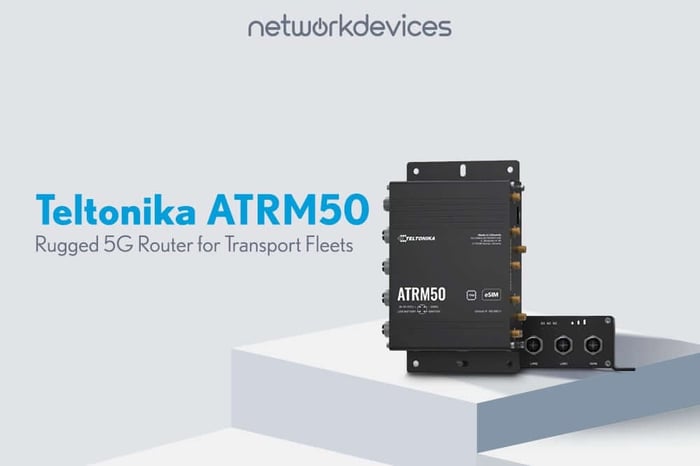

The Teltonika ATRM50 is a purpose-built 5G transportation router engineered to solve the two most common failure points in vehicle network deployments: connector integrity and power management. Standard routers retrofitted for transport often fail under constant vibration or drain vehicle batteries.
The ATRM50 was explicitly designed to overcome these issues, integrating rugged hardware like M12 connectors and aluminum housing with intelligent fleet management features.
This is not an adaptation; it is a direct response to market demands for a router that remains stable and reliable on the move. It provides dual SIM plus eSIM capabilities, ignition detection, and critical railway certifications (EN50155 & EN45545) out of the box.
In this article, you'll learn:
- Why M12 X-coded connectors are essential in mobile deployments.
- How ignition and low battery inputs prevent stranded vehicles and corrupted data.
- Where does this railway router with eSIM fit in real-world use cases?
- The key specifications you need to know before deployment.
- The straight answer: Is this the right router for your fleet?
ATRM50 Unpacked: Built for High-Vibration, Mission-Critical Connectivity
If you've ever had a barrel connector jiggle loose mid-route or a consumer-grade RJ45 tab fail under vibration, you will appreciate what Teltonika did here. The design directly confronts these physical failure points.
- 4x M12 X-coded Ethernet ports deliver stable gigabit data, eliminating the vulnerability of plastic RJ45 clips in high-vibration environments. While the device operates at 1 Gbps, the M12 X-coding standard itself supports up to 10 Gbps, ensuring the physical connector is never a bottleneck.
- 1x M12 A-coded power input protects the device against shocks, reverse polarity, and voltage surges.
- A fully integrated anodized aluminum housing with flat-surface mounting flanges means no extra bracket kits are needed for a secure installation.
- It has a tested operating range of -40°C to +75°C to endure harsh thermal conditions.
- The housing provides IP30 ingress protection.
The ATRM50 was clearly designed for moving vehicles and has been certified for railway environments, ensuring both cable security and data integrity across bumpy tracks and uneven roads.
Core Technical Specifications: A Snapshot
Key Differentiators: Why M12 Connectors and Smart Power Features Matter
The M12 Advantage: Securing Power and Gigabit Data on the Move
Standard RJ45 ports are not built for motion. M12 connectors, common in industrial networking, use different coding for specific tasks; the ATRM50 employs A-coded for power and X-coded for high-speed Ethernet.
The M12 design features threaded screw-locking mechanisms for superior vibration resistance and provides an IP-rated seal, ensuring that connected subsystems like surveillance cameras or ticketing machines maintain a stable link.
Intelligent Power Management: Ignition Detection & Low Battery Protection
The ATRM50's power management circuit prevents parasitic battery drain with two key features wired into the M12 power port:
- Ignition Detection: The router powers on only when the vehicle starts. This is critical for any industrial router for fleet management, as it allows for scheduled remote diagnostics or firmware updates without draining the battery of a parked vehicle.
- Low Battery Detection: If the vehicle's battery level drops, it signals the router to perform a graceful shutdown before the battery is fully discharged. This prevents data corruption from sudden power loss and ensures the vehicle retains enough power to restart.
Primary Deployment Scenarios: From Passenger Trains to Public Bus Fleets
The ATRM50 is certified for both fire safety and vibration, making it ideal for a range of demanding environments:
- Public Transit Buses: Provides stable connectivity for passenger Wi-Fi, digital signage, and streaming live CCTV footage to control centers.
- Passenger Trains: The M12 ports ensure stable carriage-to-carriage connectivity for onboard systems. At the same time, dual SIM with auto-failover helps avoid high roaming charges and ensures a constant connection when crossing borders.
- Emergency & Commercial Fleets: Offers secure VPNs and real-time GNSS tracking for dispatch and telematics.
- Mining, Construction & Utilities: Its ruggedness and wide temperature range make it a reliable choice for vehicles and machinery operating in harsh industrial sites, from construction zones to wind turbines.
The Verdict: Is the ATRM50 the Right Choice for Your Fleet?
If you are tired of adapting office-grade routers to industrial field conditions, the ATRM50 is the correct approach. It was designed from the ground up with real-world transportation requirements in mind.
You get:
- Certified ruggedness for mobile deployments
- Enterprise-grade VPN security with TPM 2.0 support
- Fleet-ready remote router management with VPN and RMS
- M12 Ethernet and power connectors for industrial reliability
- Modern connectivity with 5G, dual SIM, eSIM, Wi-Fi 5, and GNSS
It may not replace your entire networking stack, but for providing a reliable, rugged, and remotely managed 5G connection in any moving vehicle, it is the superior engineering choice.
In mission-critical mobile environments, failure isn’t an option. The ATRM50 gets that—and it delivers.
For complete technical specifications and to download the full datasheet, please visit the official ATRM50 product page.
FAQs
1. Does the ATRM50 support PoE?
No. The ATRM50 does not have PoE-capable ports. To power a device like a camera, an external PoE injector or switch is required. Furthermore, a separate PoE switch can be monitored via Teltonika's RMS platform, allowing for integrated remote management of the entire network.
2. Can the ATRM50 be used without RMS?
Yes, the router is a fully functional standalone device. However, for fleet deployments, Teltonika's Remote Management System (RMS) is essential for unlocking the full value stack, including centralized configuration, firmware updates, and remote access to the entire fleet of devices and their connected endpoints.
3. What railway certifications does it hold?
It is certified as EN50155 (for electronic equipment covering shock, vibration, and temperature) and EN45545 (for fire safety). It also meets E-Mark and ITxPT standards for broader transport use.
4. Can I use my own applications on the router via SDK?
Yes. The device runs RutOS (OpenWrt-based) and supports app development via an SDK, with access to Busybox shell, Lua, C, C++, and Python through its package manager.
Editor's Note: This engineering review is based on a comprehensive analysis of official product documentation, specifications, and technical webinars. Our assessment is grounded in extensive experience with industrial hardware and focuses on how the ATRM50’s features address common challenges in the field.