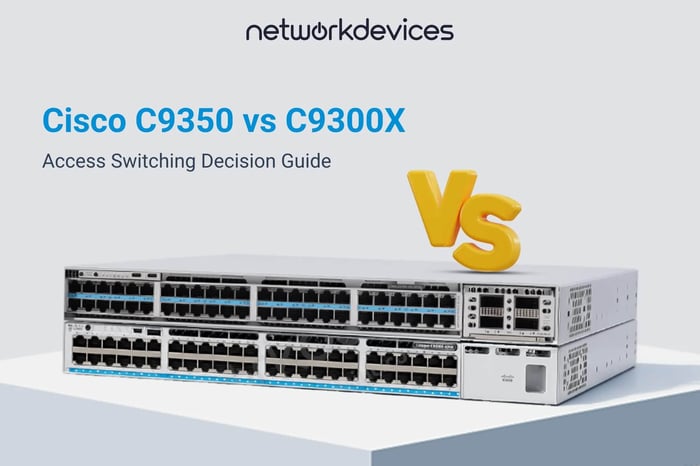

If your organization is standardized on Catalyst 9300X, keep C9300X as the default for conventional access and incremental expansion. C9350 earns its place when it solves a documented limit in the existing standard: total PoE capacity, access-layer scale, port or uplink density, or measured stack bandwidth. A greenfield site lowers the migration penalty, but being greenfield is not by itself a technical reason to choose C9350.
Wi-Fi 7, 10G multigigabit, 90W per-port UPOE+ and 100G uplinks are not enough on their own. Relevant C9300X models already support all four. Cisco has also published no end-of-sale notice for C9300X hardware, and the Catalyst 9300 data sheet and ordering guide were both refreshed on 1 September 2026.
The real question is not whether C9350 is newer. It is whether its advantage is valuable enough to justify a second stacking, spares, software and licensing standard.
C9350 vs C9300X at a glance
| Area | Catalyst 9300X | Cisco C9350 | Does it change the decision? |
|---|---|---|---|
| ASIC | UADP 2.0sec | Silicon One A100/L | Indirectly. Feature parity cannot be assumed |
| Copper access speed | Up to 10G mGig | Up to 10G mGig | No |
| Per-port PoE | Up to 90W UPOE+ | Up to 90W UPOE+ | No, not by itself |
| Total PoE, 48-port mGig | 3,290W, two PSU bays | 4,320W, three PSU bays | Yes, the clearest hardware case |
| Switching capacity, 48-port mGig | 1,760 Gbps, 1,309 Mpps | 1,760 Gbps, 1,309.44 Mpps | No. They are the same |
| Stacking | StackWise-1T, 8 members | StackWise-1.6T, 8 members | Only with measured east-west traffic |
| Mixed stacking | With C9300 at StackWise-480 | C9350 only | Major brownfield constraint |
| Stack cables | STACK-T1-50CM / 1M / 3M | STACK-T1A-50CM= / 1M= / 3M= | Separate spares line |
| Network modules | C9300X-specific | C9350-specific | Separate spares line |
| Top uplink | 4x 100G/40G | 4x 100G/40G | No |
| MAC and route scale | 32,000 MAC, 39,000 IPv4 | Up to 64,000 MAC, 192,000 IPv4 | Yes, for routed access and large fabrics |
| MACsec | Supported on current recommended releases | Introduced in IOS XE 26.1.1a | Release-dependent. Verify target PID and release |
| IPsec | Up to 100G, HSEC key required | Still documented as a future capability | Can favor C9300X today |
| Recommended IOS XE | 17.18.4, 17.15.6 | 17.18.4 for the original PIDs | Verify per PID, not per family |
| Lifecycle | No hardware end-of-sale published | Current, first shipped 2025 | Removes urgency from the decision |
Validate every PID in CCW before quoting.
Platform and model differences
Comparing the two at family level is misleading. The portfolios overlap heavily, so the useful comparison starts at PID level.
| Requirement | Relevant C9300X | Relevant C9350 | Practical interpretation |
|---|---|---|---|
| 48-port full 10G mGig, 90W capable | C9300X-48HX-E | C9350-48HX | Port capability alone does not justify C9350. Total PoE might |
| 24-port full 10G mGig, 90W capable | C9300X-24HX | C9350-24HX | Same endpoint role. Compare power and operational ecosystem |
| Mixed 5G and 10G mGig | C9300X-48HXN | C9350-48HXN | Verify the exact port split. Cisco sources conflict, see below |
| 48-port 10G mGig, no PoE | C9300X-48TX | C9350-48TX | Identical switching capacity. C9350 changes stack architecture only |
| Dense 2.5G with 90W PoE | No direct C9300X equivalent | C9350-48HM | One of the clearer C9350-specific designs |
| 12-port 25G SFP28 | C9300X-12Y | C9350-12Y | Equivalent access role |
| 24-port 25G SFP28 | C9300X-24Y | C9350-24Y | C9350-24Y is the only 24Y with a 400G uplink option |
Cisco's Catalyst 9300 data sheet describes the C9300X-48HXN as 8 ports of 10G multigigabit plus 40 ports of 5G. The Catalyst 9300 ordering guide, updated 1 September 2026, describes the same PIDs as 36-port 5G plus 12-port 10G. Those are different switches, and 36 plus 12 is also the documented C9350-48HXN split. Confirm the orderable PID and hardware revision before quoting either configuration.
Performance: what the numbers actually say
| Model | Switching capacity | Forwarding rate | With stacking |
|---|---|---|---|
| C9300X-48HX | 1,760 Gbps | 1,309 Mpps | 2,760 Gbps |
| C9350-48HX | 1,760 Gbps | 1,309.44 Mpps | 3,360 Gbps |
| C9300X-48HXN | 960 Gbps | 714.24 Mpps | 1,960 Gbps |
| C9350-48HXN | 1,000 Gbps | 1,488 Mpps | 2,600 Gbps |
On the flagship 48-port multigigabit model, local switching capacity and forwarding rate are effectively identical. The entire delta is the stack ring, and stack bandwidth only helps traffic crossing stack members. In an access closet where most traffic is northbound, a faster back panel changes nothing measurable. The HXN pair is the exception, roughly doubling forwarding rate.
C9350 also has substantially higher control-plane and table scale. Cisco's data sheet lists up to 64,000 MAC addresses and 192,000 IPv4 LPM routes, while IOS XE 26.1.1a increases supported SVI scale to as many as 3,930. These are meaningful for routed access and large fabrics, and largely irrelevant to a conventional Layer 2 access closet.
Multigigabit, PoE, and Wi-Fi 7
Wi-Fi 7 is the most commonly stated reason to refresh campus switching and, on its own, the weakest one. Start with four numbers: required AP link speed, actual AP power draw, APs per switch, and expected aggregate closet traffic.
What does a Wi-Fi 7 access point actually draw?
Cisco's access point power reference lists maximum consumption of 47W for the 9178 and 39W for the 9176. Forty-eight 9178-class access points at full draw is roughly 2,256W. A C9300X-48HX with two 1900W supplies provides 3,290W. The C9300X covers a fully loaded Wi-Fi 7 floor with headroom. Ninety watts is for endpoints that actually consume ninety watts: pan-tilt-zoom cameras, LED lighting, IP turrets, building management gateways.
One brownfield trap deserves attention. Cisco documents that Wi-Fi 7 access points support standards-based PoE, including 802.3bt, but not proprietary Cisco UPOE, and that access points failing to power up or running in reduced mode on 60W UPOE ports is a commonly reported problem. Older Catalyst 9300 UPOE closets need separate review, because standards-based 802.3bt support rather than the UPOE label determines compatibility with newer AP power modes. This does not affect the C9300X-48HX, which is 802.3bt Type 4, or the C9350 UPOE models, which Cisco documents as 802.3bt Type 3.
90W per port is not the same as 90W on every port
Here the chassis genuinely differ. The C9350 has three power supply bays. The C9300X has two.
| C9300X-48HX | C9350-48HX | |
|---|---|---|
| Default PSU and available PoE | 1100W, 590W | 1600W, 1,120W |
| Maximum PoE | 3,290W (1900W + 1900W) | 4,320W (three supplies) |
| 48 ports at 90W simultaneously | Not reachable | Reachable |
Forty-eight ports at 90W is 4,320W. The C9350-48HX reaches it; the C9300X-48HX gets to roughly 36 ports at full Type 4. If your endpoints genuinely draw 90W on more than about 36 ports of a 48-port switch, that is the clearest hardware-driven case for C9350 in this comparison.
Size PoE for normal operating demand, plus growth margin, plus what must stay powered after a PSU failure. Do not select from the per-port maximum. And check input voltage: PWR-C2-1600WAC is rated 1600W at 230V and 1200W at 115V, and PWR-C1-1900WAC-P delivers 1900W at 230V and 1500W at 115V. In a 120V closet, you do not get the datasheet value. Model the actual configuration in the Cisco Power Calculator.
Stacking and migration
For an organization already standardized on C9300X, stacking matters more than the access-port specification.
Stack domains do not merge. Cisco documents the C9350 as stacking with other C9350 models at StackWise-1.6T, at the same license level, up to eight members. Catalyst 9300 and 9300X are not listed as supported stack members. The C9300X stacks with other C9300X models at StackWise-1T and with Catalyst 9300 models at StackWise-480, though not with the higher-scale C9300-24UB, 24UXB and 48UB SKUs. You cannot add a C9350 to an existing C9300X stack. Not at reduced speed, not at all. Every C9350 purchase starts a new stack domain.
Cable part numbers are one character apart. C9350 uses STACK-T1A-50CM=, STACK-T1A-1M= and STACK-T1A-3M=. Catalyst 9300 and 9300X use STACK-T1-50CM, STACK-T1-1M and STACK-T1-3M. Same lengths, same shelf, incompatible. Cisco states the same incompatibility for StackPower cabling, so confirm any reuse plan before ordering rather than assuming the part numbers carry across.
StackPower+ is not new to the C9350. Cisco documents that Catalyst 9300X models already support it. Ring size is four switches on both platforms, so an eight-member data stack uses two power-sharing groups.
Does 1.6 Tbps actually matter? It helps when substantial traffic repeatedly crosses stack members: dense multigigabit access, high-throughput wireless, or designs that concentrate uplinks on specific members. If the existing 1T stack is nowhere near congestion, 1.6T is capacity without an identified workload. Measure before using stack bandwidth as the justification.
What a phased refresh actually costs. A closet with six C9300X switches that needs two more keeps its stack, cabling, spares, software qualification and troubleshooting model if you add C9300X. Two C9350s instead means a separate stack, new uplinks into distribution, reproduced templates and automation, a separate licensing and entitlement path, and an endpoint cutover. For one closet that is a maintenance window. Across two hundred closets it is a program, and that cost belongs in the business case alongside the hardware.
Uplinks, modules, and accessories
A requirement for 100G uplinks does not favor the C9350.
| C9300X | C9350 | |
|---|---|---|
| 4x 100G/40G | C9300X-NM-4C (48HX, 48TX, 24Y only) | C9350-NM-4C (48HX, 48TX only) |
| 2x 100G/40G | C9300X-NM-2C (default on C9300X orders) | C9350-NM-2C |
| 8x 25G/10G/1G | C9300X-NM-8Y | C9350-NM-8Y, also 4x 50G mode |
| 8x copper multigigabit | C9300X-NM-8M | C9350-NM-8M, per the datasheet |
Most C9350 models cap at 200G of modular uplink bandwidth; 400G is available only on the 48HX, 48TX and 24Y. Module restrictions are model-specific on both platforms, so "C9350 supports 400G uplinks" is true of the line and false of most of its SKUs.
Two further checks. Cisco's C9350 data sheet also lists C9350-NM-8L and C9350-NM-8M, but the 26.1.x release notes list only NM-2C, NM-4C and NM-8Y as supported network modules. Confirm module support against the release you will run. Catalyst 9300X network modules are supported only on Catalyst 9300X models, so existing module spares do not carry forward. Some optics may be reusable; validate the transceiver PID against Cisco's current compatibility documentation rather than assuming a physical fit implies support.
Software, management and licensing
Feature availability is release-dependent
This is where Cisco's own documents are least synchronized, and it is worth checking rather than inheriting.
The June 2026 C9350 data sheet footnotes line-rate MACsec, IPsec up to 100G, NBAR, XDR integration, Live Protect and post-quantum support as future releases, with BGP EVPN marked hardware capable but not available at FCS. The IOS XE 26.1.1a release notes, however, explicitly introduce MACsec Encryption and AVC with NBAR-based QoS as new C9350 software features.
So MACsec support on C9350 is release-dependent rather than absent. IPsec is still documented as a future capability, which can favor C9300X where 100G line-rate IPsec is a current requirement, and on C9300X that feature needs an HSEC key at order time. Verify both against the exact PID and target IOS XE release rather than assuming either full parity or no support.
Qualify software by PID, not by family
Cisco's September 2026 recommended releases for C9300X are 17.18.4 and 17.15.6. Cisco's separate recommended-release page for C9350 lists 17.18.4 for C9350-24P, 24T, 24U, 48P, 48T, 48TX, 48U and 48HX. For those PIDs, the original C9350 models sit on the same extended-support train as your existing fleet, which materially reduces the qualification burden.
Cisco explicitly introduced C9350-24HX and C9350-48HXN in IOS XE 26.1.1a. Other newer C9350 PIDs are absent from the September recommended-release table, so verify the currently supported and downloadable release for the exact PID rather than assuming the whole family can follow the same 17.18.x standard. Note also that the family data sheet lists 26.1.2 as the platform minimum while TAC recommends 17.18.4 for C9350-48HX; Cisco's guidance is that the software available on the specific product download page takes precedence over the recommendation page.
The operational rule: a C9350 purchase can trigger a new regression test, Catalyst Center compatibility check, template validation and change-control cycle even when another C9350 model already runs elsewhere in your estate.
Licensing is different, but not perpetual versus subscription
The claim that C9350 eliminates perpetual licensing is not accurate, and neither is the claim that C9300X can be bought outright without a subscription.
Cisco documents a perpetual Cisco Switching OS license on the C9350 in Essentials and Advantage tiers, tagged C9350-OS-ESS and C9350-OS-ADV, reported on-device as perpetual and not enforced. It arrives with a Cisco Networking Subscription carrying a 36-month minimum term. On the Catalyst 9300 side, the perpetual Network Stack license is embedded with the hardware SKU suffix rather than separately selectable, and both it and a Cisco DNA or Catalyst subscription are mandatory at time of purchase. The Catalyst 9300 Series is itself now eligible for the Cisco Networking Subscription.
A C9350 therefore does not become unusable when its subscription lapses, and the two models are not interchangeable either. What differs in practice: the C9350 subscription bundles hardware and software support with RMA upgrade service addable per device, the C9350 uses a single hardware SKU per model instead of the -E, -A and -M suffix pattern, Meraki Classic co-termination remains available, and C9350 switches ship at Switching OS Advantage boot level, requiring a CLI change and reload if Essentials was ordered.
Is C9300X end of life?
No. As of September 2026 Cisco's Catalyst 9300 end-of-life listing contains IOS XE release notices, license notices, the SSD-120G and the C9300L-STACK-KIT, and no chassis. Cisco continues to publish updated C9300X documentation and current recommended releases. C9350 is the newer architecture. That is not the same as C9300X reaching hardware end of life.
Brownfield vs greenfield
Brownfield. The burden of proof sits on C9350. Every unit is a new stack, a new spares line, and a new qualification path. If C9300X already satisfies port speed, PoE, uplink, routing, security, and stack-bandwidth requirements, staying standardized reduces migration work, hardware variants, spare inventory, configuration variance, and troubleshooting surface. Standardization has engineering value that does not appear on a data sheet.
Greenfield. The threshold drops sharply, because the stack domain is new either way. The remaining questions are feature availability on the release you will run and whether operations wants a second software train before the rest of the estate follows.
Most organizations will run both for several years. Keep the boundary at the site or building level, not the closet level.
When each platform makes more sense
C9300X by default when expanding an existing stack, when the access layer is primarily 1G or 2.5G, when endpoints draw PoE+ or UPOE rather than sustained 90W, when 100G uplinks are the only perceived reason to move, when significant C9300X spares are already distributed across sites, or when automation and golden images are standardized on an established release.
C9350 when sustained 90W is needed across more than roughly 36 ports of a 48-port switch, when measured stack traffic makes StackWise-1.6T meaningful, when access-layer table scale exceeds C9300X limits, when a C9350-specific port mix such as 48HM matches the endpoint population better, in greenfield high-density campus builds, or as a deliberate decision to make C9350 the standard for future sites with the migration work accepted rather than discovered.
The question is not whether C9350 has higher ceilings. It is whether those ceilings solve a current design constraint.
Decision matrix
| Scenario | Default choice | Why | What changes the decision |
|---|---|---|---|
| Adding members to an existing C9300X stack | C9300X | C9350 cannot join the stack at any speed | A full stack replacement is already planned |
| Typical 1G or 2.5G access | C9300X | C9350 adds little practical value | A major PoE or stack-capacity requirement appears |
| C9300X standard across many sites | C9300X | Avoids a second operational standard | Strategy explicitly moves new sites to C9350 |
| 48 Wi-Fi 7 APs, 2.5G links, standard power | C9300X | 48 APs at 47W is roughly 2,256W, inside the C9300X-48HX budget | APs share the switch with 90W lighting or PTZ cameras |
| 48 endpoints at sustained 90W | C9350-48HX | 4,320W across three PSU bays; C9300X-48HX tops out at 3,290W | Measured demand fits under about 36 ports at full Type 4 |
| 100G line-rate IPsec required today | C9300X | Supported with an HSEC key; still a future capability on C9350 | Cisco documents IPsec availability on your target release |
| MACsec required | Either | Supported on C9300X today, introduced on C9350 in 26.1.1a | Your target PID cannot run 26.1.1a or later |
| Routed access or large SD-Access fabric | C9350 | Higher MAC, route and release-dependent SVI scale | Scale requirement fits inside C9300X tables |
| Measured need beyond StackWise-1T | C9350 | 1.6T solves a real capacity constraint | Traffic analysis shows 1T is sufficient |
| Greenfield high-density campus | C9350 | No legacy stack ecosystem to preserve | Fleet standardization is a corporate requirement |
Final recommendation
Keep the Catalyst 9300X as the default for access switching and for expanding what you already run. It remains orderable with no published end-of-sale, it matches the C9350 on local switching capacity at the flagship model, it reaches 4x 100G uplinks, and it supports MACsec and 100G IPsec on current releases.
Move to C9350 when you can document what C9300X fails to provide: sustained 90W PoE past the C9300X ceiling, access-layer scale past its limits, a better-fitting PID, or a greenfield design where the new stack ecosystem carries little migration penalty.
The decision that makes this irreversible is stacking. A C9350 is not a faster member of a C9300X stack. It is a separate stack domain with its own cables, modules, spares and qualification path. Make that choice at the site level, on purpose, with the migration cost in the business case. Do not let it happen one closet at a time.


FAQs
1. Can a C9350 stack with a Catalyst 9300X?
No. Cisco documents the C9350 as stacking with other C9350 models at StackWise-1.6T, at the same license level, up to eight members. Catalyst 9300 and 9300X are not listed as supported stack members. The C9300X, separately, stacks with Catalyst 9300 models at StackWise-480.
2. Does the C9350 support MACsec?
It is release-dependent. The June 2026 data sheet still carries a future-release footnote, but the IOS XE 26.1.1a release notes introduce MACsec Encryption as a new C9350 software feature. Verify against the exact PID and target release. IPsec remains documented as a future capability on C9350, while the C9300X supports line-rate IPsec up to 100 Gbps with an HSEC key.
3. Is the C9350 subscription-only, with no perpetual license?
No. Cisco documents a perpetual Cisco Switching OS license in Essentials and Advantage tiers, tagged C9350-OS-ESS and C9350-OS-ADV. It arrives with a Cisco Networking Subscription carrying a 36-month minimum that also bundles hardware and software support. The Catalyst 9300 also requires a subscription at order time alongside its embedded perpetual Network Stack license.
4. Is the Catalyst 9300X end of life?
No end-of-sale notice has been published for C9300X hardware as of September 2026. The Catalyst 9300 end-of-life listing contains IOS XE release notices, license notices, the SSD-120G and the C9300L-STACK-KIT. Software release lifecycles are separate from hardware lifecycle.
5. Can C9300X network modules and stacking cables be reused with C9350?
No. Catalyst 9300X network modules are supported only on Catalyst 9300X models, and the C9350 uses its own module and STACK-T1A stacking families. Cisco states that C9350 stacking and StackPower cables are not compatible with those from Catalyst 9300 Series switches. Optics should be checked individually against Cisco's compatibility documentation.