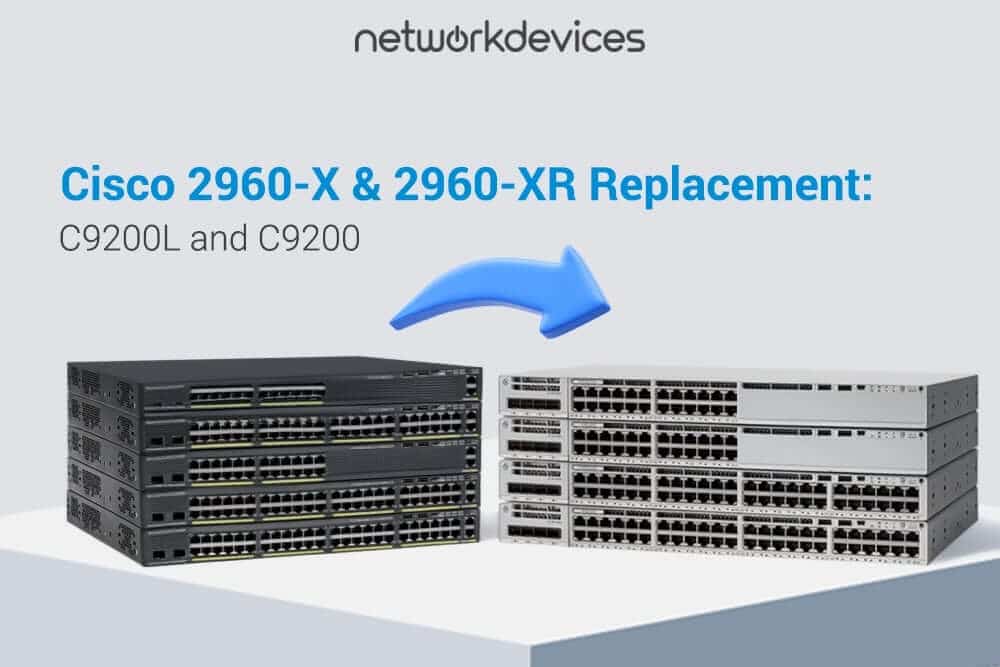

Cisco's documented replacement for the Cisco Catalyst 2960-X is the Catalyst 9200L, and the replacement for the Catalyst 2960-XR is the modular Catalyst 9200. Those are two different platforms, and most migration advice collapses them into "buy a 9200," which gets the 2960-XR path wrong.
The difference is not power redundancy. Both C9200L and C9200 support dual field-replaceable power supplies. The main architectural breaks are fixed versus modular uplinks and StackWise-80 versus StackWise-160. For SD-Access deployments, virtual-network scale is a further material difference: the C9200L is limited to one virtual network against four or more on the C9200.
Most of the 2960-X and 2960-XR population has a Last Date of Support of October 31, 2027. One SKU does not: the fanless WS-C2960X-24PSQ-L runs to April 30, 2028 but lost security support on April 29, 2026, which has already passed.
Table 1. Cisco 2960-X and 2960-XR replacement platforms at a glance
| Outgoing family | Last Date of Support | Cisco's replacement | Uplinks | Stack bandwidth | SD-Access virtual networks |
|---|---|---|---|---|---|
| Catalyst 2960-X | 31-Oct-27 | Catalyst 9200L | Fixed | StackWise-80, 80 Gbps | 1 (limited) |
| Catalyst 2960-XR | 31-Oct-27 | Catalyst 9200 | Modular | StackWise-160, 160 Gbps | 4, or 32 on PB SKUs |
| WS-C2960X-24PSQ-L (fanless) | 30-Apr-28 | C9200CX-12P-2X2G-E | Fixed | None | 16 |
Both platforms ship with one power supply and accept a second identical unit for redundancy or additional PoE, so power resiliency is not the deciding factor between them.
This guide covers the lifecycle milestones and what each one actually ends, how to identify your exact part number and license before ordering, the model-by-model replacement map for both families including required uplink modules, what genuinely changes when you move to Cisco IOS XE, the licensing and subscription rules that catch buyers out, whether you can stack old and new hardware together, a cutover sequence, the costs beyond the switch, and how to think about refurbished stock.
Every part number and date below is checked against the relevant Cisco end-of-life bulletin or the current Catalyst 9200 datasheet, linked at the point of the claim. We stage and ship these replacements, so the cutover notes reflect what we see go wrong in practice.
Lifecycle terms: what each Cisco milestone actually ends
Cisco publishes several milestones per product and they end different things. Five matter here.
End-of-Life Announcement Date is when Cisco published the bulletin. Nothing changes operationally; it starts the clock.
End-of-Sale Date is the last day the product could be ordered new through Cisco.
End of Software Maintenance Releases Date is when bug fixes stop. Cisco will no longer develop, repair, maintain, or test the product software after this date.
End of Vulnerability and Security Support is the last date Cisco Engineering may release a planned maintenance release or scheduled software remedy for a security vulnerability. It is a boundary on what Cisco may issue, not a commitment to continuous fixes until that date. This is the milestone that matters most for risk and audit conversations, and on the 2960-X and 2960-XR it falls on the same day as Last Date of Support. On the fanless SKU it does not.
Last Date of Support is the last day you can receive service under an active contract or warranty. After it, the product is obsolete: no TAC case, no RMA, no security fix.
Cisco 2960-X and 2960-XR end-of-life dates
The main 2960-X and 2960-XR families share identical milestones, published in EOL13603 and EOL13602, respectively.
Table 2. Lifecycle milestones for the main Cisco Catalyst 2960-X Series switches and 2960-XR family
| Milestone | Date |
|---|---|
| End-of-Life announcement | 31-Oct-20 |
| End-of-Sale | 31-Oct-22 |
| Last ship date | 30-Jan-23 |
| End of software maintenance releases | 31-Oct-23 |
| End of vulnerability and security support | 31-Oct-27 |
| Last Date of Support | 31-Oct-27 |
Routine software maintenance and bug-fix development ended October 31, 2023. Cisco may issue planned security remedies through October 31, 2027. The switch keeps forwarding traffic after that date. What ends is Cisco's obligation to fix it.
That leaves most organizations one more budget cycle. Standalone closets with no growth pressure are defensible candidates for a 2027 refresh. Stacked environments deserve earlier planning, because a later migration requires a full stack rebuild and new StackWise hardware rather than a unit swap, not because every stack must be replaced immediately. A stacked site with tested spares and a booked 2027 window is a reasonable plan.
The WS-C2960X-24PSQ-L is a lifecycle exception
The fanless WS-C2960X-24PSQ-L, a 24-port PoE model with a 110 W budget, was retired under its own bulletin, EOL14887, on a different schedule from the rest of the family.
Table 3. WS-C2960X-24PSQ-L lifecycle, per EOL14887
| Milestone | Date |
|---|---|
| End-of-Life announcement | 31-Oct-22 |
| End-of-Sale | 30-Apr-23 |
| End of software maintenance releases | 29-Apr-24 |
| End of vulnerability and security support | 29-Apr-26 |
| Last Date of Support | 30-Apr-28 |
Two consequences. Security support on this SKU ended on April 29, 2026, so a WS-C2960X-24PSQ-L in service today is already receiving no security remedies, roughly eighteen months before the rest of the 2960-X family reaches that point. And Cisco's documented replacement is not a 9200L at all: it is C9200CX-12P-2X2G-E, a compact 12-port PoE+ switch with a 240 W budget. Port count halves. A fully populated 24PSQ site therefore needs two independently managed C9200CX units or a different higher-port-density platform. The C9200CX does not support StackWise stacking, so two units are not a stack-equivalent replacement for one 24-port switch.
If you operate this SKU, it should be at the front of the refresh queue rather than grouped with the October 2027 population.
Identify your exact part number and license before you order
Cisco Catalyst 2960-X Series switches share port counts across several models and differ only in PoE budget or uplink type, so reading the front panel is how wrong orders happen. The part numbers we are asked to match most often are WS-C2960X-24TS-L, WS-C2960X-48TS-L and WS-C2960X-24PS-L, and the first two differ from WS-C2960X-24TD-L and WS-C2960X-48TD-L only in uplink type.
On the outgoing 2960-X or 2960-XR:
show versionreturns the model and software train. That model line is the part number you match below.show inventoryidentifies the chassis part numbers and serial numbers for the switch or each stack member. Do not rely on it alone to identify installed FlexStack hardware, which is not always called out in normal output.show switchreturns stack membership, roles and priorities. More than one member means the stack kit cost below applies. Where the exact stack accessory matters, combine this with the platform stack-status commands and physical verification of the rear module.show licenseright-to-use returns the license level on these IOS platforms.show powerinline returns actual PoE draw per port and in total.
On the replacement Catalyst 9200 or 9200L, the equivalent license command is show license summary, not show license right-to-use. The two are not interchangeable across the platforms.
The license line needs care, and there is a documented conflict worth knowing about. Cisco's 2960-X and 2960-XR family datasheet describes the 2960-XR as available with the IP Lite feature set, while the amended EOL13602 bulletin separately lists several WS-C2960XR PIDs ending in -L and describes them as LAN Base. Verify the exact part number and the active running configuration rather than assigning a feature level from the family name.
Do not send raw show inventory output to a vendor. The PID and model lines are all that is needed to match hardware; serial numbers are not.
Cisco 2960-X to Catalyst 9200L replacement map, model by model
The table below covers the standard WS-C2960X production part numbers used in US deployments. Regional, education, NAL and bundle-specific variants should be checked directly against EOL13603.
Table 4. Catalyst 2960-X to 9200L replacements documented in EOL13603
| Outgoing part number | Ports | PoE budget | Outgoing uplinks | Replacement | Replacement uplinks | Replacement PoE budget |
|---|---|---|---|---|---|---|
| WS-C2960X-24TS-L | 24 | None | 4 × 1G SFP | C9200L-24T-4G | 4 × 1G SFP | None |
| WS-C2960X-24TS-LL | 24 (LAN Lite) | None | 2 × 1G SFP | C9200L-24T-4G | 4 × 1G SFP | None |
| WS-C2960X-24TD-L | 24 | None | 2 × 10G SFP+ | C9200L-24T-4X | 4 × 1/10G SFP+ | None |
| WS-C2960X-24PS-L | 24 | 370 W | 4 × 1G SFP | C9200L-24P-4G | 4 × 1G SFP | 370 W, 740 W with second PSU |
| WS-C2960X-24PD-L | 24 | 370 W | 2 × 10G SFP+ | C9200L-24P-4X | 4 × 1/10G SFP+ | 370 W, 740 W with second PSU |
| WS-C2960X-48TS-L | 48 | None | 4 × 1G SFP | C9200L-48T-4G | 4 × 1G SFP | None |
| WS-C2960X-48TS-LL | 48 (LAN Lite) | None | 2 × 1G SFP | C9200L-48T-4G | 4 × 1G SFP | None |
| WS-C2960X-48TD-L | 48 | None | 2 × 10G SFP+ | C9200L-48T-4X | 4 × 1/10G SFP+ | None |
| WS-C2960X-48FPS-L | 48 | 740 W | 4 × 1G SFP | C9200L-48P-4G | 4 × 1G SFP | 740 W, 1440 W with second PSU |
| WS-C2960X-48FPD-L | 48 | 740 W | 2 × 10G SFP+ | C9200L-48P-4X | 4 × 1/10G SFP+ | 740 W, 1440 W with second PSU |
| WS-C2960X-48LPS-L | 48 | 370 W | 4 × 1G SFP | C9200L-48PL-4G | 4 × 1G SFP | 370 W partial, 740 W with second PSU |
| WS-C2960X-48LPD-L | 48 | 370 W | 2 × 10G SFP+ | C9200L-48PL-4X | 4 × 1/10G SFP+ | 370 W partial, 740 W with second PSU |
In sentence form, the pairings we are asked to confirm most often are WS-C2960X-24TS-L to C9200L-24T-4G, WS-C2960X-24PS-L to C9200L-24P-4G, WS-C2960X-24PD-L to C9200L-24P-4X, WS-C2960X-48TS-L to C9200L-48T-4G, and the two 740 W models, WS-C2960X-48FPS-L to C9200L-48P-4G and WS-C2960X-48FPD-L to C9200L-48P-4X.
Note that every 2960-X model with 10G uplinks had two of them, and the matching C9200L gives you four. That is a real gain and it is easy to miss when reading a bulletin that lists only the base replacement model.
Two exceptions sit outside this table. WS-C2960X-24PSQ-L has its own bulletin and maps to C9200CX-12P-2X2G-E, covered above. WS-C2960X-48PD-HC is listed in EOL13603 with no replacement product available, so it needs a requirements-led choice: match port count and measured PoE draw to the nearest C9200L SKU and confirm the uplink type separately.
Do not size PoE from the old switch's rating
The partial-PoE C9200L-48PL models carry 370 W on their default 600 W supply, rising to 740 W with a second compatible supply. The full-PoE C9200L-48P models carry 740 W on the default 1 kW supply, rising to 1440 W. The 370 W 2960-X models map to the partial SKUs on paper.
Decide between 48PL and 48P from show power inline against current endpoint demand plus planned access point and camera growth, not from the outgoing switch's original budget. A closet originally designed around a 370 W budget may have accumulated higher-power access points, cameras, phones and IoT endpoints since deployment.
Cisco 2960-XR to Catalyst 9200 replacement map, with uplink modules
EOL13602 maps every WS-C2960XR part number to a modular Catalyst 9200 base switch. Because the C9200 has modular uplinks, the base mapping alone does not preserve your existing uplink configuration. You select the network module separately, and if you skip that step, you receive a switch with no uplinks fitted.
Table 5. Catalyst 2960-XR to Catalyst 9200 replacements, with the network module needed to preserve uplink class
| Outgoing part number | Outgoing uplinks | Cisco replacement | Network module | Result |
|---|---|---|---|---|
| WS-C2960XR-24TS-I / -L | 4 × 1G SFP | C9200-24T | C9200-NM-4G | Preserves 1G uplink class |
| WS-C2960XR-24TD-I / -L | 2 × 10G SFP+ | C9200-24T | C9200-NM-4X | Preserves 10G, four ports instead of two |
| WS-C2960XR-24PS-I / -L | 4 × 1G SFP | C9200-24P | C9200-NM-4G | Preserves 1G uplink class |
| WS-C2960XR-24PD-I / -L | 2 × 10G SFP+ | C9200-24P | C9200-NM-4X | Preserves 10G, four ports instead of two |
| WS-C2960XR-48TS-I / -L | 4 × 1G SFP | C9200-48T | C9200-NM-4G | Preserves 1G uplink class |
| WS-C2960XR-48TD-I / -L | 2 × 10G SFP+ | C9200-48T | C9200-NM-4X | Preserves 10G, four ports instead of two |
| WS-C2960XR-48FPS-I / -L | 4 × 1G SFP | C9200-48P | C9200-NM-4G | Preserves 1G uplink class |
| WS-C2960XR-48FPD-I / -L | 2 × 10G SFP+ | C9200-48P | C9200-NM-4X | Preserves 10G, four ports instead of two |
| WS-C2960XR-48LPS-I / -L | 4 × 1G SFP | C9200-48PL | C9200-NM-4G | Partial PoE, preserves 1G uplink class |
| WS-C2960XR-48LPD-I / -L | 2 × 10G SFP+ | C9200-48PL | C9200-NM-4X | Partial PoE, preserves 10G |
Modular uplinks mean you can change uplink class later without replacing the chassis, but only within the modules your model supports. Cisco's higher-speed modules, C9200-NM-2Y at 2 × 25G and C9200-NM-2Q at 2 × 40G, are supported only on C9200-24PXG and C9200-48PXG. They are not an upgrade path for the C9200-24T, 24P, 48T, 48P or 48PL models that Cisco maps from the 2960-XR. If a design assumes a future 25G uplink on a C9200-24T, that assumption is wrong.
What changes when you replace a Cisco 2960-X with Catalyst 9200L and IOS XE?
The move from Cisco IOS to IOS XE is the change with the widest operational consequences, and it is worth being precise about which gains are real rather than repeating a generic modernization list.
Programmability and telemetry. The new platform provides NETCONF and RESTCONF with YANG data models, plus model-driven streaming telemetry, at the Network Essentials tier. This is the substantive difference for anyone automating the access layer.
Flow visibility at higher scale. Catalyst 9200 and 9200L support up to 16,000 Flexible NetFlow entries on the 24-port and 48-port Gigabit models, and up to 32,000 on the C9200L multigigabit models. Full Flexible NetFlow is a Cisco Catalyst Software or DNA subscription feature rather than a perpetual Network tier feature.
Cold patching. The Catalyst 9200 Series supports cold patching with reboot, so critical bug and vulnerability fixes can be applied between maintenance releases.
Management choice. Catalyst 9200 Series switches support CLI and WebUI management, Cisco Catalyst Center on premises, and current Meraki dashboard cloud management. The Meraki cloud-management path is the operational choice that was not available on the 2960-X.
Segmentation, with a caveat on the 9200L. The C9200 supports four SD-Access virtual networks, or thirty-two on the C9200-24PB and C9200-48PB SKUs. The C9200L is limited to a single virtual network and is not supported as a Fabric Edge for SD-Access Wireless. If a fabric deployment is in the roadmap, that limit is the reason to specify C9200 rather than C9200L, and it is a stronger reason than anything on a spec-sheet feature list.
What you lose is more specific than most guides admit.
Your FlexStack hardware. Cisco lists C9200L-STACK-KIT as the replacement for C2960X-STACK, the FlexStack-Plus module, and for the FlexStack-Extended fiber and hybrid modules. FlexStack cables have no replacement listed.
Stack bandwidth, assuming 160 Gbps. The 9200L is StackWise-80 at 80 Gbps. StackWise-160 belongs to the modular C9200. Several third-party migration tables get this wrong.
Field-replaceable fans. On C9200 SKUs, the fan units are field-replaceable. On the fixed C9200L SKUs, they are not. Both platforms have dual fans and support fan redundancy.
Script and template compatibility. The new software is close enough to IOS to feel familiar and different enough to break golden configs, monitoring templates, and anything parsing command output.
What license does the Catalyst 9200L need when replacing a 2960-X?
This is where quotes stop matching expectations, so it is worth taking in four separate parts.
The hardware PID carries the tier. You order C9200L-24T-4G-E for Network Essentials or C9200L-24T-4G-A for Network Advantage. The base replacement model in Cisco's EOL bulletin, C9200L-24T-4G, has no suffix, which is why the part number on a quote will not match the bulletin exactly.
The perpetual Network tier is included with the hardware. Network Essentials covers Layer 2, static routing, Routed Access with RIP, EIGRP Stub and OSPF to 1000 routes, PBR, PIM Stub Multicast, private VLANs, VRRP, QoS, 802.1X, MACsec-128, CoPP, SXP, SSO, and the automation and telemetry features named above. Network Advantage adds full OSPF, EIGRP, HSRP, IS-IS, BSR, MSDP and IP SLA, plus the segmentation set of VRF, VXLAN, LISP and SGT.
A subscription is mandatory on new orders. Cisco's current datasheet states that for all new orders subscription licenses are mandatory and must be of the same tier as the network license. That means a Network Advantage switch requires an Advantage-tier Cisco Catalyst Software or Cisco DNA subscription, in a 3, 5 or 7 year term. Both base and add-on licenses are also available for a 90-day evaluation period, which cannot be reactivated after reload once expired.
Choose the tier from the running configuration, not from the old license label. Mapping LAN Base to Essentials and IP Lite to Advantage by analogy is the wrong method, because Network Essentials already includes more Layer 3 capability than LAN Base did. Read the active configuration, find the routing protocols and segmentation features actually in use, and match those against the Network tier feature set.
One stacking constraint follows from this. Cisco does not support a C9200 or C9200L stack containing mixed Network Essentials and Network Advantage license levels, so the tier decision applies to every member of a stack at once.
Can you stack a Cisco 2960-X with a Catalyst 9200L?
No. Stack-capable Catalyst 2960-X LAN Base models use FlexStack-Plus, while the 9200L uses StackWise-80, and the two are not interoperable. Cisco states that mixed stacking is not supported: you cannot stack C9200L with C9200 models, or with other Catalyst switches including the Cisco Catalyst 2960-X and 2960-XR Series. Note that the LAN Lite models WS-C2960X-24TS-LL and WS-C2960X-48TS-LL are not stackable at all, so a site running those has no stack dependency to migrate.
The consequence for planning is narrower than it first sounds. You cannot replace 2960-X members one at a time inside the existing FlexStack-Plus stack with C9200L members. You can still migrate closet by closet, or move ports in stages, using separate switching hardware. What is impossible is a mixed old and new physical stack, so the new stack gets built and validated alongside the old one, and the cutover happens as a unit.
How to migrate a 2960-X stack to Catalyst 9200L
A sequence that survives contact with a maintenance window:
1. Capture the current state: show version, show inventory, show switch, show power inline, running configuration, VLAN database, EtherChannel and STP root state, and the uplink optics in use.
2. Match each part number to its replacement and choose the uplink variant, using Table 4 above.
3. Select the Network tier from the running configuration, and order the matching subscription tier.
4. Validate every SFP and SFP+ part number against Cisco's transceiver compatibility information for the target platform and software release.
5. Stage every new switch to one agreed firmware release before it leaves the bench, so no member arrives on a different image.
6. Build the StackWise stack off-network, with one C9200L-STACK-KIT per member, and confirm ring state.
7. Preload and validate the configuration against the captured state.
8. Write rollback criteria and keep the outgoing stack on site until they are cleared.
9. Cut over uplinks first or as the topology requires, then access ports.
10. Validate VLANs, STP, EtherChannel, 802.1X, PoE delivery, routing and monitoring before decommissioning the old stack.
In our staging work, incompatible IOS XE versions between members are one of the stack-formation problems we routinely catch before equipment reaches the maintenance window. Cisco requires stack members to run compatible software versions, and catching that on a bench costs minutes rather than a window.
What does a 2960-X or 2960-XR migration cost beyond the switch?
Stack kits and cables. Each stack member needs its own C9200L-STACK-KIT, or C9200-STACK-KIT for a C9200 stack. Each kit contains two stack adapters and one 0.5 m STACK-T4-50CM cable. Order STACK-T4-1M or STACK-T4-3M separately where rack geometry requires them. A four-member stack needs four kits, not one.
Rack mount kits. EOL13603 lists RCKMNT-1RU-2KX= and RCKMNT-REC-2KX=, the 1RU and recessed kits for the 2960-X, 2960-XR and 2960-L, with no replacement product available. If your closets use the recessed variant, confirm the new platform's bracket before install day rather than discovering it on a ladder.
Power supplies. The existing 2960-XR supply modules are not reusable in a Catalyst 9200. Cisco's EOL bulletin lists no direct replacement PIDs for them, so the new supplies are selected as part of the configuration: the PWR-C6 series on C9200, the PWR-C5 series on C9200L. Add a second identical supply where you want redundancy or the higher PoE budget.
Uplink modules on C9200. A modular chassis with no network module has no uplinks. Budget C9200-NM-4G or C9200-NM-4X per switch.
Optics revalidation. Do not treat form factor and speed as proof of support. The optic part number must appear as supported for the target switch and software release; check it against Cisco's transceiver module compatibility matrix rather than assuming a 1G SFP is a 1G SFP.
Subscription term. A matching 3, 5 or 7 year software subscription is mandatory with a new C9200 or C9200L order, and it is a term-based software line item separate from the perpetual Network license. At expiration, renewal is required to keep the subscription capabilities; Cisco documents the alternative of deactivating the expired add-on and continuing with the base Network license capabilities after a reload.
When the 9200L is right, and when to go 9200 or Catalyst 9300
The 9200L fits a 2960-X refresh where uplink needs are settled at 1G or 10G, 80 Gbps of stack bandwidth is enough, and SD-Access is either absent from the roadmap or limited to a single virtual network.
Catalyst 9200 is the correct target for any 2960-XR, and for a 2960-X site that needs modular uplinks, StackWise-160, field-replaceable fans, or more than one SD-Access virtual network.
Modular-uplink Catalyst 9300 is the step up when the closet needs StackPower, StackWise-480, or uplinks that will move to 40G. Note that the 9300 family is not uniform: C9300L, C9300LM and C9300X have different stacking architectures, so the recommendation here means the modular-uplink C9300 specifically. If you are already standardized on it elsewhere, operational consistency may outweigh the unit cost difference. If you are not, the C9200L or C9200 is the honest answer.
Conclusion
Most of the Cisco 2960-X and 2960-XR population loses support on October 31, 2027, which makes this a planning problem rather than an emergency. The exception is the fanless WS-C2960X-24PSQ-L, which is already past its security-support date and should move first.
The mapping is documented: 2960-X part numbers go to the 9200L, 2960-XR part numbers go to the modular Catalyst 9200, and the 24PSQ goes to C9200CX. The architectural break between 9200L and 9200 is fixed versus modular uplinks, StackWise-80 versus StackWise-160, and SD-Access virtual network scale. It is not power redundancy: both accept a second field-replaceable supply.
Budget the parts that are easy to leave off a quote. Stack kits are per member, rack mount kits have no successor, 2960-XR power supplies are not reusable, a modular C9200 needs a network module to have uplinks at all, and the subscription is recurring.
FAQs
1. Is the Cisco 2960-X end-of-life?
Yes. For the main family, Cisco announced end-of-life on October 31, 2020, End-of-Sale was October 31, 2022, and the Last Date of Support is October 31, 2027. The 2960-XR shares those dates. The fanless WS-C2960X-24PSQ-L is separate: Last Date of Support is April 30, 2028, and its security support ended April 29, 2026.
2. What is the successor to the Cisco 2960-X?
The Catalyst 9200L, named model by model in EOL13603. The 2960-XR maps to the modular Catalyst 9200 instead, and the fanless WS-C2960X-24PSQ-L maps to C9200CX-12P-2X2G-E.
3. What is the difference between the 2960-X and the 2960-XR?
Cisco maps the 2960-X to the fixed-uplink Catalyst 9200L and the 2960-XR to the modular Catalyst 9200. Cisco's family datasheet describes the 2960-XR with the IP Lite feature set, while the amended EOL13602 bulletin lists certain -L XR part numbers as LAN Base, so verify the specific PID rather than assuming from the family name.
4. What are the alternatives to the Cisco 2960-X switch?
Catalyst 9200L for a like-for-like refresh, Catalyst 9200 where modular uplinks, StackWise-160 or more SD-Access virtual networks are needed, C9200CX for compact and fanless deployments, and modular-uplink Cisco Catalyst 9300 where StackPower, StackWise-480 or 40G uplinks are required.
5. Does the Catalyst 9200L require a subscription?
Yes, at the point of order. The perpetual Network Essentials or Network Advantage license is included with the hardware, but Cisco's current datasheet states that subscription licenses are mandatory on all new orders and must match the network license tier. When the term expires the switch does not stop working: Cisco documents renewing the add-on, or deactivating it and reloading to continue with the base Network license capabilities. A 90-day evaluation period is available for base and add-on licenses.