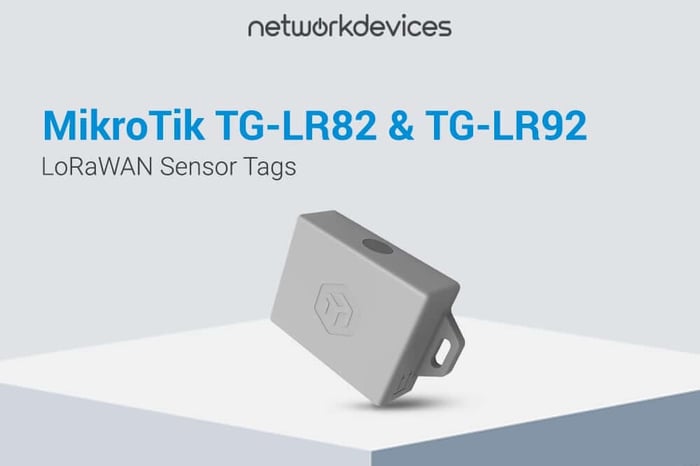

The MikroTik TG-LR82 and TG-LR92 are two new configurable LoRaWAN sensor tags that measure temperature, humidity, and motion, then report that data over long distances to a MikroTik gateway. They are the same device in two regional versions: the TG-LR82 operates on the 868 MHz band in Europe, and the TG-LR92 operates on the 915 MHz band in North America. Both also support 2.4 GHz LoRa, which works globally without regional frequency restrictions.
If you remember only one thing, remember this: choosing between the TG-LR82 and the TG-LR92 is almost entirely a regional-frequency decision, not a feature decision. Buy the TG-LR82 if you deploy in the EU and pair it with MikroTik LR8 gateways. Buy the TG-LR92 if you deploy in North America and pair it with MikroTik LR9 gateways. The sensors, battery, enclosure, and accuracy are identical.
These tags are built for deployments where you need accurate environmental data without the cost or power demands of industrial sensors: cold-chain logistics, warehouse inventory, asset tracking, smart buildings, and construction sites. Each tag carries a NIST-traceable temperature sensor accurate to ±0.2°C, an IP67-rated enclosure, and a battery rated for up to about five years depending on configuration. That mix of accuracy, durability, and battery life is what makes them worth a close look.
This article explains what the TG-LR82 and TG-LR92 do, how they differ, and where they fit. We cover the verified specifications, the regional frequency and gateway compatibility that drives the buying decision, the on-device automation, and the deployments these tags are built for. A side-by-side comparison table and an FAQ at the end answer the specific questions buyers ask before they order.
What are the MikroTik TG-LR82 and TG-LR92?
The TG-LR82 and TG-LR92 are battery-powered LoRaWAN sensor tags built around the LR1120 transceiver and certified to LoRaWAN 1.0.4, operating as Class A or Class B nodes. Each tag combines temperature, humidity, and an accelerometer to measure motion, tilt, impact, and orientation in a compact 76 × 45 × 19 mm enclosure.
LoRaWAN is a low-power, long-range wireless protocol designed to transmit small amounts of sensor data over distances of kilometers rather than meters. A Class A node listens only briefly after transmitting, which maximizes battery life, whereas a Class B node adds scheduled receive windows so the gateway can reach it more predictably. Both tags support both classes, and MikroTik RouterOS gateways with LR8G and LR9G cards now support Class B devices.
TG-LR82 vs TG-LR92: which frequency do you need?
The core difference is the sub-GHz frequency band, and it's dictated by where you operate. The TG-LR82 uses the 868 MHz band and is certified for the EU868 region (CE, EAC, RoHS), while the TG-LR92 uses the 915 MHz band and is certified for the US915 region (FCC, IC). These bands are legally regional, so you cannot swap one for the other without violating local radio regulations.
Both tags additionally support 2.4 GHz LoRa, which carries no regional frequency restrictions and can be used worldwide. This is the one case where the choice loosens: for international or moving assets, the 2.4 GHz band lets a single tag operate across regions without switching hardware.
Gateway compatibility and range
A sensor tag needs a LoRaWAN gateway to receive its uplinks. The TG-LR82 pairs with MikroTik LR8 gateways, including the KNOT LR8G kit (868 MHz) and the wAP LR8G kit. The TG-LR92 pairs with MikroTik LR9 gateways, including the KNOT LR9G kit (915 MHz) and the wAP LR9G kit. Either tag can use a 2.4 GHz gateway such as the wAP LR2 kit for the global band.
The naming convention makes matching easy: the "8" means 800 MHz, the "9" means 900 MHz, and the "2" means 2.4 GHz support. A TG-LR82 talks to an LR8 gateway; a TG-LR92 talks to an LR9 gateway.
Range depends heavily on the gateway antenna, line of sight, and environment, so treat all figures as conditional. On the sub-GHz bands, MikroTik cites best-case ranges up to roughly 15 km in ideal line-of-sight conditions; the 2.4 GHz datasheet figure is around 1.5 km. Sub-GHz gives the longest reach for fixed, wide-area deployments, while 2.4 GHz trades range for global frequency flexibility.
Temperature, humidity, and motion sensing
The temperature sensor is the standout. Both tags use a NIST-traceable TMP116N sensor rated at ±0.2°C typical accuracy (±0.3°C maximum) across -25°C to +85°C, which is high accuracy for a device this size and the reason these tags suit temperature-sensitive goods. The humidity sensor measures the full 0–100% relative humidity range.
The accelerometer reports tilt, orientation, impact against any axis, a pre-fall state, and vibration, covering asset-handling and shock-monitoring scenarios as well as basic activity tracking. An integrated magnetic reed switch adds event logic: place a magnet on a door, lid, or cabinet, and the tag can detect open and close events, count openings, or switch its reporting behavior based on magnet state.
On-device automation: profiles and event rules
These tags process data locally rather than relying on backend logic, which is what keeps them efficient. Each tag stores six configurable profile presets and can compute averages, exponential moving averages, and histograms before transmitting, reducing network traffic while preserving detail.
Data rules are the automation core: a condition such as a temperature or humidity threshold, an impact, or a magnetic-switch trigger fires an action such as switching profiles, sending an uplink, or logging an event. A typical pattern: a door tag reports every six hours while idle, then switches profiles and reports every five minutes once the door opens, with no server-side rule engine involved.
Configuration and monitoring
Like any LoRaWAN node, these tags are configured through downlink messages from the network server. You generate the configuration payloads with a dedicated tool or through a platform such as The Things Network (TTN), and a few basic settings can also be changed in the field with the magnetic switch.
For visualization, sensor data works with standard platforms such as Grafana. Because MikroTik RouterOS supports containers, you can deploy a Grafana dashboard directly on the gateway to surface temperature and humidity trends, orientation and activity states, environmental histograms, and operational health like battery status and signal strength.
Where these sensor tags fit
The combination of accuracy, IP67 sealing, and long battery life points to a clear set of use cases. Cold-chain logistics and warehouse inventory benefit from the precise temperature sensor and event-based reporting, while construction sites, agricultural assets, and smart buildings benefit from the long range and rugged enclosure.
The reed switch and accelerometer extend the tags into asset and access scenarios: door and lid monitoring, equipment activity tracking, and impact or free-fall detection during handling. For moving assets, the 2.4 GHz global band is the differentiator, since a container shipped across regions can keep reporting without swapping to a different regional tag mid-transit.
TG-LR82 vs TG-LR92: full specification comparison
| Specification | TG-LR82 | TG-LR92 |
|---|---|---|
| Target region | EU (EU868) | North America (US915) |
| Sub-GHz LoRa band | 868 MHz | 915 MHz |
| Additional band | 2.4 GHz | 2.4 GHz |
| LoRa transceiver | LR1120 | LR1120 |
| LoRaWAN protocol | 1.0.4, Class A & B | 1.0.4, Class A & B |
| Adaptive Data Rate (ADR) | Yes | Yes |
| Compatible gateways | MikroTik LR8 (KNOT LR8G, wAP LR8G, wAP LR2) | MikroTik LR9 (KNOT LR9G, wAP LR9G, wAP LR2) |
| TX power (sub-GHz / 2.4 GHz) | 10.5 dBm / 13 dBm | 10.5 dBm / 13 dBm |
| RX sensitivity (sub-GHz) | -141 dBm (125 kHz, SF12) | -141 dBm (125 kHz, SF12) |
| RX sensitivity (2.4 GHz) | -130 dBm (812 kHz, SF12) | -130 dBm (812 kHz, SF12) |
| Antenna gain (sub-GHz / 2.4 GHz) | -4 dBi / 2 dBi | -4 dBi / 2 dBi |
| Sensors | Temperature, humidity, accelerometer | Temperature, humidity, accelerometer |
| Temperature sensor | NIST-traceable TMP116N | NIST-traceable TMP116N |
| Temperature accuracy | ±0.2°C typ (±0.3°C max), -25°C to +85°C | ±0.2°C typ (±0.3°C max), -25°C to +85°C |
| Humidity range | 0–100% RH | 0–100% RH |
| Magnetic reed switch | Yes | Yes |
| Config profile presets | 6 | 6 |
| Dimensions | 76 × 45 × 19 mm | 76 × 45 × 19 mm |
| Battery | 1100 mAh LiMnO₂, non-replaceable | 1100 mAh LiMnO₂, non-replaceable |
| Expected battery life | Up to ~5 years (config-dependent) | Up to ~5 years (config-dependent) |
| Enclosure rating | IP67 | IP67 |
| Operating temperature | -10°C to +70°C | -10°C to +70°C |
| MTBF | ~100,000 h at 25°C | ~100,000 h at 25°C |
| Certifications | CE, EAC, RoHS | FCC, IC |
Which one should you buy?
If you deploy in Europe or another EU868 region, buy the TG-LR82 and pair it with MikroTik LR8 gateways. If you deploy in the United States, Canada, or another US915 region, buy the TG-LR92 and pair it with MikroTik LR9 gateways. For international or in-transit assets that cross regions, plan around the 2.4 GHz band and a 2.4 GHz gateway such as the wAP LR2 kit.
FAQs
1. What is the difference between the MikroTik TG-LR82 and TG-LR92?
The TG-LR82 operates on the 868 MHz band for Europe (EU868), and the TG-LR92 operates on the 915 MHz band for North America (US915). All other specifications, including sensors, battery, and enclosure, are identical.
2. Is the TG-LR82 a gateway or a sensor?
It is a sensor tag, not a gateway. It measures temperature, humidity, and motion and sends that data to a separate MikroTik LoRaWAN gateway, such as a KNOT or wAP LR8G/LR9G kit.
3. Which MikroTik gateways work with these sensor tags?
The TG-LR82 works with MikroTik LR8 gateways, and the TG-LR92 works with MikroTik LR9 gateways. Both can use a 2.4 GHz gateway like the wAP LR2 kit for the global 2.4 GHz band.
4. Can these tags be used worldwide?
The sub-GHz bands are region-locked (868 MHz for the EU, 915 MHz for North America), but both tags also support 2.4 GHz LoRa, which has no regional frequency restrictions and works globally, including for moving assets such as international shipments.