
Short Answer
If your branches already run PA-400 firewalls, do not replace healthy units just because the PA-500 Series is newer. Use the PA-500 for new or redesigned sites where it solves a specific problem: more Threat Prevention capacity than a PA-460 offers, SFP+ or multigigabit interfaces, a larger 802.3bt PoE budget, or consolidation of a separate switch or cellular router.
Two facts shape the decision more than the family name does. First, the lower PA-500 models do not outperform the upper PA-400 models: a PA-460 is rated at 3.0 Gbps Threat Prevention, while the PA-520 is rated at 1.8 Gbps and the PA-540 at 2.2 Gbps. Second, the PA-410, PA-415 and PA-415-5G are not listed for PAN-OS 12.2 in the compatibility matrix, so those three models currently have a more limited PAN-OS upgrade path than the rest of the PA-400 family.
Not to be confused with the original Palo Alto PA-500, a single legacy appliance that reached end-of-sale on October 31, 2018 and end-of-life on October 31, 2023. This article covers the PA-500 Series introduced in 2025.
Introduction
For organizations already running PA-400 Series firewalls, the PA-500 Series raises a standardization question: should the newer platform replace the existing branch standard, or should it be introduced only where its additional capabilities address a specific requirement?
This is a broader question than which family has higher throughput. The firewall standard affects hardware spares, support contracts, PAN-OS versions, Panorama templates, deployment procedures, power, cabling and field replacements.
Our conclusion: keep healthy PA-400 firewalls where they meet current and expected requirements. Evaluate the PA-500 first for new or redesigned branches, but select it only where its capabilities materially improve the design.
PA-400 and PA-500: Different Generations, Similar Branch Mission
Both are Palo Alto Networks next-generation firewalls (NGFWs) designed for branch and distributed deployments; Palo Alto positions the PA-500 Series for branches, retail sites and midsize organizations. The comparison therefore starts with considerable overlap. Both run PAN-OS and support Zero Touch Provisioning (ZTP), active/passive and active/active high availability at the series level, and centralized management. The core security function is the same. The differences are in the hardware.
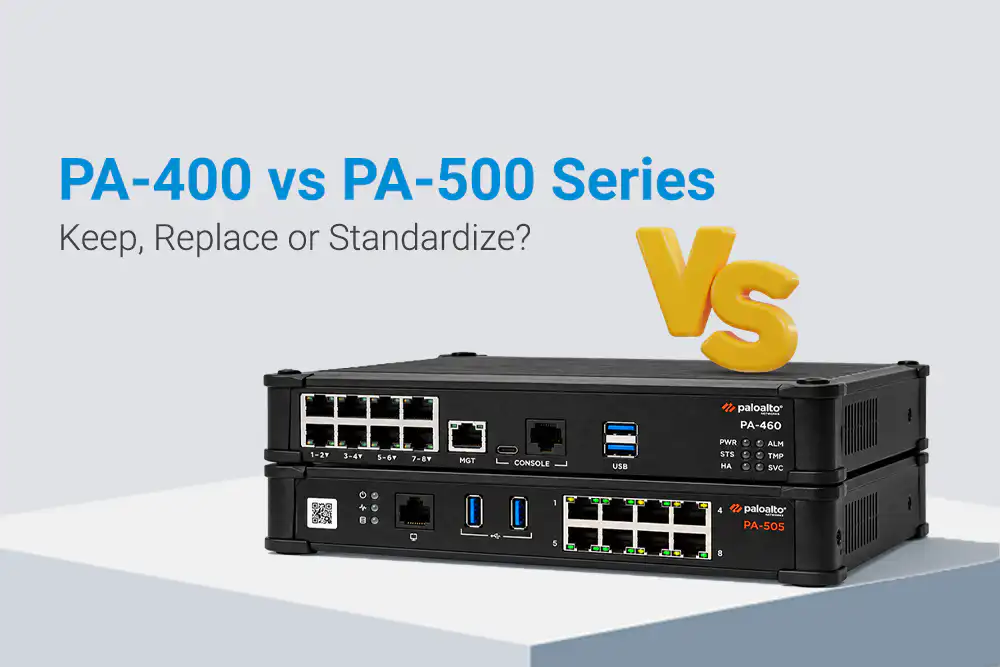
The PA-400 Series includes the PA-410, PA-415, PA-415-5G, PA-440, PA-445, PA-450, PA-455, PA-455-5G and PA-460. Palo Alto also sells a separate ruggedized PA-400R Series (including the PA-450R), which is outside the scope of this article.
The PA-500 Series includes the PA-501, PA-505, PA-510, PA-520, PA-520-5G, PA-540, PA-545-POE, PA-550, PA-555-POE and PA-560.
The PA-500 models did not all arrive at the same time. The dates below are the months in which each model first appears in the PAN-OS 12.1 release notes, not general-availability dates; Palo Alto announced the original models in August 2025.
| PA-500 models | Minimum PAN-OS | First listed in PAN-OS release notes |
|---|---|---|
| PA-520, PA-540, PA-545-POE, PA-550, PA-555-POE, PA-560 | 12.1.2 | Aug-25 |
| PA-505, PA-510 | 12.1.3 | Sep-25 |
| PA-501 | 12.1.4-h2 | Feb-26 |
| PA-520-5G | 12.1.10 | Sep-26 |
Evaluate the PA-500 as a growing family. Because the PA-520-5G was introduced in PAN-OS 12.1.10 in September 2026, organizations considering it as a standard should validate it in their environment before broad deployment.
At a Glance
| PA-400 Series | PA-500 Series | |
|---|---|---|
| Threat Prevention range | 0.8 to 3.0 Gbps | 0.5 to 6.0 Gbps |
| Firewall (App-ID) range | 1.4 to 4.2 Gbps | 0.8 to 8.5 Gbps |
| Data interfaces | Model-dependent 1G RJ-45 and SFP/RJ-45 combo interfaces; no SFP+ or multigigabit | Model-dependent 1G RJ-45 on all models; SFP, 1G/2.5G multigigabit and SFP+ on higher models (up to 24 data ports on PA-560) |
| Integrated PoE | 4 ports, 91W total (151W on PA-455-5G), 60W per port max | 4 ports and 181W (PA-545-POE); 8 ports and 330 to 332W (PA-555-POE); 802.3bt, 90W per port max |
| Integrated 5G | PA-415-5G, PA-455-5G | PA-520-5G |
| Local storage | 64GB eMMC (PA-410), 128GB eMMC (others) | 120GB, 128GB or 240GB depending on model |
| Cooling | Fanless except PA-455-5G | Fanless except PA-560 |
| Form factor | Chassis dimensions and mounting options vary by model | 1U height; chassis width and mounting kits vary by model |
| Minimum PAN-OS | 10.1.0 to 11.2.3 depending on model | 12.1.2 to 12.1.10 depending on model |
| Latest PAN-OS support | 12.2 for most models; 12.1 for PA-410, PA-415, PA-415-5G | 12.2 for all models |
Model Positioning: Focus on the Requirement Instead of the Family Name
The first mistake in a PA-400 vs PA-500 comparison is assuming every PA-500 model outperforms every PA-400 model. It does not. The PA-501 offers seven 1G RJ-45 ports and 0.5 Gbps of Threat Prevention, which is less than the PA-410 (seven ports, 0.8 Gbps). The PA-505 and PA-510 are rated at 0.8 Gbps and 1.2 Gbps. These models target small branch and retail sites, not high-capacity deployments.
The differences become significant at the top of the range. The PA-560 is rated at 6.0 Gbps of Threat Prevention and has 24 data ports.
The right procurement process is to start with branch requirements, then select the smallest model that provides enough headroom. Do not standardize on the PA-560 because it is the fastest model. Standardize on the model that provides enough performance, interfaces, storage, connectivity and lifecycle headroom without unnecessarily increasing acquisition and operating costs.
Performance: When More Throughput Actually Matters
For branches running security services, raw firewall throughput should not be the primary sizing metric. Threat Prevention throughput is a more relevant reference because it reflects inspected traffic under Palo Alto's documented test profile, with App-ID, IPS, antivirus, antispyware, WildFire, file blocking, and logging enabled.
One caveat when comparing the two families: the datasheet test profiles are not identical. As published at the time of review, the PA-400 Threat Prevention figure includes DNS Security in the test profile, and the PA-500 figure does not. Do not treat small cross-family differences as decisive; size with adequate operational margin.
| Model | Threat Prevention | Firewall (App-ID) | IPsec VPN | Max sessions |
|---|---|---|---|---|
| PA-410 | 0.8 Gbps | 1.4 Gbps | 0.5 Gbps | 64,000 |
| PA-415 / PA-415-5G | 0.8 Gbps | 1.5 Gbps | 0.5 Gbps | 64,000 |
| PA-440 | 1.2 Gbps | 2.4 Gbps | 1.1 Gbps | 200,000 |
| PA-445 | 1.25 Gbps | 2.7 Gbps | 1.1 Gbps | 200,000 |
| PA-450 | 2.1 Gbps | 3.3 Gbps | 1.7 Gbps | 300,000 |
| PA-455 | 2.3 Gbps | 3.6 Gbps | 1.8 Gbps | 300,000 |
| PA-455-5G | 1.8 Gbps | 3.2 Gbps | 1.6 Gbps | 300,000 |
| PA-460 | 3.0 Gbps | 4.2 Gbps | 2.3 Gbps | 400,000 |
| PA-501 | 0.5 Gbps | 0.8 Gbps | 0.24 Gbps | 30,000 |
| PA-505 | 0.8 Gbps | 1.2 Gbps | 0.4 Gbps | 64,000 |
| PA-510 | 1.2 Gbps | 1.8 Gbps | 0.8 Gbps | 98,000 |
| PA-520 | 1.8 Gbps | 2.8 Gbps | 1.5 Gbps | 148,000 |
| PA-520-5G | 1.5 Gbps | 2.6 Gbps | 1.4 Gbps | 148,000 |
| PA-540 | 2.2 Gbps | 3.8 Gbps | 2.0 Gbps | 248,000 |
| PA-545-POE | 3.0 Gbps | 5.0 Gbps | 3.0 Gbps | 298,000 |
| PA-550 | 4.5 Gbps | 6.5 Gbps | 4.0 Gbps | 398,000 |
| PA-555-POE | 5.0 Gbps | 7.5 Gbps | 4.5 Gbps | 448,000 |
| PA-560 | 6.0 Gbps | 8.5 Gbps | 5.5 Gbps | 598,000 |
The table shows where the PA-500 actually adds capacity. Up to the PA-545-POE, the PA-500 models overlap the PA-400 range. The PA-550, PA-555-POE, and PA-560 are the first models that clearly exceed the PA-460.
Closest Performance Match and First Clear Step Up
| Current PA-400 | Closest PA-500 match by Threat Prevention | First clear performance step up |
|---|---|---|
| PA-410 / PA-415 (0.8 Gbps) | PA-505 (0.8 Gbps) | PA-510 (1.2 Gbps) |
| PA-440 / PA-445 (1.2 to 1.25 Gbps) | PA-510 (1.2 Gbps) | PA-520 (1.8 Gbps) |
| PA-450 (2.1 Gbps) | PA-540 (2.2 Gbps) | PA-545-POE (3.0 Gbps) |
| PA-455 (2.3 Gbps) | PA-540 (2.2 Gbps) | PA-545-POE (3.0 Gbps) |
| PA-460 (3.0 Gbps) | PA-545-POE (3.0 Gbps) | PA-550 (4.5 Gbps) |
This mapping is based on Threat Prevention only and is not a Palo Alto replacement recommendation. Interfaces, PoE, 5G, and power requirements can point to a different model.
When does performance justify PA-500?
When the current firewall nears its practical security-processing capacity, not simply because a replacement model has higher specifications. A branch running a PA-460 with sufficient headroom has no performance reason to migrate. A new branch expecting significantly more inspected traffic, more VPN traffic or heavier application use may justify a PA-550 or PA-560 from the start.
A practical sizing test: take peak throughput measured with the security profiles you actually run, add expected growth over the hardware's service life, and add operating headroom. If the result fits comfortably inside a PA-400 model's Threat Prevention rating, keep the PA-400. If it does not, the PA-500 is a rational upgrade.
Interface Density: A Hardware Decision, Not Just a Specification
Interface count can affect a deployment more than throughput does. It helps to know where the PA-500 actually adds ports:
- The PA-520 has eight 1G RJ-45 ports, the same count as the PA-440, PA-450 and PA-460. It does not add density.
- The PA-540 adds two 1G SFP ports.
- The PA-545-POE adds four 1G/2.5G multigigabit PoE ports and four 1G SFP ports.
- The PA-550 adds two 1G/10G SFP/SFP+ ports.
- The PA-560 has 16 1G RJ-45 ports, four 1G SFP ports and four 1G/10G SFP/SFP+ ports, for 24 data ports.
No PA-400 model offers SFP+ or multigigabit interfaces. The PA-440, PA-450, and PA-460 have no SFP ports at all; the PA-415, PA-445, PA-455, and PA-455-5G offer one or two SFP/RJ-45 combo ports.
To see why this matters, compare two branch designs. The first has two WAN links and a LAN trunk to an access switch; extra firewall ports add little. The second has multiple WAN circuits, fiber uplinks, separate network segments, and devices that need direct firewall connections. In the second case, additional interfaces can remove the need for another switch or an interface expansion layer.
If additional ports remove another device, reduce cabling, or simplify the physical design, they can justify the newer platform. If the branch already has a simple switched architecture, they may provide no meaningful benefit.
5G: Integrate It When Cellular Is a Core Requirement
The PA-400 Series already offers integrated 5G on the PA-415-5G and PA-455-5G, so 5G alone does not justify replacing a PA-400. The PA-500 Series adds the PA-520-5G, supported from PAN-OS 12.1.10.
For standard offices with dependable fiber or Ethernet WAN, integrated 5G adds little. For temporary sites, retail outlets, construction offices, remote facilities, backup-WAN designs, or locations without stable wired connectivity, it can remove extra devices. Instead of a firewall, a cellular router, a separate power adapter, and additional cabling, the cellular connection is part of the firewall.
Compare the two 5G options in the details. The PA-455-5G is rated at 1.8 Gbps Threat Prevention and provides a 151W PoE budget. The PA-520-5G is rated at 1.5 Gbps in the release notes (1.6 Gbps in the datasheet) and has no PoE. For a 5G site where integrated PoE is also a requirement, the PA-455-5G may be the more practical fit because the PA-520-5G does not provide PoE.
If cellular WAN is a core requirement for new branches, both families deserve consideration. If it is not, 5G should not drive the standardization decision.
Local Storage and Logging: Don't Pay for Capacity You Don't Need
The PA-400 Series provides 64GB of eMMC storage on the PA-410 and 128GB of eMMC on the other models. PA-500 storage varies by model: 128GB on the PA-501, PA-505 and PA-510, 120GB on the PA-520, PA-540, PA-545-POE, PA-550 and PA-555-POE, and 240GB on the PA-560. Palo Alto's current sources disagree on the PA-520-5G: the hardware reference lists 128GB while the datasheet lists 120GB. Verify the current specification before using local storage capacity as a purchasing criterion.
More storage does not automatically mean a better branch design. If logs already go to Panorama, a centralized logging service or a SIEM, local storage is mainly a buffer. If a branch must retain more logs locally because WAN connectivity is intermittent or centralized logging is unavailable, storage becomes more important.
Storage should justify a PA-500 upgrade only when local logging needs exceed what the current PA-400 design supports. Organizations with established centralized logging should rarely need to migrate a fleet for storage alone.
High Availability and Power Redundancy
Both families support active/passive and active/active high availability at the series level, so HA does not automatically favor the PA-500. Neither family has dedicated HA ports; HA links use data interfaces, which matters when counting ports on smaller models.
The real difference is power:
• PA-400: every model except the PA-410 supports a second power adapter for load sharing and redundancy.
• PA-501 and PA-505: single power adapter only, per the model-specific electrical specifications. The family overview currently lists only the PA-505 as the exception, so confirm PA-501 power options before purchase.
• PA-510, PA-520, PA-540, PA-550 and PA-560: optional second adapter for load sharing and redundancy.
• PA-520-5G: optional second adapter for redundancy; the two inputs do not load-share.
• PA-545-POE and PA-555-POE: a second power supply can be added for redundancy.
Organizations should specify the exact model and power configuration in the standard rather than listing "dual power" as a family feature. Availability planning must include power, not just firewall HA.
Physical Design: Form Factor and Cooling
All PA-500 models are 1U-height appliances, although chassis width varies substantially by model. Every model except the PA-560 is passively cooled. The PA-560 uses two fans and is rated at up to 62 dBA. In the PA-400 Series, every model except the PA-455-5G is fanless.
PA-400 chassis dimensions and mounting options vary by model; PA-500 models are 1U-height with model-specific rack-mount and wall-mount options. Check the appropriate mounting kit for the exact model when standardizing.
Cooling matters for retail counters, offices, and wall-mounted installations where noise and dust are concerns. If a site needs PA-560 capacity but has no equipment room, plan the location accordingly.
ZTP and Branch Deployment
ZTP matters most for organizations deploying many geographically dispersed firewalls with minimal specialist involvement at each site. Palo Alto's Strata Cloud Manager documentation lists both PA-400 and PA-500 models as ZTP-supported, without the separate ZTP SKUs older platforms required. ZTP through Strata Cloud Manager requires a Strata Cloud Manager Essentials or Pro subscription and a claim key; confirm the equivalent requirements if you provision through Panorama.
Because both families support ZTP, organizations can keep the same general zero-touch deployment model, although onboarding requirements depend on whether provisioning is done through Strata Cloud Manager or Panorama. A mixed fleet can keep the existing PA-400 process while adding PA-500 units for new branches.
The real advantage appears when the PA-500 reduces the number of devices at a site. A PA-555-POE can combine firewall and PoE switching for a small site, and a PA-520-5G combines firewall and cellular WAN. ZTP then provisions a simpler physical setup, not just a newer firewall.
Post-Quantum Cryptography: Not a Reason to Migrate on Its Own
Palo Alto's quantum terminology is not fully consistent across its own materials. The PA-500 datasheet listing describes the series as "quantum-optimized." Palo Alto's quantum feature support documentation classifies both PA-400 and PA-500 firewalls as "Quantum-Ready," reserves the "Quantum-Optimized" label for the PA-5500 Series, and ties post-quantum decryption and cipher translation to PAN-OS 12.1 rather than to PA-500 hardware. The PA-400 datasheet also describes the PA-400 as PQC-ready with PAN-OS 12.1.
For planning purposes, use the quantum feature support matrix rather than the marketing label. Post-quantum readiness depends on running PAN-OS 12.1 or later, which every PA-400 model supports, so it is not by itself a reason to replace PA-400 hardware.
Licensing: Hardware Is Only Part of the Cost
Palo Alto's Cloud-Delivered Security Services, such as Advanced Threat Prevention, Advanced URL Filtering, Advanced WildFire and Advanced DNS Security, apply whichever family the branch uses. If subscription requirements stay the same, a hardware refresh does not reduce recurring security-service spend; it adds a capital expense.
The business case is strongest when the PA-500 changes the branch architecture, for example by removing a PoE switch or a cellular router. A higher firewall cost can then be offset by fewer network devices and simpler deployment. Without that, be cautious about replacing working PA-400 hardware.
Panorama and the Mixed PA-400/PA-500 Estate
A mixed estate is practical. Panorama can manage both families, and Palo Alto lists the CLI, web interface, Panorama and Strata Cloud Manager as PA-500 management options. Panorama must run a PAN-OS release that supports the specific PA-500 models it manages; confirm the minimum Panorama version against the Panorama release notes before the first PA-500 ships.
The key is configuration structure. Centralize common policies, security profiles and controls, and keep hardware-specific settings such as PoE, 5G and interface layouts in separate templates. A Panorama design that separates security policy from hardware configuration makes a mixed PA-400/PA-500 estate manageable. For many organizations, the additional template and software-management overhead will be smaller than the cost and disruption of a fleet-wide hardware refresh.
Migration: When Should an Existing PA-400 Be Replaced?
The most reliable standardization rule is to require documented justification before replacing an existing PA-400 with a PA-500.
Acceptable reasons include:
- Sustained performance pressure beyond the current model's Threat Prevention rating
- Insufficient session capacity or VPN throughput
- Insufficient interface density
- A need for SFP+ or multigigabit interfaces
- A need for integrated PoE, or more PoE budget than the PA-400 provides
- A need for integrated 5G that the current model lacks
- New local logging requirements
- A branch redesign where the PA-500 eliminates another network device
- Lifecycle or software support requirements, such as a PA-410, PA-415 or PA-415-5G that must move beyond PAN-OS 12.1
Weak reasons include:
- The PA-500 is newer
- The PA-500 has higher throughput on paper, when the branch does not need it
- A preference for every branch to run the newest hardware
- The PA-400 is several years old, without an actual lifecycle requirement
- Post-quantum readiness, which depends on PAN-OS 12.1 rather than the hardware generation
A standardization effort should simplify operations. It should not be a hardware refresh project that makes the inventory look newer.
PA-400 to PA-500 Standardization and Migration Matrix
| Deployment requirement | Recommendation | Why |
|---|---|---|
| Existing PA-400 has adequate capacity | Keep PA-400 | No technical justification for migration |
| Existing PA-400 has sufficient interfaces | Keep PA-400 | PA-500 adds little practical value |
| Branch needs more Threat Prevention than a PA-460 (3.0 Gbps) | PA-550, PA-555-POE or PA-560 | Only these models clearly exceed the PA-400 range |
| Branch needs many physical interfaces | Consider PA-545-POE, PA-550 or PA-560 | Higher-density models can simplify topology |
| Branch requires SFP+ or multiple fiber connections | Consider PA-550, PA-555-POE or PA-560 | No PA-400 model has SFP+ |
| Branch needs basic PoE (4 ports, up to 91W) | PA-400 may be sufficient | PA-415, PA-445 and PA-455 already cover this |
| Branch needs more PoE budget or multigigabit PoE | PA-545-POE or PA-555-POE | Larger 802.3bt budgets and 2.5G PoE ports |
| Branch needs integrated 5G | Either family | PA-455-5G adds PoE and higher Threat Prevention; PA-520-5G was introduced in September 2026 |
| New branch designed from scratch | Evaluate both families; prefer PA-500 when requirements, operational standardization and software roadmap are otherwise equivalent | Newer platform generation, without forcing unnecessary capacity |
| Existing branch already works well | Keep PA-400 | Migration adds cost without solving a problem |
| Existing branch requires a new PoE switch anyway | Evaluate PA-500 PoE models | May reduce total device count |
| Existing branch requires a separate cellular router | Evaluate a 5G model from either family | May consolidate WAN hardware |
| Centralized Panorama management | Mixed estate is acceptable | Both families can be centrally managed |
| Maximum spare-inventory simplicity | Keep the current family for the installed base | Avoid an unnecessary second hardware family |
| PA-410, PA-415 or PA-415-5G needs PAN-OS 12.2 or later | Evaluate replacement or redesign the software baseline | These models are not currently listed for PAN-OS 12.2 |
| Hardware replacement required for lifecycle or support reasons | Evaluate PA-500 first | Opportunity to move the site to the newer platform |
When PA-400 Remains the More Practical Choice
The PA-400 remains a suitable choice for many current branches. If the firewall's performance, interfaces, WAN design and centralized logging meet requirements, and no additional PoE or 5G capability is needed, replacing the appliance offers limited operational benefit. The upper PA-400 models also match or exceed the PA-520 and PA-540 on Threat Prevention.
The installed PA-400 fleet also represents investment in spare units, power adapters, cabling, mounting hardware, configuration templates, operational expertise and support processes. For organizations running hundreds of PA-400 firewalls, keeping functional units and adding PA-500 models incrementally is more practical than a complete hardware overhaul.
When PA-500 Should Become the New Branch Standard
The PA-500 is the better option when a new branch's requirements exceed what the current PA-400 standard can deliver. The clearest cases:
• High-performance branches: security inspection requirements above a PA-460's 3.0 Gbps Threat Prevention rating.
• High-density or fiber-heavy branches: SFP+, additional SFP or multigigabit interfaces that simplify the physical topology.
• PoE-heavy micro-sites: a PA-545-POE or PA-555-POE can power access points, cameras and phones and potentially remove a separate PoE switch.
• New standardized branch architectures: where the PA-500's interface, PoE, switching or software capabilities materially simplify the design. Palo Alto has not announced end-of-sale for the PA-400 Series, so verify current lifecycle notices before treating platform age as a deciding factor.
Final Recommendation
For organizations already standardized on the PA-400, do not treat the PA-500 as a mandatory replacement platform. The PA-400 remains appropriate wherever it provides sufficient performance, interfaces, logging, WAN connectivity and software support. Instead, make the PA-500 the preferred platform for new or redesigned branches when its capabilities provide a measurable benefit.
The strongest reasons to introduce the PA-500 are:
• Threat Prevention requirements above the PA-400 range
• Greater interface density
• SFP+ or multigigabit connectivity
• Integrated 802.3bt PoE with enough budget for the site
• Branch designs where consolidation reduces the total number of network devices
• Lifecycle-driven replacement, including PA-410, PA-415 and PA-415-5G units that need to move beyond PAN-OS 12.1
That gives a clear standardization strategy. The PA-400 remains the installed-base standard. The PA-500 becomes the preferred new-branch standard when its capabilities materially improve the design. This avoids unnecessary migration while still letting the organization adopt the newer platform where it provides real value.
The procurement question
The question is not "Is the PA-500 better than the PA-400?" It is: what requirement does this branch have that the PA-500 can meet more effectively or more economically than our existing PA-400 design? If the answer is performance, connectivity, PoE, device consolidation, or software lifecycle, the PA-500 is justified. If the answer is simply that the PA-500 is newer, keep the PA-400.


FAQs
1. Is the PA-500 Series replacing the PA-400 Series?
Palo Alto had not announced end-of-sale or end-of-life for any PA-400 model as of September 22, 2026. Both families are current. The PA-410, PA-415 and PA-415-5G are not currently listed for PAN-OS 12.2, so they have a more limited upgrade path than the other PA-400 models.
2. Which PA-500 model is closest to a PA-460?
On Threat Prevention, the PA-545-POE (3.0 Gbps) is the closest performance match to a PA-460 (3.0 Gbps), while the PA-550 (4.5 Gbps) is the first clear performance step up. The PA-520 and PA-540 are rated lower than the PA-460.
3. What PAN-OS version does the PA-500 Series require?
PAN-OS 12.1.2 for the PA-520, PA-540, PA-545-POE, PA-550, PA-555-POE and PA-560; 12.1.3 for the PA-505 and PA-510; 12.1.4-h2 for the PA-501; and 12.1.10 for the PA-520-5G.
4. Can Panorama manage PA-400 and PA-500 firewalls together?
Yes. Panorama can manage both families, provided it runs a PAN-OS release that supports the PA-500 models in the estate. Keep hardware-specific settings in separate templates.
5. Can a PA-500 run an older PAN-OS release during a migration?
No. PA-500 models are supported only on PAN-OS 12.1 (from each model's minimum release) and 12.2, so a PA-500 cannot be temporarily downgraded to PAN-OS 10.2 or 11.x to match an older PA-400 configuration. Plan the migration around a PAN-OS release supported by both the source and target appliances, and validate configuration compatibility and the migration procedure for the specific models before cutover. Every PA-400 model supports PAN-OS 12.1.
6. Do I need a PA-500 for post-quantum cryptography?
No. Palo Alto ties post-quantum decryption and cipher translation to PAN-OS 12.1, and classifies both PA-400 and PA-500 firewalls as Quantum-Ready.