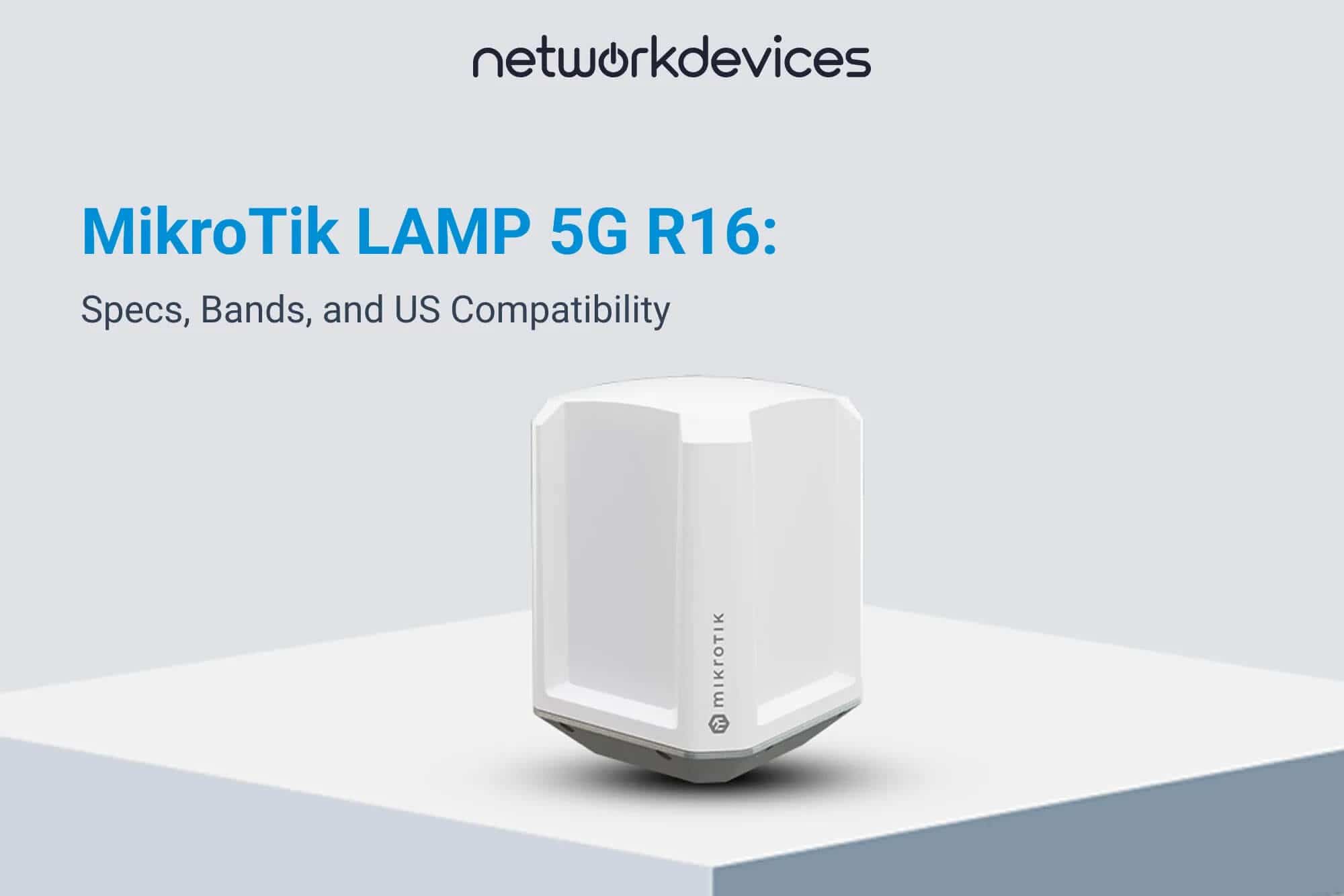

The MikroTik LAMP 5G R16 is an outdoor 5G router that trades antenna gain for the ability to stop caring which direction the tower is in. It is a strong device for its intended market, and for almost every US deployment it is the wrong purchase. MikroTik has published one variant, product code LAMPGM&RG520F-EU, built around a European band plan, with CE, EAC, and ROHS listed under certification and no US carrier certification listed.
Worth stating before the specifications, because no IP67 rating or eSIM convenience compensates for missing the bands your carrier transmits on. LAMP supports n41, n77, and n5, which touch T-Mobile mid-band and AT&T and Verizon C-band and low-band 5G. It does not support n71, n66, n2, or n25, and its LTE band list omits the practical US LTE layer, which removes usable fallback when 5G drops.
There is one narrow exception. A site with strong T-Mobile n41 coverage and no requirement for fallback could work, because T-Mobile runs 5G standalone on that band. Verify your carrier's exact band list against the table below before treating that as your plan.
The device itself is well built: a rugged IP67-rated enclosure on a stainless-steel mounting bracket, omnidirectional antennas, a 5G SA/NSA modem with LTE Cat 20 and 3G fallback, a built-in eSIM alongside a microSIM slot, GNSS support, and one Gigabit Ethernet port with 802.3af/at PoE-in. RouterOS v7 at license level 3 makes it a full router with firewall, NAT, VPN, and failover routing rather than a modem needing one behind it.
Below: US band compatibility in detail, the certification question, what the omnidirectional design costs in antenna gain, verified specifications, how to read the throughput figures, eSIM at fleet scale, GNSS boundaries, deployment scenarios, a comparison against the directional ATL 5G R16, an FAQ, and a verdict naming the buyer this device does not suit.
US 5G band compatibility: what works and what does not
The band list below is MikroTik's published specification for LAMPGM&RG520F-EU. The carrier mapping alongside it comes from public US band references rather than from MikroTik, who publish no US compatibility guidance for this product. Confirm against your own carrier's current band list before purchasing.
Three of LAMP's bands map to US networks. Band n41 at 2500 MHz is the backbone of T-Mobile's mid-band 5G, n77 at 3700 MHz carries AT&T and Verizon C-band, and n5 at 850 MHz provides AT&T and Verizon low-band 5G.
The gaps are larger than the overlap. LAMP does not support n71, T-Mobile's 600 MHz nationwide layer, nor n66, n2, or n25, which all three carriers rely on for capacity and coverage.
| Band | LAMP 5G R16 | US carrier use |
|---|---|---|
| n5 (850 MHz) | Supported | AT&T and Verizon low-band 5G |
| n41 (2500 MHz) | Supported | T-Mobile mid-band 5G |
| n77 (3700 MHz) | Supported | AT&T and Verizon C-band |
| n78 (3500 MHz) | Supported | Primarily European C-band |
| n71 (600 MHz) | Not supported | T-Mobile nationwide low-band |
| n66 (AWS) | Not supported | AT&T, Verizon, T-Mobile |
| n2 / n25 (1900 MHz) | Not supported | AT&T, Verizon, T-Mobile PCS |
The LTE picture is worse and it ends the discussion for most US deployments. LAMP's LTE FDD bands are 1, 3, 5, 7, 8, 20, 28, and 32, with LTE TDD bands 38, 40, 41, 42, and 43. Only bands 5 and 41 see meaningful US deployment, and the bands US networks depend on, including 2, 4, 12, 13, 66, and 71, are absent entirely.
A 5G CPE loses its usefulness the moment 5G is unavailable and LTE Cat 20 fallback cannot find a band to land on.
The certification question
MikroTik's published certification list for the LAMP 5G R16 is CE, EAC, and ROHS. FCC is not among them.
MikroTik is explicit when a product is ready for North America, and its own LTE and 5G catalog shows the pattern three times. The SXTsq Embedded LTE4 Global is described there as the global version with extra USA and non-EMEA LTE bands, AT&T and T-Mobile certified. The KNOT Embedded LTE4 Global carries expanded North American band support with the same certifications, and the Chateau LTE6-US is labeled US carrier-certified.
No equivalent label exists for LAMP 5G R16, and none exists for the directional ATL 5G R16. Until MikroTik publishes a US or Global variant, treat this as European hardware.
What the omnidirectional design actually does
A directional antenna concentrates radiated energy toward one point, raising gain and improving signal-to-noise on that single path. An omnidirectional antenna radiates evenly around the horizontal plane, so it registers whatever base stations are in reach without being aimed at any of them.
MikroTik's framing is that a tower going offline, a change in network conditions, or a better signal appearing elsewhere can all be handled without physically realigning the antenna. Installation stops requiring a signal survey and an alignment pass: mount it, feed it PoE, and let RouterOS handle band and cell selection.
The tradeoff nobody puts on the brochure
Omnidirectional coverage costs you gain. MikroTik's gain-versus-frequency chart in the datasheet tells the honest story: gain climbs steadily with frequency, reaching roughly 7 dBi toward 4.5 GHz, while the region around 700 MHz sits at or below 0 dBi.
That low-band dip is the important part, because sub-1 GHz spectrum is what carriers lean on for range and building penetration.
A user in the r/mikrotik discussion posted a band-by-band comparison against the directional ATL 5G R16 showing LAMP roughly 8 dB behind at 700 MHz and 9 dB behind at 3500 MHz. Treat those numbers as unverified community data, but the direction of the gap matches the official chart.
Verified specifications
Every figure below comes from MikroTik's published product page and datasheet for LAMPGM&RG520F-EU.
| Specification | Value |
|---|---|
| Product code | LAMPGM&RG520F-EU |
| CPU | Dual-core 88F3720, 800 MHz, ARM 64-bit |
| RAM / Storage | 512 MB DDR3L / 32 MB flash |
| Operating system | RouterOS v7, license level 3 |
| Modem module | R11mL-RG520F-EU |
| 5G SA category | DL 4.2 Gbps, UL 900 Mbps (modem maximum) |
| 5G NSA category | DL 5.0 Gbps, UL 650 Mbps (modem maximum) |
| LTE category | Cat 20, DL 2.0 Gbps, UL 200 Mbps (modem maximum) |
| 3G category | R8, DL 42.2 Mbps, UL 5.76 Mbps |
| MIMO | 4x4 MIMO downlink, 2x2 uplink |
| 5G SA/NSA FDD bands | n1, n3, n5, n7, n8, n20, n28 |
| 5G SA/NSA TDD bands | n38, n40, n41, n75, n76, n77, n78 |
| LTE FDD bands | 1, 3, 5, 7, 8, 20, 28, 32 |
| LTE TDD bands | 38, 40, 41, 42, 43 |
| 3G bands | 1, 5, 8 |
| Ethernet | 1x 10/100/1000 with PoE-in |
| Powering | 802.3af/at PoE-in, 12-56 V, 10 W maximum |
| SIM | 1x microSIM plus built-in eSIM |
| M.2 slots | 1 |
| GNSS support | GPS, GLONASS, Galileo, BeiDou, QZSS |
| Enclosure | IP67-rated, stainless-steel mounting bracket |
| Operating temperature | -40 °C to +70 °C |
| MTBF | Approximately 200,000 hours at 25 °C |
| Dimensions with mount | 276 x 267 x 133 mm |
| Certification | CE, EAC, ROHS |
In the box: a 24 V 0.5 A power adapter, the LAMP mount for poles from 25 to 60 mm, and a Gigabit PoE injector. RouterOS is preinstalled and licensed, with free updates for the life of the product or a minimum of five years.
One documentation inconsistency is worth knowing. The specification table lists GLONASS among the supported constellations while the descriptive text on the same document omits it. Confirm with MikroTik if GLONASS is load-bearing for your application.
Read the throughput numbers correctly
The 4.2 Gbps and 5.0 Gbps figures are modem category maximums under ideal conditions with full carrier aggregation. They describe the silicon, not the product you install.
With a single Gigabit Ethernet port, routed throughput to your LAN tops out below 1 Gbps. One commenter in the r/mikrotik thread raised the port as a limitation and another answered that a gigabit uplink suits the role this device fills, which is fair for backup WAN, site connectivity, and vessel or vehicle installations.
If you need multi-gigabit cellular throughput to a wired network, this is the wrong product category.
What RouterOS v7 adds
License level 3 gives the full routing feature set rather than a stripped modem interface: stateful firewall and NAT, policy routing, VPN termination, VLAN handling, and scriptable failover between the cellular WAN and a wired uplink.
For a backup WAN role that matters more than any radio specification, because the device holds the failover logic itself. One commenter in the Reddit thread was right that you can connect it directly to a switch, add access points as needed, and skip the additional router.
What eSIM changes at scale
LAMP ships with a built-in eSIM alongside the microSIM slot, supports multiple eSIM profiles and third-party eSIM providers, and works with MikroTik Connectivity, MikroTik's pre-activated data service.
For one device this is convenience. For twenty, fifty, or a hundred it changes the deployment model, because provisioning data plans stops requiring a site visit with the right carrier's SIM card in hand.
Multiple stored profiles let one unit carry different operator plans and switch between them as requirements change. Note the slot is sized for micro SIM, and MikroTik advises against a nano SIM in an adapter.
GNSS support and marine durability
GNSS covers GPS, Galileo, BeiDou, and QZSS, with GLONASS listed in the specification table, supporting fleet management, asset tracking, and remote infrastructure monitoring. MikroTik states plainly that this is for positioning and non-critical location-aware use, and that the device is not designed or certified for navigation, route guidance, or safety-critical marine navigation. Treat that as a hard boundary in any maritime specification.
Several retailer listings describe the device as carrying EN 60945 maritime certification. MikroTik's own wording is that it is designed to meet the EN 60945 maritime standard, which is a weaker and more careful claim. The physical build is not in question, with the IP67-rated enclosure, stainless-steel mounting bracket, and -40 °C to +70 °C range all published, but if procurement requires a certification document rather than a design intent statement, request it before specifying this on a vessel.
Where this device fits
Dense urban sites
Several base stations in reach with loading that shifts hour to hour, where omnidirectional reception takes the best available cell without a truck roll.
Backup and failover WAN
Mount it, provision the eSIM data plans remotely, leave it. No alignment to drift, no SIM card to swap.
Ports, marinas, and vessels
The environmental design targets this case, with GNSS supporting asset tracking alongside connectivity.
Industrial sites and transport hubs
Obstruction and interference change as equipment and vehicles move, which makes fixed alignment a liability.
Mobile installations
Campervans, work vehicles, and yachts have no fixed tower relationship, which removes the directional option entirely.
LAMP 5G R16 against the ATL 5G R16
| Consideration | LAMP 5G R16 | ATL 5G R16 |
|---|---|---|
| Antenna | Omnidirectional | Directional |
| Antenna gain | Lower, weakest below 1 GHz | Substantially higher on a known path |
| Enclosure rating | IP67 | IP66 |
| Installation | Mount and power, no alignment | Requires survey and aiming |
| Multiple towers in reach | Selects the best available cell | Locked to the aimed direction |
| Single distant tower | Poor fit | Correct choice |
| Moving installations | Correct choice | Not viable |
| US carrier certification | Not listed | Not listed |
The decision is a site survey question. Count the usable base stations from your mounting point: one means directional; several, or a site that moves, means omnidirectional.
Verdict
The LAMP 5G R16 solves a real problem. Sites with coverage from more than one direction, sites where alignment is impractical, and sites that physically move are all poorly served by directional CPE, and this answers that. The eSIM support, IP67 build, RouterOS v7 feature set, and single-cable PoE install make it straightforward to deploy at volume.
For US buyers it is not the right device today. The band plan is European, the LTE fallback layer does not exist on US networks, and MikroTik has not published a US or Global variant the way it has for several other products in this line.
If you are deploying in the US and need omnidirectional or mobile cellular connectivity, look at MikroTik's US carrier-certified products or another vendor's US-band CPE. If you are deploying in Europe, or specifying hardware for vessels operating in European waters, this is well-matched hardware with an honest set of tradeoffs.


FAQs
1. What is the MikroTik LAMP 5G R16?
A rugged outdoor 5G router with omnidirectional antennas, built-in eSIM, and GNSS, running RouterOS v7. It targets sites where aiming a directional antenna at one fixed base station is impractical.
2. Will the MikroTik LAMP 5G R16 work in the US?
Not reliably. The published variant is LAMPGM&RG520F-EU with a European band plan and no listed US carrier certification. It supports n5, n41, and n77 but lacks n71, n66, n2, and n25, and its LTE band list omits the bands US networks use for fallback.
3. Is the MikroTik LAMP 5G R16 waterproof?
It carries an IP67 rating covering dust ingress and temporary immersion, with an enclosure built for rain, salt air, and -40 °C to +70 °C. MikroTik describes it as designed to meet the EN 60945 maritime standard.
4. Does the LAMP 5G R16 have eSIM?
Yes, a built-in eSIM supporting multiple eSIM profiles and third-party eSIM providers, plus a microSIM slot, and it works with MikroTik Connectivity data plans.
5. How does the LAMP 5G R16 perform in rural areas?
Rural coverage usually depends on one distant tower on low-band spectrum, which is where this antenna is weakest. A directional unit will almost always outperform it there.