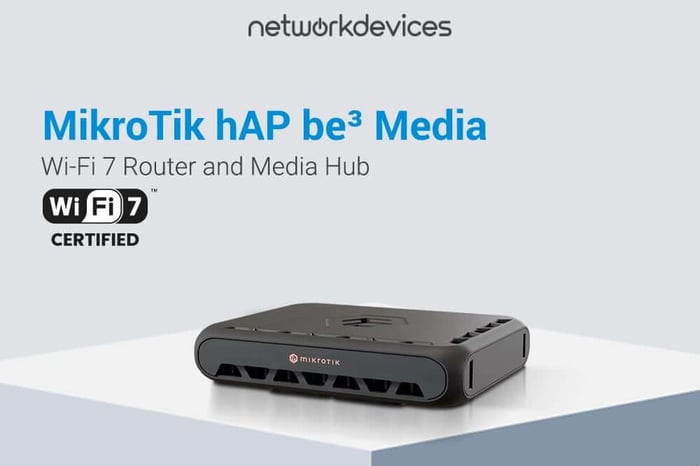

The MikroTik hAP be³ Media is a triple-band Wi-Fi 7 router that also works as a five-port 2.5GbE switch, a container host, local storage and Thread automation hardware. For a home lab, a small office or a technical household, it folds four devices into one: the router, the 2.5G switch, the Wi-Fi access point and the low-power box running your containers and file share.
It is not right for everyone. The 512 MB of internal NAND, the 2x2 chain count and the absence of PoE output set real limits, and each one is covered below.
This article covers what the device is, how its Wi-Fi 7 and multi-link support behaves, what the five 2.5G ports and PoE-in give you, where the storage and container platform runs out, what the Thread radio does, how to power it, who it fits, the verified specifications and the questions buyers ask most.
hAP be³ Media at a glance
| Wi-Fi | Triple-band Wi-Fi 7, 2x2 MIMO per band |
|---|---|
| Speed class | BE9300 |
| Ethernet | 5 x 2.5GbE |
| CPU | Quad-core IPQ-5322 ARM64, up to 1.5 GHz |
| RAM | 2 GB DDR4 |
| Storage | 512 MB NAND, plus microSD and USB |
| PoE | 802.3af/at input only, no PoE output |
| IoT | Thread radio and Bluetooth 5.4 |
| Operating system | RouterOS v7, license level 6 |
| Best for | Home labs, technical households, small offices |
| Main limits | 2x2 chains, 512 MB internal storage, no PoE-out |
What is the MikroTik hAP be³ Media?
The hAP be³ Media is MikroTik's hybrid indoor router, combining router, switch, Wi-Fi 7 access point, media storage and automation hub in one enclosure. MikroTik lists it under product code MA53UG+HbeH, and US listings commonly carry a -US suffix on the same code.
It runs RouterOS v7 at license level 6, MikroTik's unrestricted tier, so nothing is held back behind a subscription. MikroTik states the operating system is preinstalled and licensed, with free software updates for the life of the product or a minimum of five years from purchase.
Key Features
Triple-band 2x2 MIMO Wi-Fi 7
The hAP be³ Media runs 2.4 GHz, 5 GHz and 6 GHz radios at once, each 2x2 MIMO, rated at 688 Mbit/s, 2882 Mbit/s and 5764 Mbit/s. Those figures add up to MikroTik's BE9300 class rating. MikroTik does not publish channel width, but 5764 Mbit/s is the standard 2x2 figure at 320 MHz.
Antenna gain is 4 dBi on 2.4 GHz, 7.5 dBi on 5 GHz and 8 dBi on 6 GHz. The 6 GHz radio has the highest gain of the three, but placement should still account for the shorter range and weaker obstacle penetration associated with that band.
MikroTik lists Wi-Fi 7 Multi-Link Operation as supported in TR-MLMR mode in AP mode. MLO only pays off when the client supports it too, so treat it as headroom for newer laptops and phones rather than a gain your current fleet will see.
Five 2.5 Gigabit Ethernet ports
All five Ethernet ports run at 2.5 Gbps on a QCA8386 switch chip, so there is no single fast uplink and four slow ports. Link speed is not tested routing throughput, so check MikroTik's published Ethernet test results before sizing a deployment around a figure.
Port 1 accepts PoE-in at 802.3af/at. The specification lists PoE input only, so the hAP be³ Media cannot power cameras or access points downstream and you will still need an injector or PoE switch for those.
Storage: USB-C, two USB-A and microSD
Under the lockable lid sit one USB Type-C port, two USB 3.0 Type-A ports and a microSD slot, with maximum USB current listed at 1.5 A. That covers flash storage and compatible bus-powered SSDs for backups, camera footage and file shares, though power draw varies by drive and enclosure.
MikroTik points to the improved file-sharing function in WinBox and the BTH app for moving large files without conventional cloud-sharing workflows.
Matter and Thread for local smart home control
The hAP be³ Media includes a built-in Thread radio and Bluetooth 5.4. MikroTik's brochure describes deploying Matter-over-Thread automation that stays local, while the product page uses the narrower phrase "Thread IoT automation."
The hardware carries a Thread radio, and MikroTik positions it for Matter-over-Thread work. That is not the same as shipping a certified Matter controller for every ecosystem, so confirm current support and certification for your platform in MikroTik's latest RouterOS and product documentation.
Quad-core CPU and container support
The device runs a quad-core IPQ-5322 ARM64 CPU at up to 1.5 GHz with 2 GB of DDR4 RAM. MikroTik positions the platform for containers, local dashboards, scripting, firewall rules, encryption, multiple VPNs, BGP and advanced routing alongside core networking, and WinBox includes a one-click page of reviewed container images including Zabbix, Vaultwarden and Viseron.
Internal storage is the most immediate constraint. The 512 MB NAND is shared with RouterOS, so container images and data belong on microSD or USB, planned before deployment rather than after. CPU, RAM and external storage performance set the ceiling from there.
Powering, cooling and placement
The hAP be³ Media takes power through the DC jack or PoE-in, both at 24 to 57 V, and ships with a 24 V 1.5 A adapter. Maximum consumption rises from 20 W without attachments to 29 W overall, so PoE deployments should budget to the higher figure.
Cooling is passive; the enclosure is IP20 rated for indoor use, and MikroTik lists a tested ambient range of -30 °C to 50 °C with a CPU temperature monitor in RouterOS. Leave clearance around the vents if containers keep the CPU busy for long periods, and use the included base to stand it vertically.
Is the hAP be³ Media a NAS replacement?
No. USB, microSD and File share make it useful local storage for backups, media and document sharing on a small network, which is what the media hub name refers to.
There are no drive bays, no RAID and no redundancy. Anyone needing sustained storage throughput or drive management should run a dedicated NAS behind it.
Who it fits, and who should look elsewhere
It suits a home lab, a technical household, or a small branch office that wants Wi-Fi 7, multi-gigabit wired ports, local automation, and a few self-hosted services without a separate mini PC. Network engineers get a RouterOS platform at license level 6 with modern wireless attached, which the media framing undersells.
Skip it if you need PoE output, more than 2x2 chains for dense client environments, or a container host for databases and sustained disk writes. Consolidation also creates a larger failure domain: one reboot, firmware upgrade, or hardware fault takes routing, wireless, storage, and local services down together, whereas a modular build keeps them independent.
| Requirement | hAP be³ Media |
|---|---|
| Wi-Fi 7 home lab | Excellent fit |
| Multi-gigabit wired home or office | Strong fit |
| Lightweight containers | Strong fit |
| Local IoT and Thread work | Strong fit |
| Downstream PoE devices | Separate switch or injector needed |
| High-density Wi-Fi | Dedicated access points |
| Heavy container or database host | Dedicated compute |
| High-performance storage | Dedicated NAS |
Verdict
The hAP be³ Media makes sense when consolidation itself has value. If you would otherwise buy a router, a 2.5GbE switch, a Wi-Fi 7 access point and a light container host separately, this covers all four, and the specification is honest about where that ends: 2x2 chains, 512 MB of internal storage, passive cooling and no PoE output.
If wireless density, PoE delivery, storage performance or container compute matters more than consolidation, dedicated components remain the better architecture. For the right deployment, the advantage is not any single specification but how many small-network roles it folds into one RouterOS platform.


FAQs
1. Does the MikroTik hAP be³ Media support Wi-Fi 7?
Yes. It is a Wi-Fi 7 router with 2.4 GHz, 5 GHz and 6 GHz radios, each 2x2 MIMO, rated BE9300 combined. Multi-Link Operation is supported in TR-MLMR mode in AP mode, which requires MLO-capable clients to take effect.
2. Can the hAP be³ Media power other devices over PoE?
No. The specification lists PoE-in only, on port 1, at 802.3af/at with a 24 to 57 V input range. It can be powered over Ethernet but cannot supply power to cameras, phones or access points, so those need a separate injector or PoE switch.
3. How much storage does the hAP be³ Media have for containers?
Internal storage is 512 MB of NAND shared with RouterOS, which is not enough for container work on its own. Images and data should live on the microSD card or a USB device. The 1.5 A maximum USB current covers flash and compatible bus-powered SSDs, though power draw varies by drive and enclosure.
4. Does the MikroTik hAP be³ Media have 10GbE?
No. All five Ethernet ports are 2.5 Gigabit and there is no SFP or SFP+ cage. BE9300 refers to the combined Wi-Fi 7 speed class across three bands, not to wired port speed, which is a common point of confusion on Wi-Fi 7 hardware.
5. What is the product code for the hAP be³ Media?
MikroTik lists it as MA53UG+HbeH, and US listings commonly show the same code with a -US suffix. RouterOS v7 is preinstalled at license level 6, with free software updates for the life of the product or a minimum of five years from purchase.