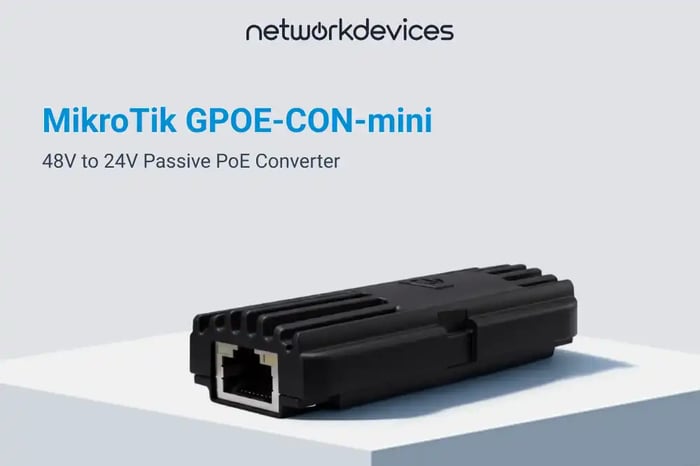

The MikroTik GPOE-CON-mini is a compact PoE converter that accepts IEEE 802.3af/at PoE at 48-57 V and outputs 24 V Passive PoE. It lets a 24 V Passive PoE device run from an existing standards-based PoE switch or injector, over the same Ethernet cable that carries its data.
The problem it solves sits at the far end of a cable run. The run to a mast, rooftop, or remote cabinet already carries 802.3af/at PoE, but the radio or CPE you want to mount there expects 24 V Passive PoE. Without a converter, the options are a different switch, a separate 24 V injector, or a second power cable to the site.
The short answer: if your infrastructure delivers 802.3af/at PoE and your endpoint accepts 24 V Passive PoE within the converter's rated 0.5 A output, the GPOE-CON-mini closes the gap in-line. If the endpoint needs more current, a different voltage, or an outdoor-rated housing with no enclosure planned, it is the wrong part.
The GPOE-CON-mini is most relevant to installers and network teams that use standards-based PoE switching while deploying compatible 24 V Passive PoE MikroTik devices. MikroTik names the LHG, SXTsq, Groove, and NetBox ax as examples of compatible 24 V Passive PoE devices.
Two details matter for real deployments. The GPOE-CON-mini supports Ethernet speeds up to 2.5 Gbps, though actual link speed still depends on the connected switch and endpoint. At 87 × 33 × 20 mm, it also fits inside MikroTik's GPeR-IP67-Case for outdoor installs.
This article covers how the conversion fits into the link, the full specifications and how to read the power figures, what 2.5 Gigabit support does and does not mean, which devices the converter is meant for and how to verify yours, outdoor installation in the GPeR-IP67-Case, and the limitations to check before you buy.
What Is the MikroTik GPOE-CON-mini?
The MikroTik GPOE-CON-mini is an in-line PoE converter in MikroTik's accessories line. It takes 802.3af/at PoE in on one Ethernet port and delivers 24 V Passive PoE out on the other, with data passing through on both.
MikroTik built it for one situation: the PoE you have and the PoE your device needs do not match. The converter removes the need to change switches, add PoE injectors, or run another power cable to the endpoint.
Why 802.3af/at PoE and 24 V Passive PoE Do Not Mix Directly
IEEE 802.3af (PoE) and 802.3at (PoE+) use standards-based detection: the switch or injector checks for a compatible powered device before it supplies power.
Passive PoE does not use that detection process. The injector supplies a fixed voltage, and a 24 V Passive PoE device expects exactly that: 24 V on the cable.
The two power methods are not directly compatible, so the GPOE-CON-mini converts between them.
How the 48V to 24V Passive PoE Conversion Fits Into the Link
The GPOE-CON-mini goes in-line between the standard PoE source and the 24 V Passive PoE device. In MikroTik's documented use case, standard 48 V PoE infrastructure brings data and power to the installation location over one Ethernet run, and the converter handles the conversion there.
A typical link looks like this:
- PoE switch or injector delivers 802.3af/at PoE at 48-57 V.
- The existing Ethernet run carries data and standard PoE to the remote location.
- GPOE-CON-mini input port accepts the 802.3af/at PoE.
- GPOE-CON-mini output port, marked "PoE Out 24 V" on the housing, delivers data plus 24 V Passive PoE.
- The 24 V Passive PoE device (for example an LHG or SXTsq) powers up from that port.
The practical effect is that the switch side does not change. The switch-side run remains standards-based PoE, while the converter's output side supplies 24 V Passive PoE to the endpoint.
GPOE-CON-mini Specifications
The GPOE-CON-mini accepts 802.3af/at PoE at 48-57 V and outputs 24 V Passive PoE at a rated 0.5 A, with two 2.5G Ethernet ports. Specifications below are from MikroTik's GPOE-CON-mini product page and product brochure.
| Specification | GPOE-CON-mini |
|---|---|
| PoE input standard | IEEE 802.3af/at |
| PoE input voltage | 48-57 V |
| DC inputs | 1 (PoE-in) |
| PoE output type | Passive PoE |
| Output voltage | 24 V |
| Rated output current | 0.5 A |
| Listed PoE-out current limit | 0.635 A |
| Ethernet ports | 2 × 2.5G (PoE in, PoE out) |
| Dimensions | 87 × 33 × 20 mm |
| Tested ambient temperature | -40°C to +70°C |
| MTBF | Approximately 100,000 hours at 25°C |
| Certifications | CE, EAC, RoHS |
| Included parts | K-96 fastening set |
How to Read the Power Figures
The GPOE-CON-mini has an output voltage of 24 V and a rated output current of 0.5 A. Size your device against that current rating: at 24 V, it works out to 12 W nominal (24 V × 0.5 A). That 12 W is a calculation from the rated figures, not a number MikroTik publishes.
MikroTik's product page also lists a 0.635 A PoE-out current limit. Treat it as a limit, not as continuous capacity you can plan around.
2.5 Gigabit Ethernet Support: What It Means
The GPOE-CON-mini supports Ethernet speeds up to 2.5 Gigabit. MikroTik lists two 2.5G Ethernet ports, one on the PoE input side and one on the PoE output side.
The converter does not make a slower switch or endpoint run at 2.5G. Link speed is set by the switch port and the endpoint, so verify the Ethernet capability of both devices separately.
Which Devices Work With the GPOE-CON-mini?
The GPOE-CON-mini is meant for compatible 24V Passive PoE devices. MikroTik names the LHG, SXTsq, Groove, and NetBox ax as examples.
Those are examples, not a blanket guarantee for every model in each family. Check the specific device before you order.
How to Verify Your Device
- Power input: If the device's spec sheet lists Passive PoE input that accepts 24 V, it matches the converter's output. If it only lists 802.3af/at input, you do not need this converter.
- Power draw: If the device requires no more than 0.5 A at 24 V (12 W, if its spec sheet lists power consumption in watts), its input requirement is within the converter's rated output. If it needs more, the GPOE-CON-mini is undersized. For devices near that limit, confirm the complete power budget with MikroTik or your distributor.
- Switch port: If your switch or injector delivers 802.3af or 802.3at PoE at 48-57 V, it matches the converter's input. If your source is Passive PoE or outside that voltage range, it does not.
All three conditions need to hold. Two out of three is a failed install.
Outdoor Installation With the GPeR-IP67-Case
MikroTik does not publish an IP rating for the GPOE-CON-mini itself. For outdoor installs, the converter fits inside the MikroTik GPeR-IP67-Case, which is sold separately.
The converter's tested ambient temperature range is -40°C to +70°C. Outdoor weather protection therefore depends on the enclosure, not on a published IP rating for the converter itself.
Installation Checklist
- Confirm the switch port, the device, and its power draw against the three checks in the previous section.
- Connect the Ethernet cable from the PoE switch or injector to the converter's input side.
- Connect the 24 V Passive PoE device to the side marked "PoE Out 24 V" on the housing.
- For outdoor runs, seat the converter inside a GPeR-IP67-Case.
- Secure the unit. MikroTik includes a K-96 fastening set in the box.
Where the GPOE-CON-mini Fits, and Where It Does Not
The GPOE-CON-mini does one conversion: 802.3af/at PoE at 48-57 V in, 24 V Passive PoE at a rated 0.5 A out. Anything outside that is a different product.
Good Fit
- The source is a standards-based 802.3af/at PoE switch or injector delivering 48-57 V.
- The endpoint accepts 24 V Passive PoE and requires no more than 0.5 A at 24 V.
- The existing switch and cable run should stay as they are, for example on a device swap or at a remote outdoor site.
This can include WISPs, MSPs, and teams managing outdoor wireless deployments.
Wrong Fit
- If your device accepts 802.3af/at directly, power it from the switch. A converter adds a part and a failure point for nothing.
- If your device needs more than 0.5 A at 24 V (12 W), the GPOE-CON-mini is undersized.
- If your device needs a voltage other than 24 V, the output is fixed at 24 V Passive PoE.
- If your PoE source is Passive PoE or outside 48-57 V, the input does not match. MikroTik lists 802.3af/at only.
- If the install is outdoors and no enclosure is planned, the converter has no published IP rating on its own.
- If your procurement requires a specific certification, check it first. MikroTik lists CE, EAC, and RoHS for this model.
One power-budget question is open. MikroTik does not publish conversion efficiency or how much power the converter draws from the switch port. If your device runs close to 12 W, confirm the budget with MikroTik or your distributor before relying on an 802.3af port.


FAQs
1. What does the MikroTik GPOE-CON-mini do?
The MikroTik GPOE-CON-mini converts IEEE 802.3af/at PoE at 48-57 V into 24 V Passive PoE. It lets a 24 V Passive PoE device run from a standards-based PoE switch or injector over a single Ethernet cable.
2. Can I power a 24 V MikroTik device from a 48 V PoE switch?
Yes, if the device accepts 24 V Passive PoE, stays within the GPOE-CON-mini's rated 0.5 A output at 24 V, and the switch port delivers 802.3af/at PoE at 48-57 V. Check the specific model's spec sheet first, because not every MikroTik device takes 24 V Passive PoE.
3. How much power can the GPOE-CON-mini deliver?
The GPOE-CON-mini has a rated output of 24 V at 0.5 A, which is 12 W nominal by calculation. MikroTik also lists a 0.635 A PoE-out current limit, which is a limit rather than a continuous rating.
4. Does the GPOE-CON-mini support 2.5 Gigabit Ethernet?
Yes. MikroTik lists two 2.5G Ethernet ports on the GPOE-CON-mini, so it supports link speeds up to 2.5 Gbps. The actual link speed depends on the switch port and the endpoint device.
5. Is the GPOE-CON-mini waterproof?
MikroTik does not publish an IP rating for the GPOE-CON-mini itself. For outdoor installs, the converter fits inside the GPeR-IP67-Case, which is a separate product.