
Which SMB Firewall Is Best in 2025? The Bottom Line
Let’s not pretend SMB buyers want vague platitudes or diplomatic walkarounds. You’re here to figure out which firewall is going to protect your business, scale with your needs, and not create headaches in three years.
If performance, scalability, and a tightly integrated security stack are critical, Fortinet’s FortiGate F-series is the right move. It’s built for long-term growth, consistent performance under load, and seamless Zero Trust enforcement.
However, if your network footprint is limited, you prioritize fast deployment, and you require granular control over licensing costs, SonicWall’s TZ series remains one of the most efficient choices for SMBs with modest complexity.
This guide doesn’t sugarcoat differences. It walks through model specs, deployment, threat protection, ZTNA, management tools, and TCO—and it tells you where each product truly shines.
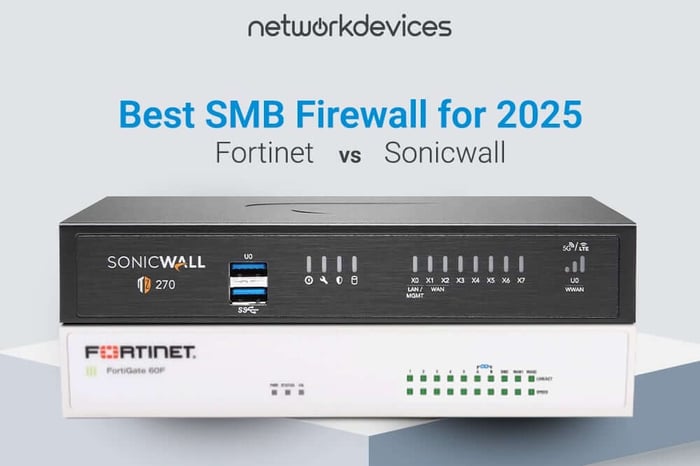
Key SMB Firewall Models for 2025
Fortinet FortiGate F-Series: High Performance and Deep Integration
| Model | Best For |
| FortiGate 60F | Small offices and branch locations |
| FortiGate 80F | Mid-sized businesses with growing traffic needs |
| FortiGate 100F | Larger remote offices or distributed networks |
Fortinet utilizes ASIC-based hardware to accelerate inspection, ensuring you don’t compromise performance for security. These models integrate directly into the Fortinet Security Fabric, offering a holistic approach to unified network protection.
SonicWall TZ Series: Accessible, Capable, and Flexible
SonicWall’s TZ series is lean, well-priced, and equipped with the latest SonicOS 7 interface. It’s often favored by MSPs and IT generalists for its ease of rollout and familiar dashboard.
| Model | Best For |
| TZ270 | Home offices, small retail setups |
| TZ370 | SMBs with moderate security demands |
| TZ470 | Branch locations or offices needing more bandwidth |
Fortinet vs. SonicWall: Feature Comparison
| Feature | Fortinet FortiGate F-Series | SonicWall TZ Series | Verdict |
| Performance | Up to 20 Gbps with ASICs | Up to 4 Gbps with multi-core CPUs | Fortinet dominates in raw throughput under full inspection loads. |
| Threat Protection | Unified UTM with FortiGuard Labs & sandboxing | Capture ATP with RTDMI™ | SonicWall excels in detection, but Fortinet maintains speed with full features enabled. |
| Zero Trust (ZTNA) | Built-in with FortiOS and MFA support | Requires SMA appliance and license | Fortinet is easier, cheaper, and native. |
| Management Tools | FortiManager, FortiCloud, FortiAnalyzer | NSM (cloud/on-prem), SonicExpress | Fortinet is better for scaling teams; SonicWall is easier for small deployments. |
| Deployment | CLI, GUI, FortiCloud, automated provisioning | Zero-touch via mobile app | SonicWall wins for speed; Fortinet for control. |
| Licensing Model | Bundled: Base, UTM, Enterprise | Modular: Essential, Advanced, Premium | Fortinet: one contract. SonicWall: pick-your-own-path. |
| Analytics/Reporting | FortiAnalyzer is deeply embedded | NSM Advanced or Analytics add-on required | Fortinet offers more by default |
Security Features Breakdown
Unified Threat Management (UTM)
Fortinet includes AV, IPS, URL filtering, app control, and cloud sandboxing in a unified system. Thanks to ASIC acceleration, even full inspection doesn’t slow performance.
SonicWall’s Capture ATP with RTDMI™ excels at identifying unknown threats. But enabling all inspection features on TZ hardware may require sacrifices in performance, especially on lower-tier models.
Verdict: Fortinet wins for performance under protection; SonicWall wins for modular flexibility.
Zero Trust and Secure Remote Access
ZTNA isn’t a buzzword anymore—it’s table stakes.
- Fortinet integrates ZTNA into the OS, providing seamless integration with FortiClient and FortiToken. No bolt-ons required.
- SonicWall can deliver ZTNA via SMA, but it requires more configuration and investment.
Verdict: Fortinet is ahead in simplicity and cost of deploying ZTNA.
Deployment, Management, and TCO
Fortinet Strengths
- Centralized orchestration across firewall, switching, wireless, and endpoint
- Deep visibility into threats via FortiAnalyzer
- Predictable licensing with UTM or Enterprise Protection tiers
SonicWall Strengths
- Quick deployment with SonicExpress
- Flexible licensing for teams needing only a subset of services
- Cloud-based NSM for managing multiple devices (though advanced reporting requires additional cost)
Verdict: Fortinet is better for scaling and security consistency. SonicWall wins for cost-managed simplicity.
When to Choose Fortinet
- You run critical cloud apps and can’t afford security bottlenecks
- You want a full Zero Trust strategy with native support
- You need centralized management across multiple locations
- You prefer inclusive pricing that doesn’t scale with every feature
- You’re an MSP managing several sites or clients
When to Choose SonicWall
- You need protection for 1–2 small offices with basic internet security
- Your team prefers a faster, less technical setup
- You want to minimize upfront spend and choose services modularly
- You don’t need deep integration with switching or endpoint
- You already use SonicWall and need to expand without retraining
Final Verdict: Choose Based on Growth Horizon
If your business plans to scale, adopt Zero Trust, and unify network security, Fortinet is a better strategic investment. It’s faster, deeper, and built for future complexity.
If you want straightforward protection today with minimal IT overhead, SonicWall offers incredible efficiency. It’s fast to deploy, easy to use, and affordable.
This isn’t about picking favorites. It’s about making smart choices based on where your business will be in two years.
Next Steps: Explore the Products
Ready to take the next step? Browse our curated collections to find the exact model and licensing bundle that fits your needs.
Shop the Fortinet FortiGate Collection: Explore all F-series models, including the popular FortiGate 60F and FortiGate 80F, and compare UTM and Enterprise bundles.
Shop the SonicWall TZ Series Collection: View the full line of TZ firewalls, from the entry-level TZ270 to the powerful TZ470, and customize your security services.