
Key Takeaways
- pfSense is a free, open-source firewall that offers high customization and low initial costs. It requires strong technical skills and active management.
- Commercial firewalls from Fortinet and Cisco are paid, turnkey appliances with integrated security, vendor support, and simplified setup.
- The choice depends on Total Cost of Ownership (TCO): Weigh internal labor costs for managing pfSense against the predictable subscription model of commercial solutions.
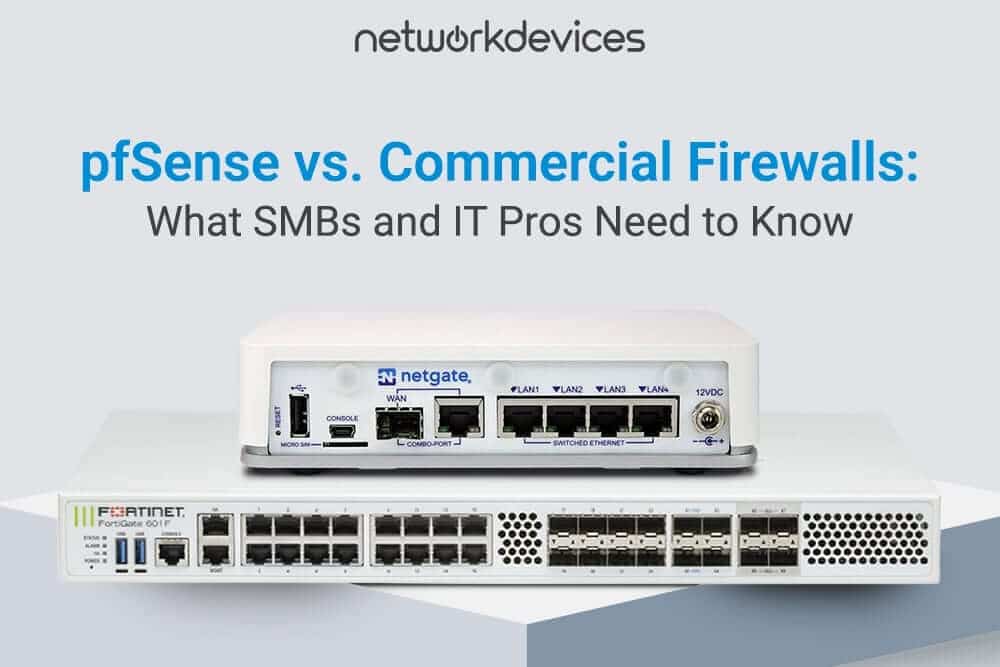
As a network engineer with years of experience deploying firewall solutions for businesses of all sizes, I know that choosing the right platform is a critical decision. Should you build your perimeter using an open-source system like pfSense, or choose a fully supported commercial firewall from vendors such as Fortinet or Cisco?
pfSense provides significant upfront cost savings and flexibility. Commercial solutions, on the other hand, offer faster deployment, automated protection, and vendor support, making them a practical choice for time-constrained IT teams.
In this guide, you’ll learn:
- How pfSense compares to Fortinet and Cisco in real-world scenarios
- What TCO really means when managing these systems
- Which firewall aligns with your team, scale, and compliance goals
Quick Comparison: pfSense vs. Fortinet vs. Cisco
| Feature | pfSense | Commercial Firewalls (Fortinet, Cisco) |
| Best For | Technical teams with deep expertise | SMBs prioritizing simplicity and reliability |
| Initial Cost | Free software, build your own hardware | Paid appliance and support licensing |
| Total Cost of Ownership | Low upfront, higher internal workload | Higher initial cost, lower operational effort |
| Management | Manual setup, web GUI or CLI | Centralized GUI, policy templates, wizards |
| Security Capabilities | Core firewall plus add-on packages | Integrated UTM, real-time threat feeds |
| Scalability & HA | Flexible but complex | Built-in HA, virtualization, easy scaling |
| Support & Maintenance | Community docs or third-party support | Vendor SLAs, documentation, and ongoing updates |
Tip: On mobile, swipe left to see the full comparison table.
This table offers a snapshot. The sections below provide a detailed comparison across each area.
What Are pfSense and Commercial Firewalls?
What is pfSense?
pfSense is a free, open-source firewall and router platform built on FreeBSD. It includes:
- Stateful Packet Inspection (SPI), NAT, and VLAN support
- VPN protocols such as OpenVPN, IPsec, and WireGuard
- Add-on packages like Snort, Suricata, and pfBlockerNG for intrusion detection and filtering
It is flexible and powerful, but assumes your team can manage configuration, security tuning, and maintenance without vendor support.
What Are Commercial Firewalls?
Commercial firewalls, such as Fortinet FortiGate and Cisco Secure Firewall, combine specialized hardware with licensed software. They provide:
- Next-Generation Firewall (NGFW) and Unified Threat Management (UTM)
- Real-time threat intelligence from FortiGuard Labs and Cisco Talos
- Hardware acceleration through ASICs
- Centralized cloud-based control using FortiManager or Cisco SecureX
These appliances are designed for fast deployment and simplified long-term management.
What Is the True Cost: pfSense vs. Commercial?
pfSense:
- No software licensing fees
- Compatible with custom or existing hardware
- Ongoing cost in staff hours for setup, maintenance, and troubleshooting
- No official vendor escalation or direct support
Commercial Firewalls:
- Upfront purchase of hardware and licenses
- Predictable recurring subscription fees
- Lower internal burden due to vendor-supported automation and training
- Access to live support, documentation, and security updates
Although pfSense can save money at the start, commercial firewalls often reduce risk and cost over time when labor and downtime are considered.
Which Is Easier to Manage?
pfSense:
- Requires manual installation and configuration
- Offers a capable interface, but few setup guides or wizards
- Lacks centralized management or automated deployment tools
- Best suited to technically experienced teams
Fortinet and Cisco:
- Software is preinstalled, ready to use
- GUI interfaces are user-friendly with policy templates and configuration assistants
- Central dashboards support multi-site management
- Ideal for SMBs or IT teams managing limited resources
Which Offers Better Security?
pfSense:
- Provides stateful firewalling, VPN support, and NAT
- Security can be extended with community-developed packages
- All updates and tuning must be done manually
- No integrated threat intelligence or real-time alerts
Fortinet and Cisco:
- Includes intrusion prevention, malware protection, and web filtering by default
- Uses real-time feeds from FortiGuard and Cisco Talos
- Offers sandboxing and automated behavior analysis
- Designed to meet strict compliance and audit standards
pfSense can match many core functions but lacks automated intelligence and centralized response, which are key features in commercial platforms.
Can pfSense Scale Like a Commercial Firewall?
pfSense:
- Performance depends on the hardware chosen by the user
- High availability and redundancy features are supported, but require manual setup
- Cloud deployments are possible, but not seamless
- Virtual firewall options exis,t but need configuration
Commercial Firewalls:
- Designed for out-of-the-box scalability
- Native support for HA, failover, and clustering
- Available in virtual and cloud-native versions
- Consistent throughput due to dedicated hardware acceleration
Commercial firewalls scale more efficiently, especially across multiple locations or hybrid environments.
Choosing the Right Solution
An Engineer’s Note:
When advising clients, I focus on time. A low-cost tool is not truly affordable if it requires hours of weekly management. This list helps determine which solution fits best.
Choose pfSense if you:
- Have experienced IT staff who can manage manual configuration
- Prefer full control over the system
- Are working within a tight budget
- Operate a simple or single-site network
Choose Fortinet or Cisco if you:
- Want minimal setup and ongoing maintenance
- Prefer security updates, automation, and vendor support
- Operate multiple locations or cloud workloads
- Need enterprise-level compliance and support agreements
Real-World Use Cases
Practical results often speak louder than specs. These anonymized examples are drawn from real projects that illustrate how firewall decisions affect day-to-day operations.
Startup Using pfSense
A bootstrapped tech startup chose pfSense and installed it on recycled hardware to save costs. It initially worked well and provided reliable performance. Over time, however, their lead sysadmin spent several hours each week managing updates, tuning rules, and resolving issues. These tasks began to interfere with other IT priorities, slowing the team's ability to scale.
Accounting Firm Using FortiGate 40F
A regional accounting firm required fast deployment and a system they could manage with minimal IT resources. The FortiGate 40F delivered exactly that. With preinstalled software and FortiGuard security services, the device was fully operational within hours and required little hands-on oversight afterward.
Consultancy Standardizing on Cisco Secure Firewall
A growing consultancy with multiple offices adopted Cisco Secure Firewall 1000 Series appliances across locations. By using Cisco SecureX, they gained centralized visibility, consistent policy enforcement, and vendor-backed support. Their lean IT team could manage the entire infrastructure efficiently without needing to hire additional staff.
Frequently Asked Questions (FAQ)
1. Is pfSense good enough for a business?
Yes, pfSense can effectively protect business networks. It works best when managed by a skilled team that can handle updates and configuration internally.
2. Why are commercial firewalls so expensive?
Their cost includes more than hardware. You are also paying for licensed security services, automated updates, real-time intelligence feeds, and expert support, all of which are critical for reducing operational risk.
3. Can pfSense replace a FortiGate or Cisco firewall?
It can handle core firewalling and VPN needs, but lacks built-in UTM features, automated updates, and integration with vendor security ecosystems like SecureX or FortiGuard.
Final Thoughts
Before deciding, review your team’s technical capabilities and future growth plans to choose the platform and hardware that protects your network without overextending your resources. If that strategy points to a commercial solution, the next logical step is to explore our curated selection of Fortinet and Cisco firewalls.
Ultimately, the best firewall is not only secure—it should support your business without becoming a burden.