
In any small-to-medium business (SMB) network, the rack can quickly become a jungle of devices. You have a dedicated router, a separate managed PoE switch for your access points and cameras, and maybe another for fiber aggregation.
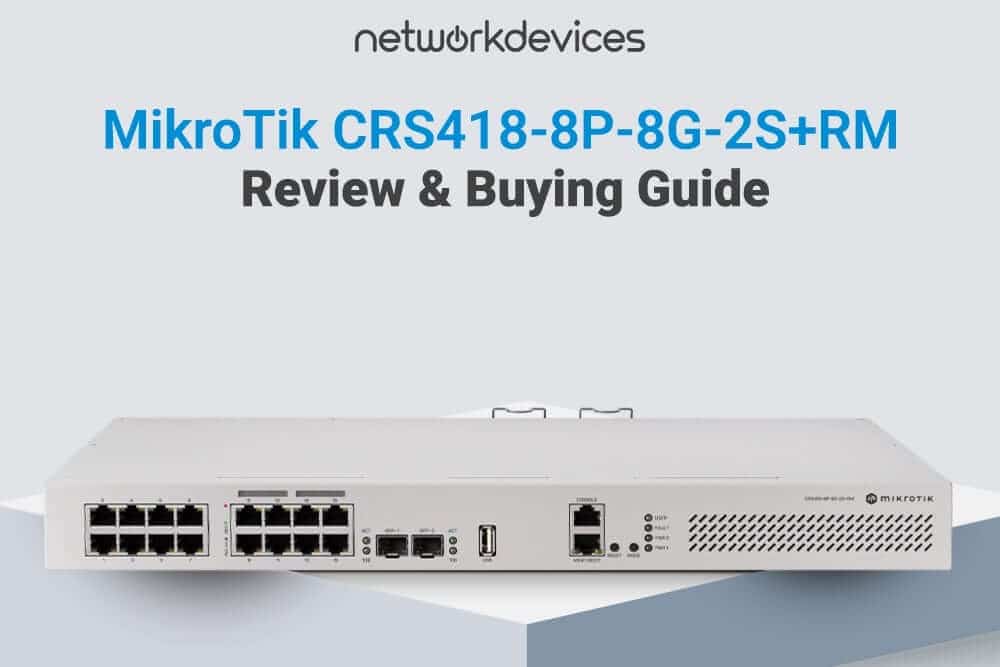
The MikroTik CRS418-8P-8G-2S+RM is engineered to be the machete that clears that jungle. It's not just another switch; it's a powerful "router disguised as a switch" built to consolidate your stack and replace a "jungle of devices with one smart multitasker".
Suppose you're a network admin who sees a quad-core ARM CPU, L3 hardware offloading, and RouterOS v7 as an opportunity for robust control, not a complexity to be feared. In that case, this review will determine if this is the best MikroTik switch for your small business.
The Bottom Line Up Front: Who Should Buy This Layer 3 Switch?
The MikroTik CRS418 is a purpose-built consolidation tool. It’s the ideal 1U rackmount PoE switch for SMBs whose network engineers need to power multiple PoE devices like APs and IP cameras, leverage high-speed 10G SFP+ fiber uplinks for servers or backbone links, and deploy robust Layer 3 routing and firewalling without buying a separate gateway.
If you value centralized hardware and have the skill to master RouterOS, the CRS418 offers one of the most versatile and cost-effective performance packages available today.
At a Glance: CRS418 PoE Budget and Specs
This is not just a managed PoE switch; it's a hybrid powerhouse. Here are the core specifications, optimized for search snippets.
- CPU: Quad-core ARM 64-bit IPQ-8072 @ 2208 MHz.
- RAM: 1 GB, DDR3L.
- Ethernet Ports: 17x Gigabit Ethernet ports total.
- PoE Output: 8x Gigabit ports (Ether9-Ether16) with 802.3af/at PoE+ and 24V Passive PoE support.
- SFP+ Ports: 2x 10G SFP+ cages for fiber uplinks.
- PoE Budget: 150 W total output power with a max total current of 5.4 A.
- Management Port: 1x dedicated Gigabit port with a direct CPU connection.
- Power: Dual-redundant AC power supplies (100-240V).
- OS: RouterOS v7 with a Level 5 license.
- Special Features: IPsec hardware acceleration for VPN throughput.
- Cooling: Actively cooled by four fans.
Deep Dive: CRS418-8P-8G-2S+RM Performance Review
The Powerhouse Ports: PoE+ and 10G SFP+ Uplinks
The CRS418’s port mix is its main strength. You get eight standard Gigabit ports and eight PoE-out ports. This versatility allows you to power a fleet of modern 802.3af/at access points and cameras while also supporting legacy 24V Passive PoE devices, all without separate injectors.
The dual SFP+ fiber uplinks are critical for connecting to a high-speed NAS, media server, or a core network switch without creating a 1G bottleneck.
Layer 3 Routing Performance & RouterOS v7 Features
What truly makes this a MikroTik Layer 3 PoE switch is its brain. The quad-core ARM CPU offers approximately 3x the CPU performance of older CRS320/CRS328 models for CPU-intensive tasks. This power, combined with L3 Hardware Offloading, means it can handle real routing workloads. The included RouterOS v7 license unlocks advanced VLAN segmentation, ACLs, traffic shaping, and even allows the switch to function as a CAPsMAN controller.
How Does CRS418 Compare to Competitors?
While official head-to-head performance benchmarks against competitors are not readily available, a feature comparison reveals key differences. The CRS418's advantages lie in its operating system flexibility and legacy support.
With RouterOS v7, you get granular, scriptable control over every aspect of routing and switching—a significant edge for complex networks. Furthermore, its support for 24V Passive PoE offers a direct and cost-effective upgrade path for businesses that already have passive-powered MikroTik devices in their infrastructure.
Potential Drawbacks & Considerations
- Active Cooling Noise: The four fans are not silent. This is a fan-cooled rackmount switch designed for a server room, not a quiet office.
- RouterOS Learning Curve: This is a professional tool. Its advanced capabilities require configuration expertise.
- No Multi-Gig Copper Ports: All RJ45 ports are 1G; higher speeds require the 10G SFP+ cages.
- PoE Budget Limits: The 150 W budget cannot power eight high-power 30 W 802.3at devices at their maximum draw simultaneously.
- No Integrated Wi-Fi: This is a wired-only device. For users who need an all-in-one solution, MikroTik offers a Wi-Fi 6 equipped model of the CRS418 that integrates a powerful access point.
The Verdict: Is the MikroTik CRS418 Good for Small Business?
Yes, for the right business. The MikroTik CRS418-8P-8G-2S+RM successfully merges a high-performance router and a versatile managed PoE switch into one affordable unit. It's arguably the best MikroTik PoE switch for small businesses that need to consolidate hardware without sacrificing control.
Buy it if you are a network professional who:
- The goal is to consolidate a router, PoE switch, and aggregator into a single device.
- Needs robust Layer 3 routing features like VLANs and ACLs alongside a solid PoE budget.
- Has the expertise to leverage the power and flexibility of RouterOS v7.
Skip it if you need:
- A simple plug-and-play, unmanaged switch.
- Multi-gigabit (2.5G/10G) copper RJ45 ports.
- A silent, fanless device for a desktop or open office.
FAQs
1. Does the CRS418 support Layer 3 routing?
Yes, the CRS418 is a fully capable Layer 3 switch with a powerful quad-core CPU and L3 hardware offloading to ensure high performance.
2. How much PoE power does the CRS418 provide?
It provides a total of 150 W across eight ports. The max output per port is 1.1 A for inputs below 30 V.
3. Can the CRS418 replace a router and switch in one unit?
Yes, it is powerful enough to replace most small or medium office routers, serving as an internet gateway, firewall, and PoE switch simultaneously.
4. What is the difference between the CRS418 and CRS328?
The main difference is processing power. The CRS418's CPU is approximately three times faster than the CPU in a CRS328, making it far more capable for routing and other CPU-intensive tasks.