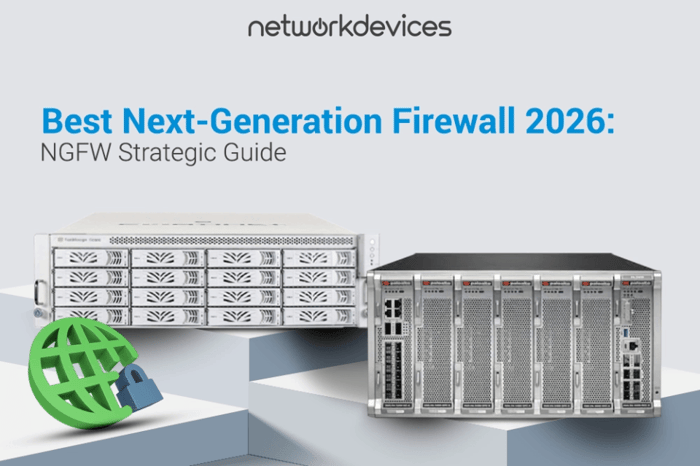

Cyber threats in 2026 are faster, AI-driven, and harder to contain with fragmented network security stacks. Organizations running separate tools for firewalls, VPNs, endpoint protection, intrusion prevention, and cloud security are facing visibility gaps and slower incident response across all layers of their infrastructure.
The best next-generation firewall 2026 solves this by consolidating AI-powered threat prevention, Zero Trust Network Access (ZTNA), deep packet inspection, application control, and full visibility across cloud and on-prem environments into a single platform. Instead of bolting together point products, modern NGFWs act as the security control plane for hybrid networks.
This guide breaks down how platform-based NGFWs, AI defense capabilities, and zero-trust implementation reshape your cybersecurity strategy. It includes a direct Fortinet vs Palo Alto 2026 comparison alongside coverage of Cisco, Check Point, Juniper, and Sophos, so you can match the right enterprise firewall to your deployment.
Is an NGFW Worth It in 2026?
Yes. A next-generation firewall is no longer optional for any organization serious about network security. Traditional firewalls that only filter traffic by port and protocol cannot defend against advanced threat vectors like encrypted malware delivery, credential-based lateral movement, or AI-generated phishing campaigns.
An NGFW combines stateful inspection with IPS (intrusion prevention system), sandboxing, antivirus, application control, and threat intelligence into an all-in-one platform. In 2026, the best firewall solutions go further by embedding AI-powered threat detection, native ZTNA, and granular segmentation policies that enforce zero trust across users, devices, and workloads.
For small businesses, an NGFW replaces the need to purchase and manage five or six separate security tools. For large enterprises, it provides centralized management and consistent policy enforcement across data centers, branch offices, and multi-cloud environments running on AWS, Azure, or hybrid infrastructure.
Platform vs. Point Product: The Consolidation Trend in 2026
The most consequential shift in enterprise cybersecurity strategy is the move from fragmented point products to integrated NGFW platforms.
Why Consolidation Matters
Traditional security stacks relied on multiple standalone tools. Firewalls, VPN concentrators, endpoint agents, IPS appliances, and cloud security brokers each operated independently with their own management console, alerting logic, and blind spots. The result: slow correlation, inconsistent policy enforcement, and security gaps that attackers exploit during lateral movement.
Consolidating these functions into a unified NGFW platform reduces that complexity. A 2024 Forrester Total Economic Impact study, commissioned by Fortinet, found that deploying integrated NGFWs with AI-powered security services delivered a 318% ROI over three years, with payback in under six months for enterprise data center environments. [VERIFY: Confirm publication year and link to Forrester study before publishing.]
This platform approach, sometimes described under the broader SASE (Secure Access Service Edge) framework, brings together secure firewall capabilities, SD-WAN, cloud management, and threat protection into a unified ecosystem. Security teams get a single pane of glass instead of tabbing between six dashboards during an incident.
Platform Approach vs. Point Products
| Feature | Platform NGFW | Point Product Stack |
|---|---|---|
| Visibility | End-to-end across cloud, on-prem, and endpoints | Siloed per tool |
| Management | Centralized management, unified policy engine | Separate consoles per vendor |
| Threat Detection | AI-driven correlation across all traffic | Isolated alerts, manual correlation |
| Cost Efficiency | Lower long-term TCO through consolidation | Higher operational cost, more staff hours |
| Scalability | Modular expansion within the same ecosystem | Requires new integrations per tool |
Essential NGFW Features for 2026: ZTNA, AI Defense, and Hardware Acceleration
The best next-generation firewall 2026 is not just a packet filter with extras. It functions as a centralized network security control plane. Here are the capabilities that separate modern enterprise firewalls from legacy appliances.
Built-in Zero Trust Network Access (ZTNA)
ZTNA is now a baseline requirement, not a premium add-on. The old model of trusting users because they connected through a VPN is obsolete. Modern NGFWs enforce zero trust by continuously verifying identities, checking device posture, and making context-aware access decisions for every session.
In practice, a contractor on a managed laptop connecting from a coffee shop gets different access rights than a full-time engineer on a hardened workstation inside the office. Access is scoped to the minimum required resources through granular segmentation, and that scope is re-evaluated continuously.
Why it matters: ZTNA eliminates lateral movement within networks, which remains one of the most common and damaging attack vectors in ransomware campaigns that escalate privileges after initial access.
AI-Powered Threat Prevention and Advanced Threat Detection
AI is now embedded directly into NGFW inspection engines. These systems analyze traffic patterns, file behavior, and network telemetry in real time to detect both known malware signatures and unknown zero-day threats through behavioral analysis.
Modern threat detection goes beyond signature matching. AI-powered engines use inline machine learning, sandboxing for suspicious file detonation, and deep packet inspection to identify threats hiding inside encrypted traffic and legitimate application flows. This combination of IPS, antivirus, sandboxing, and AI-driven analysis provides layered threat protection that adapts to new attack techniques automatically.
Why it matters: AI-powered threat prevention reduces manual monitoring overhead and dramatically improves incident response speed. Security teams shift from triaging thousands of alerts to investigating the handful that the AI engine flags as genuinely anomalous.
Agentic Guardrails for AI Systems
Organizations deploying AI internally face a new risk category. Without controls, AI applications can leak sensitive data through prompts, make unauthorized API calls, or drift outside their intended operational boundaries.
Agentic guardrails are security policies designed to monitor and constrain the behavior of AI models within the network. Fortinet FortiGate appliances, through FortiAI integration, allow administrators to define policies around LLM interactions, including data classification rules that prevent sensitive information from leaving the network through AI queries. Palo Alto Networks addresses this through AI Access Security, providing visibility and control over SaaS-based AI tools.
Why it matters: As AI adoption accelerates, agentic guardrails are becoming a compliance requirement in regulated industries. Finance, healthcare, and government organizations need auditable controls over how AI systems interact with internal data.
Hardware Acceleration with NP7 Processors
Security that degrades network performance is security that gets disabled. Fortinet's NP7 network processors solve this by offloading inspection to purpose-built silicon, delivering ultra-low latency and high-throughput performance even during full threat inspection.
The NP7 architecture is critical for environments handling large volumes of encrypted traffic. With over 95% of web traffic now encrypted via SSL/TLS, any NGFW that cannot perform deep packet inspection on encrypted flows at line rate creates either a performance bottleneck or a security blind spot.
Palo Alto Networks uses its own custom ASIC architecture across the PA-Series to achieve similar hardware-accelerated inspection, and Cisco's Secure Firewall series uses the Snort 3 engine optimized for high-throughput encrypted traffic analysis.
Why it matters: Hardware acceleration allows NGFWs to maintain full inspection depth, including SSL decryption, IPS, sandboxing, and application control, without degrading throughput or user experience under heavy workloads.
SD-WAN Integration
Modern enterprise firewalls increasingly combine NGFW functionality with SD-WAN capabilities for branch offices and distributed networks. Fortinet FortiGate appliances include SD-WAN natively in FortiOS, eliminating the need for a separate SD-WAN appliance. This integration simplifies deployment at branch offices while maintaining consistent security policies and centralized management across the entire network.
SD-WAN integration is a core component of SASE architectures, providing intelligent traffic routing alongside threat protection and application control at the network edge.
Selecting the Right Firewall: SMB vs. Data Center
Choosing the best firewall for your organization depends on network scale, traffic profile, cloud footprint, team expertise, and budget.
SMB vs. Enterprise Requirements
| Criteria | SMB / Small Businesses | Enterprise / Data Center |
|---|---|---|
| Budget | Cost-sensitive, bundled licensing preferred | Higher budget, modular licensing acceptable |
| Complexity | Single-site or small multi-site with branch offices | Hybrid cloud, multi-region, multi-tenant |
| Performance | Moderate throughput (1–10 Gbps) | High-throughput requirements (40–400+ Gbps) |
| Security Features | Core NGFW + ZTNA + IPS + antivirus | Full AI suite + sandboxing + agentic guardrails + advanced security analytics |
| Deployment | On-prem or simple cloud | Hybrid, multi-cloud (AWS, Azure), SD-WAN integrated |
Fortinet vs Palo Alto 2026: Strategic Comparison
This is the comparison most security teams are evaluating. Here is how the two leading NGFW vendors stack up in 2026.
| Feature | Fortinet (FortiGate Series) | Palo Alto Networks (PA Series) |
|---|---|---|
| Performance (data center) | NP7 + CP10: up to 397 Gbps firewall, 80 Gbps threat protection (FortiGate 3000G) | Custom ASIC: up to 90 Gbps firewall, 76 Gbps threat prevention (PA-5445) |
| Performance (mid-enterprise) | NP7Lite + CP10: up to 39 Gbps firewall, 6 Gbps threat protection (FortiGate 200G) | Up to 9.5 Gbps firewall, 6.2 Gbps threat prevention (PA-1420) |
| AI Threat Prevention | FortiGuard AI Services, inline ML in FortiOS | Advanced WildFire, Precision AI |
| IPS / Sandboxing | FortiGuard IPS + inline sandboxing | Threat Prevention + WildFire sandbox |
| ZTNA | Built-in FortiZTNA, included in FortiOS license | Prisma Access ZTNA, separate licensing |
| SD-WAN | Native SD-WAN in FortiOS, no extra cost | Prisma SD-WAN, separate product |
| Management | FortiManager + FortiAnalyzer (centralized management) | Panorama + Strata Cloud Manager |
| Application Control | FortiGuard app signatures, granular policies | App-ID technology, granular policies |
| Cost Model | Lower per-unit, bundled licensing | Higher per-unit, modular licensing |
| Best Fit | SMB through large enterprise, budget-conscious | Large enterprises, complex multi-cloud |
Performance figures sourced from official Fortinet Product Matrix (2025) and Palo Alto Networks PA-Series datasheets. All values are "up to" under ideal lab conditions.
Top NGFW Solutions to Consider in 2026
Selecting the best next-generation firewall for 2026 depends on your use case. Below are our top picks, organized by deployment scenario, with specific model recommendations and the vendors that best fit each need.
Best for Data Centers and High-Performance Environments: Fortinet FortiGate 3000G
The FortiGate 3000G is the flagship of Fortinet's G-Series, built for data centers and large campus networks that demand maximum throughput without compromising security inspection depth. It delivers up to 397 Gbps firewall throughput, 90 Gbps IPS throughput, and 80 Gbps threat protection throughput using NP7 and CP10 hardware acceleration.
With support for up to 88 million concurrent sessions and 100GE QSFP28 interfaces, it handles hyperscale traffic volumes while running full AI-powered threat inspection. ZTNA and SD-WAN are included natively in FortiOS at no additional license cost.
Best for Large Enterprise and Multi-Cloud: Palo Alto Networks PA-5445
The PA-5445 is the highest-performing fixed-form-factor model in the PA-5400 Series, delivering 90 Gbps firewall throughput and 76 Gbps threat prevention throughput with support for 48 million concurrent sessions. Its single-pass architecture ensures consistent performance with all security services enabled.
Palo Alto Networks excels in complex multi-cloud environments (AWS, Azure) through Prisma Cloud integration, and its Precision AI engine provides advanced threat intelligence across a global network of over 70,000 customers. Best suited for organizations that prioritize cloud-native security and deep AI analytics.
Best for Mid-Size Enterprise and Campus Networks: Fortinet FortiGate 200G
The FortiGate 200G targets large corporate campuses, internal network segmentation, and regional data center edges. It provides up to 39 Gbps firewall throughput, 9 Gbps IPS throughput, and 6 Gbps threat protection throughput with NP7Lite and CP10 acceleration.
The 200G includes 5GE RJ45 ports for modern switch and access point connectivity, built-in SD-WAN, and universal ZTNA. For mid-size organizations that need strong performance and bundled licensing without the cost of a data center chassis, the FortiGate 200G hits the right balance.
Best for Large Branch and Small Campus: Palo Alto Networks PA-1420
The PA-1420 provides 9.5 Gbps firewall throughput and 6.2 Gbps threat prevention throughput in a compact 1U form factor with PoE support for branch office devices. It runs the same PAN-OS as every other Palo Alto firewall, so policy management and security capabilities are consistent from branch to data center.
The PA-1400 Series supports virtual systems (VSYS) for multi-tenant branch deployments and integrates natively with Panorama for centralized management across distributed locations.
Best for Cisco-Centric Environments: Cisco Secure Firewall 3100 / 4200 Series
Cisco remains a major player in network security with its Secure Firewall series, powered by the Snort 3 inspection engine and backed by Cisco Talos threat intelligence.
The Secure Firewall 3100 and 4200 series deliver strong threat detection and application control for mid-size and large enterprise deployments. The primary advantage is deep integration with the broader Cisco ecosystem. If your organization already runs Cisco switching, routing, and SD-WAN infrastructure, the Secure Firewall integrates without requiring a parallel management stack.
Best for Threat Intelligence and Global Policy Enforcement: Check Point Quantum
Check Point's Quantum series provides high-performance threat protection with strong centralized management through SmartConsole. Check Point is particularly well-regarded for the breadth of its threat intelligence through the ThreatCloud AI network, which aggregates data from hundreds of millions of sensors globally. A strong choice for organizations that prioritize threat prevention accuracy and consistent policy enforcement across data centers and cloud environments.
Best for Juniper Networking Environments: Juniper Networks SRX Series
Juniper's SRX Series firewalls combine NGFW capabilities with advanced threat detection through Juniper ATP (Advanced Threat Prevention). Juniper is especially competitive in environments that already use Juniper routing and switching, offering deep integration and simplified cloud management through Juniper Mist AI.
Best for Small Business Simplicity: Sophos XGS Series
Sophos XGS firewalls target small businesses and mid-market organizations with a user-friendly management interface and synchronized security across endpoints and the firewall. Sophos Xstream architecture provides hardware-accelerated SSL inspection and sandboxing, making it a practical option for organizations with smaller security teams that need all-in-one threat protection without enterprise-level complexity.
Quick Decision Matrix
| Your Priority | Recommended Solution |
|---|---|
| Maximum data center throughput + bundled licensing | Fortinet FortiGate 3000G |
| Mid-size campus + cost-effective NGFW with SD-WAN | Fortinet FortiGate 200G |
| Large enterprise + multi-cloud AI analytics | Palo Alto Networks PA-5445 |
| Branch/small campus + consistent PAN-OS policies | Palo Alto Networks PA-1420 |
| Existing Cisco infrastructure | Cisco Secure Firewall 3100 / 4200 |
| Global threat intelligence + centralized management | Check Point Quantum |
| Juniper routing/switching ecosystem | Juniper Networks SRX |
| Small business simplicity + endpoint sync | Sophos XGS |
Related: Fortinet vs. Palo Alto Firewall Platform Comparison
2026 NGFW Evaluation Checklist
Use this checklist when scoring NGFW vendors during your evaluation or RFP process. These capabilities define the modern network security baseline.
Native ZTNA: Identity-based access control built into the firewall OS, eliminating reliance on traditional VPN for remote access.
AI-Powered Threat Prevention: Inline machine learning and behavioral analysis that detect and block both known malware and zero-day threats in real time.
IPS and Sandboxing: Integrated intrusion prevention and file sandboxing for advanced threat detection without requiring separate appliances.
Deep Packet Inspection: Full inspection of encrypted SSL/TLS traffic at line rate without creating performance bottlenecks.
Application Control: Granular visibility and control over application-layer traffic, enabling security teams to enforce policies per application, user, and device.
SD-WAN Integration: Native SD-WAN capabilities for branch offices and distributed networks, reducing the need for separate routing appliances.
Endpoint and Cloud Integration: Full telemetry sharing across endpoints, applications, and multi-cloud workloads on AWS, Azure, and hybrid infrastructure.
Centralized Management: Single-pane-of-glass management for policy enforcement, monitoring, and reporting across all firewall instances.
Automation and Orchestration: Automated policy enforcement, incident response playbooks, and threat remediation workflows that reduce mean time to containment.
Segmentation: Micro-segmentation and network segmentation policies that enforce zero-trust principles across internal network zones.
Agentic AI Guardrails: Policy controls for monitoring and constraining internal AI deployments, including data classification, prompt filtering, and audit logging.
Build a Resilient, Integrated Security Fabric
Cybersecurity in 2026 comes down to three things: integration, intelligence, and speed. The best next-generation firewall 2026 is not a standalone appliance sitting at the network edge. It is the foundation of a unified defense strategy that spans cloud, on-prem, endpoints, and AI systems.
The Fortinet vs. Palo Alto 2026 decision depends on your operational requirements, budget constraints, and the complexity of your environment. Both vendors deliver strong NGFW platforms. Fortinet leads on cost efficiency, bundled licensing, SD-WAN integration, and NP7 hardware acceleration. Palo Alto Networks leads on advanced AI analytics, multi-cloud integration, and enterprise-scale threat intelligence. Cisco, Check Point, Juniper, and Sophos each bring distinct strengths depending on your existing ecosystem, network security priorities, and organizational scale.
Network Devices Inc. stocks FortiGate and Palo Alto Networks appliances with same-day shipping from our US warehouses. Whether you need a FortiGate 200G for a growing office, a FortiGate 3000G for a data center buildout, or a PA-5400 for a multi-cloud enterprise, we have it in inventory. Talk to our team to match your requirements to the right hardware.


FAQs
1. Is an NGFW worth it in 2026?
Yes. A next-generation firewall is the most cost-effective way to consolidate multiple security functions into a single platform. Instead of purchasing and managing separate tools for IPS, antivirus, sandboxing, application control, VPN, and web filtering, an NGFW handles all of these in one appliance. For small businesses, this reduces both hardware costs and operational complexity. For enterprises, it provides centralized management and consistent threat protection across all network segments.
2. What is the difference between a traditional firewall and an NGFW?
A traditional firewall filters traffic based on port, protocol, and IP address. An NGFW adds deep packet inspection, application-layer visibility, intrusion prevention, malware detection, SSL/TLS decryption, and identity-based access control. Modern NGFWs in 2026 also include AI-powered threat detection, built-in ZTNA, and SD-WAN capabilities, making them a complete network security platform rather than just a packet filter.
3. Which firewall is best for enterprise networks in 2026?
For most enterprise environments, Fortinet FortiGate and Palo Alto Networks PA-Series are the two leading choices. Fortinet offers stronger value through bundled licensing, native SD-WAN, and NP7 hardware acceleration. Palo Alto Networks leads in advanced AI analytics, multi-cloud integration, and global threat intelligence. Cisco Secure Firewall is the best fit for organizations already invested in the Cisco ecosystem. The right choice depends on your throughput requirements, cloud footprint, and budget.
4. What are the top next-generation firewalls to consider in 2026?
The top NGFW solutions for 2026 include the Fortinet FortiGate 3000G for data centers, the FortiGate 200G for mid-size campuses, the Palo Alto Networks PA-5445 for large enterprise and multi-cloud, the PA-1420 for branch offices, the Cisco Secure Firewall 3100/4200 for Cisco-centric environments, Check Point Quantum for global threat intelligence, Juniper SRX for Juniper networking shops, and Sophos XGS for small businesses needing all-in-one simplicity.
5. Is Fortinet better than Palo Alto in 2026?
Neither is universally better. Fortinet FortiGate offers higher raw throughput per dollar, includes ZTNA and SD-WAN at no extra license cost, and uses NP7 hardware acceleration for energy-efficient performance. Palo Alto Networks provides more advanced AI-driven threat analytics through Precision AI, deeper multi-cloud native integration through Prisma, and a broader global threat intelligence network. Choose Fortinet when budget efficiency and throughput are priorities. Choose Palo Alto when advanced analytics and cloud-native security are the deciding factors.