


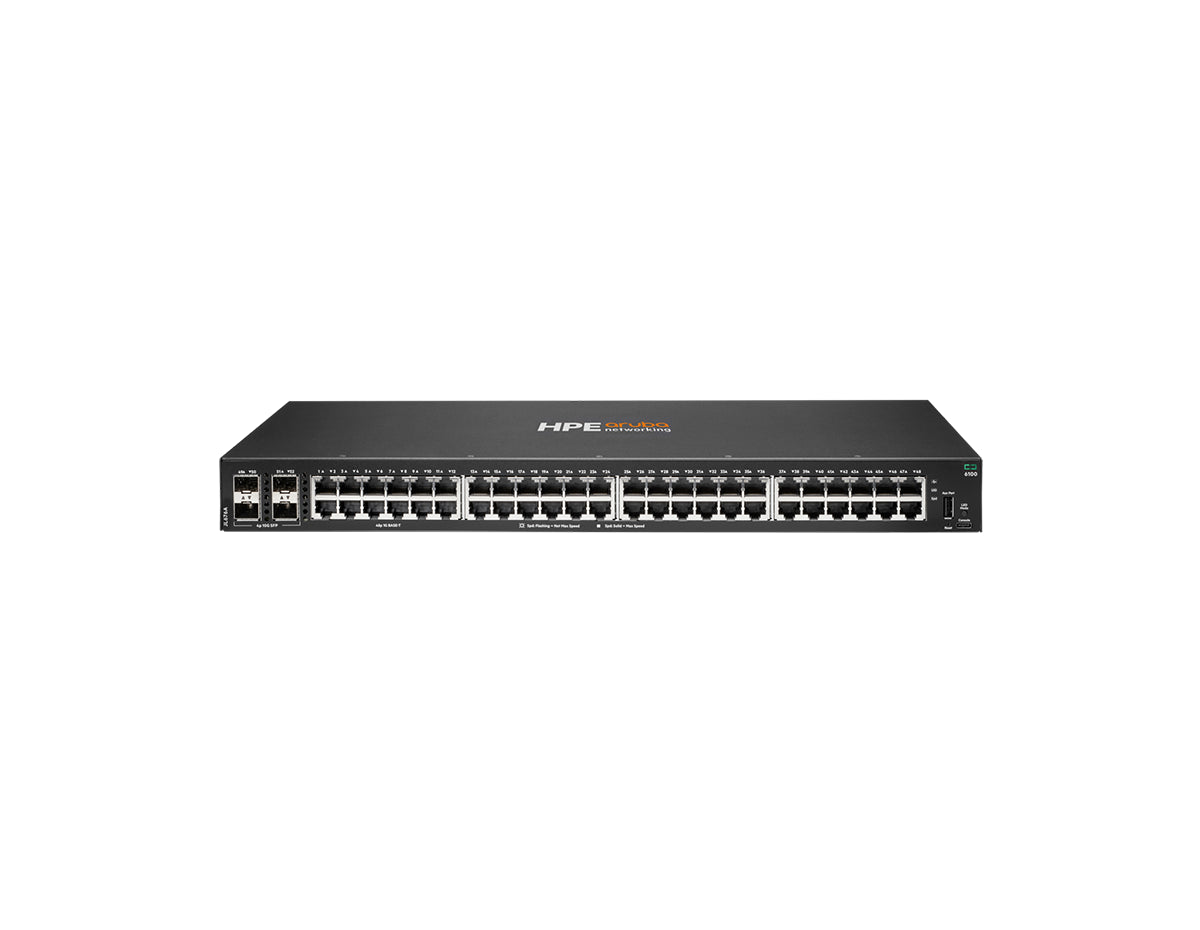
HPE Aruba Networking CX 6100 JL676A 48-Port Data Switch with 4x 1G/10G SFP+
- Managed, Rack-mountable, 48 x 1G ports, 4 x 1G/10G SFP+ Uplinks, No PoE (Data Only), Layer 2

Overview
HPE positions the CX 6100 Switch Series as a modern family of entry-level access switches for enterprise branch offices and SMB networks, built on the HPE Aruba Networking ASIC architecture and the AOS-CX operating system used across the CX portfolio. The JL676A is the 48-port data-only model: 48 Gigabit access ports, four SFP+ uplinks that accept 1G or 10G optics, and VSF stacking of up to six switches managed as one. Its axis within the CX family is the upgrade path over time, from Gigabit to 10G uplinks and from one switch to a stack, where the CX 6000 stays on fixed 1G uplinks with no listed stacking. The closely matched JL675A shares the 48-port, 4x 1G/10G SFP+ layout and adds Class 4 Power over Ethernet.
Technical Details
The HPE Aruba Networking CX 6100 JL676A is a Layer 2+ managed 1U rackmount switch with 48 Gigabit (10/100/1000BASE-T) access ports and four 1G/10G SFP+ uplinks, running AOS-CX. Switching capacity is 176 Gbps and forwarding rate is 98.6 Mpps. It carries no Power over Ethernet, so all 48 access ports are data-only. It supports VSF stacking of up to six CX 6100 24- and 48-port switches on AOS-CX 10.16.1006 or later; HPE publishes no stacking bandwidth. It connects desktops, printers and wired IoT devices in branch and campus wiring closets.
Best For
The JL676A suits branch and campus wiring closets that connect up to 48 wired endpoints such as desktops, printers and wired IoT devices that do not need power from the switch, with 10G uplink capacity and room to grow by stacking.
Not suitable if:
- you need to power access points, phones or cameras, since this model has no Power over Ethernet
- you need uplinks faster than 10G, since the SFP+ uplinks are 1G/10G
- you need OSPF or BGP routing, since the CX 6100 documents list static routing
- you need to stack more than six switches, since VSF allows up to six members
- you need multigigabit access ports, since the access ports are 10/100/1000BASE-T
JL676A Specifications
| Class & Licensing | |
|---|---|
| License Tier | None (switch software embedded, no subscription required to enable; no feature tiers) |
| License Detail / MTBF | None (switch software embedded, no subscription required to enable; no feature tiers; a separate software license is required only for HPE Aruba Networking NetEdit / Switch Multi-Edit); MTBF not published |
| Ports & Uplinks | |
| Port Speed | Gigabit |
| Uplink Configuration | 4x 1G/10G SFP+ (fixed) |
| Performance & Scale | |
| Stacking | VSF (Virtual Switching Framework); requires AOS-CX 10.16.1006 or later |
| Switching Capacity | 176 Gbps |
| Forwarding Rate | 98.6 Mpps |
| MAC Table | 8,192 entries |
| Max Stack Members | 6 (mixed CX 6100 24- and 48-port switches only) |
| Hardware & Memory | |
| DRAM | 4 GB DDR3 |
| Flash | 16 GB eMMC |
| Power & Thermal | |
| Power Input / PSU | Fixed 65 W power supply; 100-127 VAC / 200-240 VAC, 50/60 Hz |
| Redundant PSU | No (fixed power supply) |
| Cooling | Fixed fans |
| Physical & Environmental | |
| Dimensions (H x W x D) | 1.73 x 17.4 x 9.74 in (4.39 x 44.2 x 24.74 cm) |
| Weight | 7.54 lbs (3.42 kg) |
| Operating Temperature | 32 to 113 °F (0 to 45 °C), up to 5000 ft (1.5 km); derate 1 °C for every 1000 ft (305 m) from 5000 ft (1.5 km) to 10000 ft (3.0 km) |
| Software | |
| Operating System | AOS-CX |
JL676A Accessories
| Transceivers | |
|---|---|
| J4858D | Aruba 1G SFP LC SX 500m MMF Transceiver |
| J4859D | Aruba 1G SFP LC LX 10km SMF Transceiver |
| J8177D | Aruba 1G SFP RJ45 T 100m Cat5e Transceiver |
| J9150D | Aruba 10G SFP+ LC SR 300m MMF Transceiver |
| J9151D | Aruba 10G SFP+ LC LR 10km SMF Transceiver |
| J9281D | Aruba 10G SFP+ to SFP+ 1m DAC |
| J9283D | Aruba 10G SFP+ to SFP+ 3m DAC |
| Cables | |
| J9281D | Aruba 10G SFP+ to SFP+ 1m DAC Cable |
| J9283D | Aruba 10G SFP+ to SFP+ 3m DAC Cable |
| Software | |
| JL639AAE | Aruba NetEdit Single Node: 1 year |
| JL640AAE | Aruba NetEdit Single Node: 3 years |
| Aruba Central Foundation Licenses | |
| Q9Y68AAE | Aruba Central 25xx/6100/8 to 12 port Switch Foundation 1 year Subscription E-STU |
| Q9Y69AAE | Aruba Central 25xx/6100/8 to 12 port Switch Foundation 3 year Subscription E-STU |
| Q9Y70AAE | Aruba Central 25xx/6100/8 to 12 port Switch Foundation 5 year Subscription E-STU |
| Q9Y71AAE | Aruba Central 25xx/6100/8 to 12 port Switch Foundation 7 year Subscription E-STU |
| Q9Y72AAE | Aruba Central 25xx/6100/8 to 12 port Switch Foundation 10 year Subscription E-STU |
| R6U73AAE | Aruba Central On-Premises 25xx/6100/8 to 12 port Switch Foundation 1 year Subscription E-STU |
| R6U74AAE | Aruba Central On-Premises 25xx/6100/8 to 12 port Switch Foundation 3 year Subscription E-STU |
| R6U75AAE | Aruba Central On-Premises 25xx/6100/8 to 12 port Switch Foundation 5 year Subscription E-STU |
| R6U76AAE | Aruba Central On-Premises 25xx/6100/8 to 12 port Switch Foundation 7 year Subscription E-STU |
| R6U77AAE | Aruba Central On-Premises 25xx/6100/8 to 12 port Switch Foundation 10 year Subscription E-STU |
| Support: | 4 Hour Onsite 3 Year (HY2M9E) |
FAQ
Does the HPE Aruba Networking CX 6100 JL676A support PoE?
No. The HPE Aruba Networking CX 6100 JL676A is a data-only switch: its 48 Gigabit access ports carry no Power over Ethernet, so it cannot power wireless access points, IP phones or security cameras. If the switch must power those devices, the JL675A is the 48-port CX 6100 model with IEEE 802.3at Class 4 Power over Ethernet and a 370 W budget, with the same four 1G/10G SFP+ uplinks.
What transceivers do the JL676A uplinks use?
The JL676A has four 1G/10G SFP+ uplink ports that automatically detect whether a 1G or 10G transceiver is installed. They take 1G SFP and 10G SFP+ optics; they are 1G/10G ports, so higher-speed optics are not supported. HPE lists 1G SFP SX, LX and RJ45 transceivers, 10G SFP+ SR, LR and BiDi transceivers, and 10G SFP+ direct attach copper cables for the CX 6100. Unsupported Transceiver Mode can enable other 1G and 10G transceivers, but HPE does not support them in that mode. Transceivers are sold separately.
Can the JL676A be stacked, and with which switches?
Yes. The JL676A supports VSF (Virtual Switching Framework) stacking of up to six members in a chain or ring topology, and the stack is managed as a single chassis. CX 6100 24- and 48-port switches stack with each other; HPE states that VSF between them and the 12-port CX 6100 is not supported. VSF links use the 1/10G SFP fiber and copper ports, and HPE states that VSF stacking requires AOS-CX 10.16.1006 or later. HPE does not publish a VSF stacking bandwidth.
What is the difference between the JL676A and the JL675A?
Both are 48-port CX 6100 switches with four 1G/10G SFP+ uplinks, 176 Gbps switching capacity, 98.6 Mpps forwarding, 4 GB DDR3 / 16 GB eMMC and six-member VSF stacking. The JL675A adds IEEE 802.3at Class 4 Power over Ethernet with a 370 W budget and uses a 500 W fixed power supply; the JL676A has no PoE and a 65 W supply. The PoE model is also deeper and heavier: 30.48 cm and 11.07 lb versus 24.74 cm and 7.54 lb.
How does the JL676A compare with the CX 6000 R8N86A?
Both are 48-port Layer 2+ AOS-CX switches with 10/100/1000BASE-T access ports and no PoE. The CX 6100 JL676A has four 1G/10G SFP+ uplinks, 176 Gbps switching capacity, 98.6 Mpps forwarding and six-member VSF stacking. The CX 6000 R8N86A has four fixed 1G SFP uplinks, 104 Gbps, 77.3 Mpps and no listed stacking. Choose the JL676A for 10G uplinks or a stack.
How is the JL676A managed?
The JL676A is a fully managed switch. HPE lists a web GUI, an industry-standard CLI, REST APIs, HPE Aruba Networking NetEdit for configuring many switches at once (NetEdit requires its own separate software license), and cloud-based or on-premises HPE Aruba Networking Central, which is an optional management subscription. The switch software itself is embedded, with no subscription required to enable it. Routing is static IPv4 and IPv6, and the CX 6100 data sheet also lists RIPv2 and RIPng; neither document lists OSPF or BGP.
What condition is the JL676A sold in, and what warranty applies?
The JL676A is sold new and factory-sealed. It is covered by the Network Devices Inc. 1-year warranty and a 30-day return policy.
