


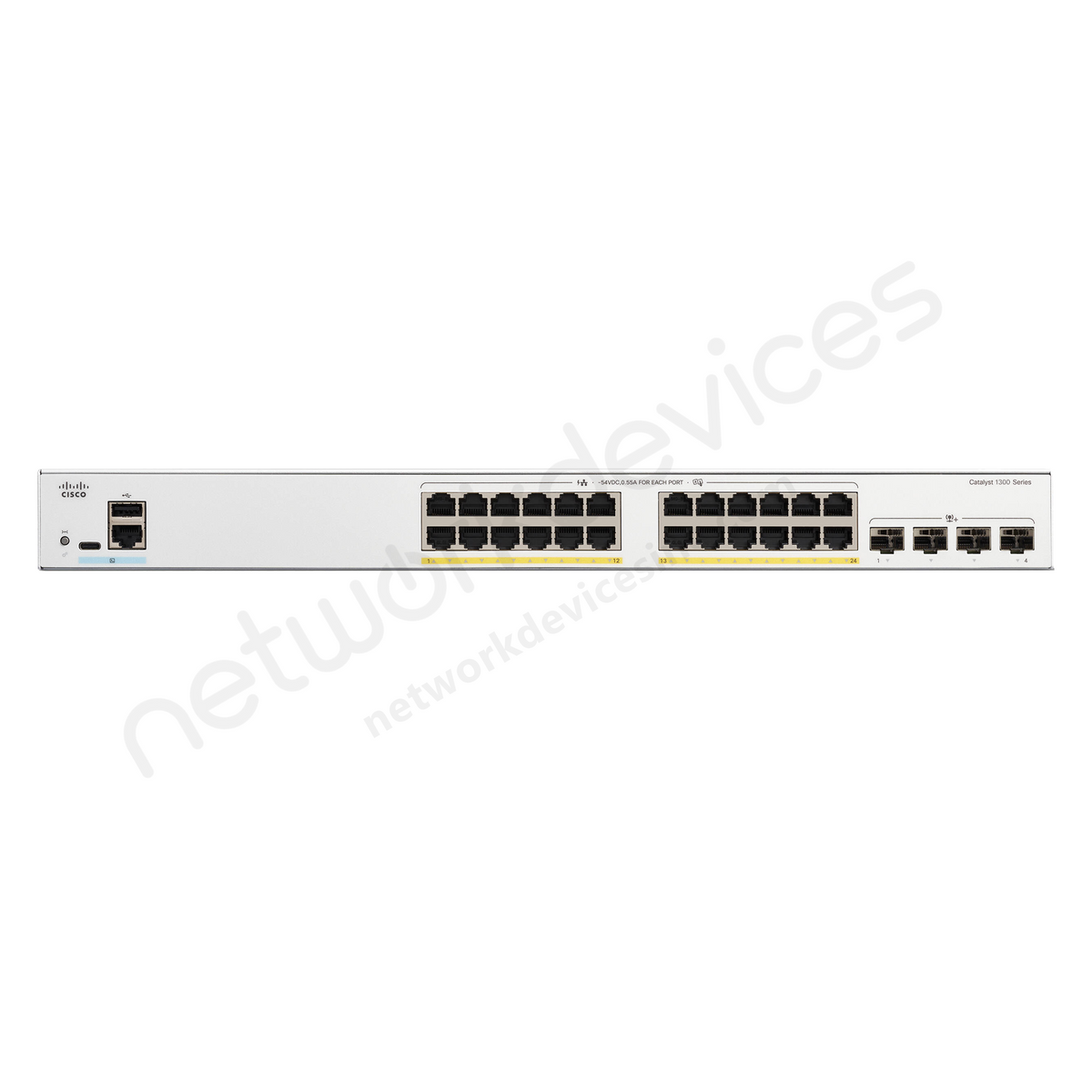
Cisco Catalyst C1300-24T-4X 24-Port Layer 3 Managed Data Switch, 4x10G SFP+
The Cisco Catalyst C1300-24T-4X is a 24-port Layer 3 managed switch with 4x 10G SFP+ uplinks. It supports Front Panel Stacking and dynamic Layer 3 routing.

Overview
The Cisco Catalyst 1300 Series is a line of fixed, managed, enterprise-class Layer 3 switches for small and medium-sized business and branch offices, and Cisco positions it as the next-generation successor to the Cisco Business CBS350 Series managed switches. The C1300-24T-4X is the 24-port data-only configuration with four 10G SFP+ uplinks, and those 10G fiber interfaces are what make it stackable: they carry Cisco Front Panel Stacking, letting up to eight switches operate as a single logical unit under one IP address, unlike the 1G-uplink C1300-24T-4G, which does not stack. It is managed through the Cisco Business Dashboard, the Cisco Business mobile app, an on-box web UI, and a CLI, and runs a customized Linux-based operating system rather than Cisco IOS.
Technical Details
The Cisco Catalyst C1300-24T-4X is a Layer 3 managed 1U rackmount access switch with 24 Gigabit Ethernet (10/100/1000) data ports and four fixed 10G SFP+ uplinks, running a customized Linux-based operating system. Switching capacity is 128 Gbps and forwarding rate is 95.23 Mpps. It carries no Power over Ethernet, so all 24 access ports are data-only. It supports Cisco Front Panel Stacking of up to eight switches through the 10G SFP+ fiber interfaces, and routes with static routing and RIP v2. It connects non-powered endpoints such as desktops, printers, and wired IoT devices in branch and campus wiring closets.

 Small Business
 Branch Office


Best For
The C1300-24T-4X suits branch and campus wiring closets that connect non-powered endpoints such as desktops, printers, and wired IoT devices and want 10G fiber uplinks back to the distribution layer. Its four 10G SFP+ ports also enable Cisco Front Panel Stacking, so several switches can be managed as one, and Layer 3 static routing with RIP v2 handles basic inter-VLAN routing at the access layer.
Not suitable if:
- you need to power devices such as wireless access points, IP phones, or IP cameras, since this is a data-only switch with no Power over Ethernet
- you need OSPF, BGP, or EIGRP dynamic routing, since this model routes only with static routing and RIP v2
- you need multigigabit (mGig) access ports, since the access ports are standard Gigabit Ethernet
- you need more than 24 access ports in a single unit
C1300-24T-4X Specifications
| Class & Licensing | |
|---|---|
| License Tier | None |
| License Detail / MTBF | None; MTBF 646,083 hours |
| Ports & Uplinks | |
| Port Speed | Gigabit |
| Uplink Configuration | 4x 10G SFP+ |
| Performance & Scale | |
| Stacking | Front Panel Stacking |
| Switching Capacity | 128 Gbps |
| Forwarding Rate | 95.23 Mpps |
| MAC Table | 16000 |
| Stacking Bandwidth | 10 Gigabit Ethernet fiber interfaces |
| Max Stack Members | 8 |
| IPv4 Routes | Up to 990 (Dynamic + Static) IPv4 routes; up to 128 IP interfaces |
| Hardware & Memory | |
| DRAM | 1 GB DDR4 |
| Flash | 1GB SLC |
| Power & Thermal | |
| Power Input / PSU | 100-240V 50-60 Hz, internal universal |
| Redundant PSU | No |
| Cooling | Fanless |
| Physical & Environmental | |
| Dimensions (H x W x D) | 1.73 x 17.49 x 9.45 in (43.94 x 444.3 x 240 mm) |
| Weight | 6.92 lbs (3.14 kg) |
| Operating Temperature | -5°C to 50°C (23°F to 122°F) |
| Operating System | Linux |
| Software | |
| Routing Protocols | Static routing; RIP v2 |
Part Number Decode
- C1300 — C1300 is the platform prefix, identifying the Cisco Catalyst 1300 Series of managed Layer 3 switches.
- 24 — 24 is the port count, indicating 24 Gigabit Ethernet access ports.
- T — T is the port-type marker, indicating data-only Gigabit ports with no Power over Ethernet.
- 4X — 4X is the uplink code, indicating four fixed 10G SFP+ uplinks; on this model, those 10G interfaces also carry Cisco Front Panel Stacking.
C1300-24T-4X Accessories
| Included | Mounting kit (19-in brackets for 24/48-port models), Power cord, Pointer card |
| Optional – SFP Modules | MGBSX1, MGBLX1, MGBLH1, MGBT1, GLC-SX-MMD, GLC-EX-SMD, GLC-ZX-SMD, GLC-LH-SMD, GLC-BX-U, GLC-BX-D, GLC-TE, CWDM-SFP series |
| CAB-CONSOLE-RJ45 | RJ-45 console cable |
| CAB-CONSOLE-USB-C / CAB-CONSOLE-USB-C= | USB-C console cable |
| PWR-CLP | Power cable clip |
| RCKMNT-1RU-1K= | Rack-mount kit for 1U devices |
FAQ
Does the Cisco Catalyst C1300-24T-4X support PoE?
No. The Cisco Catalyst C1300-24T-4X is a data-only switch, and all 24 Gigabit Ethernet access ports carry no Power over Ethernet. It cannot power devices such as wireless access points, IP phones, or IP cameras. If you need PoE+ on the access ports with the same four 10G SFP+ uplinks and Front Panel Stacking, the Cisco Catalyst C1300-24P-4X provides a 195 W PoE+ budget, and the C1300-24FP-4X provides a 375 W full PoE+ budget.
What transceivers do the uplinks on the C1300-24T-4X use?
The Cisco Catalyst C1300-24T-4X has four fixed 10G SFP+ uplink ports. These slots accept 10-Gigabit SFP+ optics and also support 1G SFP modules for slower fiber or copper links. Specific transceiver compatibility should be verified against the supported-SFP module list in the Cisco Catalyst 1300 Series data sheet and Cisco's transceiver compatibility matrix. Transceivers are sold separately.
How many C1300-24T-4X switches can you stack?
The Cisco Catalyst C1300-24T-4X supports Cisco Front Panel Stacking of up to eight switches, managed as a single unit under one IP address with a unified data, control, and management plane. Front Panel Stacking runs over the 10 Gigabit Ethernet (SFP+) fiber interfaces. This model can stack only with compatible Front Panel Stacking-capable Catalyst 1300 models within the same stacking family. It does not stack with the 1G-uplink C1300-24T-4G, which has no 10G SFP+ interfaces and does not support stacking.
What Layer 3 routing does the C1300-24T-4X support?
The Cisco Catalyst C1300-24T-4X is an enterprise-class Layer 3 switch that supports static routing and RIP v2 for routing between VLANs and network segments. It does not support OSPF, BGP, or EIGRP; OSPF is added only on the Cisco Catalyst 1300X models, and this switch is a standard Catalyst 1300. For small and medium-sized business and branch access with straightforward routing needs, static routing and RIP v2 cover inter-VLAN and inter-segment forwarding.
What is the difference between the C1300-24T-4X and the C1300-24T-4G?
Both are 24-port Gigabit data-only Catalyst 1300 Layer 3 switches, and they differ in uplinks and stacking. The C1300-24T-4G has four fixed 1G SFP uplinks and does not stack, with 56 Gbps switching capacity. The C1300-24T-4X has four fixed 10G SFP+ uplinks, 128 Gbps switching capacity, and supports Cisco Front Panel Stacking of up to eight switches over those 10G interfaces. Choose the 4X model for 10G fiber uplinks and stacking; choose the 4G model when 1G uplinks are sufficient.
Does the Cisco Catalyst 1300 replace the Cisco Business CBS350?
Yes. Cisco positions the Catalyst 1300 Series as the next-generation successor to the Cisco Business CBS350 Series managed switches, and it is the named migration path following the CBS350 End-of-Sale. Organizations moving from a CBS350 to the C1300-24T-4X keep managed Layer 3 switching and gain four 10G SFP+ uplinks and Cisco Front Panel Stacking, managed through the Cisco Business Dashboard and Cisco Business mobile app.
Is the Cisco Catalyst C1300-24T-4X end of life?
No. The Cisco Catalyst 1300 Series is a current, actively shipping product line, and Cisco has not published an End-of-Sale or End-of-Life hardware notice for the C1300-24T-4X or the Catalyst 1300 Series. It remains an actively available product. Lifecycle status can change, so it is worth re-checking Cisco's official end-of-life notices periodically.
What condition is the C1300-24T-4X sold in, and what warranty applies?
The Cisco Catalyst C1300-24T-4X is sold new and factory-sealed. It is covered by a Network Devices Inc. one-year warranty and a 30-day return policy.
