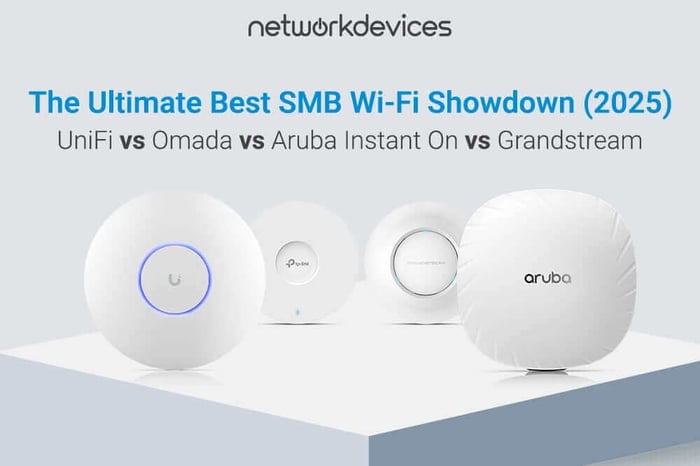

For most professional SMB Wi-Fi environments in 2025, Ubiquiti UniFi emerges as the best all-around solution. It offers an unmatched blend of performance, features, and ecosystem integration at a competitive price.
However, the decision isn't always that simple. Fierce competitors like TP-Link Omada, Aruba Instant On, and Grandstream each excel in specific scenarios, from budget-focused deployments to set-it-and-forget-it reliability.
As a certified network engineer with over 15 years of hands-on experience, I'm cutting through the marketing hype to deliver a real-world, technical breakdown. This guide is for IT managers tired of chasing down firmware bugs, MSPs seeking affordable enterprise Wi-Fi, and business owners who demand reliability.
This comparison will help you choose the best Wi-Fi system for your small business in 2025 by analyzing the four leading contenders across the criteria that truly matter.
Hardware & Real-World Performance: Who Delivers on Speed?
While all four brands offer modern Wi-Fi 6 access points, their real-world performance under load varies significantly. This is driven by hardware quality, antenna design, and firmware optimization. UniFi and Aruba generally lead, while Omada and Grandstream compete on price.
UniFi: The Performance Benchmark
UniFi is known for professional-grade hardware that delivers strong throughput in demanding environments.
- Models: High-performance Wi-Fi 6 APs like the U6+ and U6 Pro deliver impressive real-world speeds.
- Design: Their ceiling-mount designs are ideal for crowded offices and public venues.
- Pain Point: High-performance models require PoE+ switches. A well-known issue on some U6 Pro units also causes reboots with STP cables.
TP-Link Omada: The Competitive Value Player
Omada's hardware competes well on paper, offering modern features at a lower price point.
- Models: The EAP6xx Series offers solid Wi-Fi 6 and mesh capabilities for most businesses.
- Pain Point: In very high-density environments, users report performance can lag behind UniFi, with potential for slower speeds under heavy load.
Aruba Instant On: Enterprise-Grade Reliability
Backed by HPE, Aruba’s hardware is engineered for stability and consistent performance.
- Models: APs like the AP22 and AP25 provide exceptionally stable Wi-Fi 6 connectivity.
- Pain Point: While top-tier, a past firmware update did temporarily cause Android connectivity issues, proving that no system is perfect.
Grandstream: The Budget-Friendly Option
Grandstream provides functional hardware at the lowest price, suitable for basic needs.
- Models: The GWN7664 and other GWN APs offer basic Wi-Fi 6 functionality.
- Pain Point: The hardware can struggle with overheating or unstable firmware, making it a risk for any business-critical application.
Management & Usability: UniFi Controller vs. Aruba’s App
Effective network management balances deep control with daily usability. Aruba wins on radical simplicity, while UniFi offers unparalleled depth for experts. Omada strikes a popular balance right in the middle.
UniFi: Powerful but with a Learning Curve
The UniFi Network Controller is a powerful tool for those who need granular control.
- Controller: Required—either via hardware (Cloud Key, UDM) or a self-hosted server.
- Key Feature: Deep network visibility with detailed topology maps.
- Pain Point: Firmware updates can be a source of anxiety, often introducing bugs.
TP-Link Omada: The Scalable Cloud Contender
Omada's platform is a favorite among MSPs for its balance of features, cost, and ease of deployment.
- Controller: Optional—use an affordable on-site controller or the free cloud portal.
- Key Feature: AI-driven RF optimization and central VPN management.
- Pain Point: The UI lacks the polish of UniFi, and some advanced features are harder to find.
Aruba Instant On: Unmatched Simplicity
Aruba is the clear winner for non-technical users who need a "set-it-and-forget-it" solution.
- Controller: Not required. Managed entirely from a clean mobile app or web portal.
- Key Feature: Setup takes minutes with zero technical expertise needed.
- Pain Point: This simplicity is its biggest limitation; it lacks advanced logging and configuration options.
Grandstream: Functional but Unpolished
Grandstream's GWN.Cloud is free but lacks the modern feel and stability of its rivals.
- Controller: Not required. Free cloud management is included.
- Key Feature: Functional device management at no extra cost.
- Pain Point: The UI feels dated, and users report needing to manually reboot APs for some changes to take effect.
Ecosystem & Features: Beyond Wi-Fi to a Full Stack
A strong ecosystem provides a single point of management for your entire network. UniFi offers the most comprehensive stack by a wide margin. Omada is building its core network offerings, while Aruba and Grandstream are more focused.
UniFi: The All-in-One Leader
UniFi excels with its vast range of integrated products, creating a true single-vendor solution. This includes switches, security gateways, cameras (UniFi Protect), door access, and even VoIP phones. The main advantage is managing your entire infrastructure from one dashboard.
TP-Link Omada: The Growing SDN Platform
Omada is rapidly building its Software-Defined Networking (SDN) platform. It now fully integrates access points, switches, and routers under one centralized controller. The platform supports essential business features like VLANs, ACLs, and guest captive portals.
Aruba Instant On: Focused and Simple
The Aruba Instant On ecosystem is purposefully lean and focused on core networking. It consists of high-performance access points and simple-to-deploy smart switches. While VLANs work flawlessly, the ecosystem does not include routers, firewalls, or cameras.
Grandstream: Broad but Disjointed
Grandstream manufactures a wide array of products, but the integration between them feels disjointed. Firmware and management philosophies are not always consistent, making a unified setup feel cobbled together.
Reliability & Support: Who Won’t Let You Down?
For any business, a stable Wi-Fi network is non-negotiable. Aruba’s enterprise DNA gives it a clear edge in reliability. UniFi and Omada lean on their communities, while Grandstream's support is inconsistent.
UniFi: Powerful, with a Caveat
When UniFi is stable, it's excellent. However, its reputation is impacted by buggy firmware. Official support can be slow, making the vast online community your primary resource.
TP-Link Omada: Improving but Inconsistent
Omada's reliability has improved significantly, but firmware quality can be a mixed bag. The community forums and YouTube are often faster sources of help than official support.
Aruba Instant On: Enterprise-Grade Stability
This is Aruba's greatest strength. The firmware is thoroughly tested, and updates are delivered seamlessly. Support is professional and responsive, making it the most dependable choice.
Grandstream: A Risky Bet for Business
Grandstream's reputation for both reliability and support is inconsistent. This makes it a risky choice for any business where network uptime is a critical priority.
Comparison Snapshot: At a Glance
| Brand | Best For | Key Pro | Key Con |
| UniFi | Full-stack control, MSPs | Deep features, single ecosystem | Controller required, buggy updates |
| TP-Link Omada | Budget IT setups, scaling MSPs | Free cloud, extremely low TCO | UI is less refined than UniFi |
| Aruba Instant On | Simple, no-IT teams | Plug-and-play, rock-solid reliability | Limited advanced configuration |
| Grandstream | Tiny offices, budget-constrained | Cheapest upfront cost | Stability and support are inconsistent |
Final Recommendations & Scenarios
Choosing the right SMB Wi-Fi system means matching the platform's strengths to your business's needs, budget, and technical expertise. After extensive hands-on testing, here is my final verdict.
Scenario-Based Recommendations
- Best for 'Set-It-and-Forget-It' Reliability:
Aruba Instant On. For businesses without a dedicated IT team (e.g., cafes, retail stores) that need rock-solid Wi-Fi. The higher initial cost pays for peace of mind.
- Best for Budget-Conscious MSPs & Scalable SMBs:
TP-Link Omada. For IT providers and growing businesses that need a scalable solution with an extremely low TCO. The free cloud management is a massive advantage.
- Best for Full-Stack Control & Tech Enthusiasts:
Ubiquiti UniFi. For IT-savvy businesses that want a single pane of glass to manage their entire network stack and aren't afraid of managing a controller.
- Best for Ultra-Low-Budget Deployments:
FAQs
1. What is the most reliable Wi-Fi for a small business?
For pure set-it-and-forget-it reliability, Aruba Instant On is the top choice. Its enterprise-grade hardware and stable firmware mean less downtime, making it ideal for businesses without on-site IT staff.
2. Is UniFi better than Omada in 2025?
UniFi is "better" for those who want a more mature and expansive ecosystem, including security cameras. Omada is "better" for those whose primary concern is achieving the lowest TCO with a highly scalable, cloud-managed network.
3. Do I need a controller for Aruba Instant On?
No. Aruba Instant On is managed entirely through a free mobile app and web portal. There is no need to purchase or maintain any controller hardware, and there are no licensing fees.