


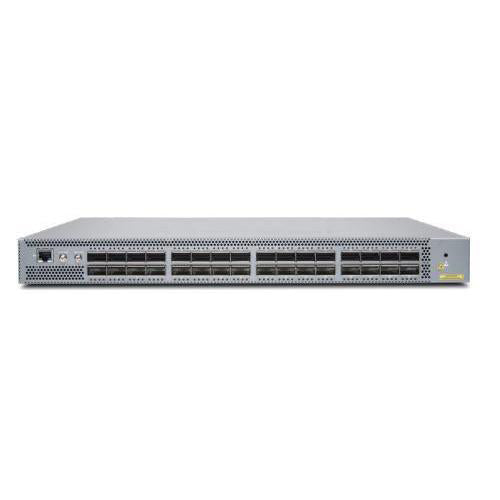
Juniper QFX5200-32C-DCSAFI Switch
- QFX5200, with SONiC, 32 x QSFP+/QSFP28 ports, Redundant Fans, 2 x DC power supplies, Back-to-front airflow
$32,696.00
$27,464.64
Instant Savings
$5,231.36

Juniper QFX5200-32C-DCSAFI Switch
The QFX5200 line of access switches is ideally suited for leaf deployments in next-generation IP fabrics. It features line-rate, high-density SFP28/QSFP+/QSFP28 ports that support 10GbE, 25GbE, 40GbE, 50GbE, and 100GbE connections. Offering an advanced L2, L3, and MPLS feature set, network operators can use the QFX5200 to build large, high-density IP fabrics that support upgrades to 25GbE servers, network virtualization, and intelligent traffic forwarding based on proven, Internet-scale technology. The QFX5200 also supports a version of Junos OS software in which control plane and data plane processes and functions run in parallel, maximizing utilization of the high-performance quad-core CPU.
| Properties | Juniper QFX5200-32C-DCSAFI |
| Description | QFX5200 (hardware only; software services sold separately), with SONiC, 32 QSFP+/QSFP28 ports, redundant fans, 2 DC power supplies, back-to-front airflow |
| Product Family | QFX5200 Series |
| Product Type | Ethernet Switch |
| Included | SONiC |
| Dimensions (HxWxD) Inches | 17.36 x 1.72 x 20.48 in. (44.09 x 4.37 x 52.02 cm) |
| Rack units | 1 U |
| Weight | 23.8 lb (10.8 Kg) |
| Deployment Options for QFX5200-32C | |
| 32x100GbE | Spine |
| 128x25GbE | Leaf |
| 64x25GbE + 16x100GbE | 25GbE access |
| 96x10GbE + 8x100GbE | 10GbE access |
| Interface Options | |
| QSFP+/QSFP28 ports | 32 QSFP+ or QSFP28 |
| SFP+/SFP28 | 128 10GbE SFP+ through QSFP+ to SFP+ breakout cable 128 25GbE SFP28 through QSFP28 to SFP28 breakout cable |
| Maximum 10GbE port density | 128 |
| Maximum 25GbE port density | 128 |
| Maximum 40GbE port density | 32 |
| Maximum 50GbE port density | 64 |
| Maximum 100GbE port density | 32 |
| Management and Precision Time Protocol (PTP) interfaces | 1 RJ-45 1GbE port for PTP Grandmaster 2 SMB connectors, one for pulse per second (PPS) output and one for 10 MHz clock output 2 SFP and 1 RJ-45 10/100/1000 BASE-T for management (only two ports can be used) 1 RS-232 console port 1 USB 2.0 port |
| Rack Installation Kit | Versatile four post mounting options for 19-in server rack or datacom rack |
| Cooling | Back-to-front cooling Redundant (N+1) hot-pluggable fan modules with variable speed to minimize power draw |
| Power | Redundant (1+1) hot-pluggable 850 W AC/DC power supplies 110-240 V single phase AC power -36 to -72 V DC power |
| Maximum Thermal Output | |
| Maximum power draw | 480 W (AC, DC), 1638 BTU/hr |
| Typical power draw | 380 W (AC, DC), 1296 BTU/hr |
| Specifications | QFX5200-32C-DCSAFI |
| CPU | Intel Quad Core Ivy Bridge 1.8 GHz CPU |
| Memory | 16 GB |
| Storage | 64 GB SSD |
| System throughput | Up to 6.4 Tbps (bi-directional) |
| Forwarding capacity | Up to 2.4 Bpps |
| Total packet buffer | 16 MB |
| MAC addresses per system | 136,000 |
| VLAN Ids | 4,096 |
| Number of link aggregation groups (LAGs) | 128 |
| Number of ports per LAG | 64 (Number of FCoE VLANs/FC virtual fabrics: 4095) |
| Firewall filters | Ingress: 768 Routed ACL (RACL), VLAN ACL (VACL), and Port ACL (PACL) rules Egress: 1024 RACL, VACL, and PACL rules |
| IPv4 unicast routes | 128,000 prefixes; 104,000 host routes |
| IPv4 multicast routes | 52,000 |
| IPv6 multicast routes | 28,000 |
| IPv6 unicast routes | 98,000 prefixes; 52,000 host routes |
| Address Resolution Protocol (ARP) entries | 32,000 |
| Generic routing encapsulation (GRE) tunnels | 1024 |
| MPLS labels | 16,000 |
| MPLS IPv4 L3 VPNs (Premium Services License) | 2048 |
| Jumbo frame | 9,216 bytes |
| Spanning Tree Protocol (STP) | - Multiple Spanning Tree Protocol (MSTP) instances: 64 - VLAN Spanning Tree Protocol (VSTP) instances: 253 |
| Traffic mirroring | - Mirroring destination ports per switch: 4 - Maximum number of mirroring sessions: 4 - Mirroring destination VLANs per switch: 4 |
| Software Specifications | |
| Layer 2 Features | STPIEEE 802.1D (802.1D-2004) Rapid Spanning Tree Protocol (RSTP) (IEEE 802.1w); MSTP (IEEE 802.1s) Bridge protocol data unit (BPDU) protect Loop protect Root protect RSTP and VSTP running concurrently VLANIEEE 802.1Q VLAN trunking Routed VLAN Interface (RVI) Port-based VLAN MAC address filtering QinQ VLAN translation Static MAC address assignment for interface Per VLAN MAC learning (limit) MAC learning disable Link Aggregation and Link Aggregation Control Protocol (LACP) (IEEE 802.3ad) IEEE 802.1AB Link Layer Discovery Protocol (LLDP) |
| Layer 3 Features (IPv4) | Static routing RIP v1/v2 OSPF v1/v2 OSPF v3 Filter-based forwarding Virtual Router Redundancy Protocol (VRRP) IPv6 Virtual routers Unicast RPF (uRPF) Loop-free alternate (LFA) BGP (Advanced Services or Premium Services license) IS-IS (Advanced Services or Premium Services license) Dynamic Host Configuration Protocol (DHCP) v4/v6 relay VR-aware DHCP IPv4/IPv6 over GRE tunnels (interface-based with decap/encap and firewall-based with decap only) |
| Fibre Channel over Ethernet (FCoE) | FCoE transit switch (FIP snooping ACL installation) FCoE session path learning FCoE session health monitoring Graceful restart for FIP snooping FC-BB-6 VN2VN snooping |
| Multicast Features | Internet Group Management Protocol (IGMP) v1/v2 Multicast Listener Discovery (MLD) v1/v2 IGMP proxy, querier IGMP snooping MLD snooping Protocol Independent Multicast PIM-SM, PIM-SSM, PIM-DM, PIM-Bidir* Multicast Source Discovery Protocol (MSDP) |
| Link Aggregation | Multichassis link aggregation (MC-LAG) Redundant trunk group (RTG)* LAG load sharing algorithmbridged or routed (unicast or multicast) traffic: IP: Session Initiation Protocol (SIP), Dynamic Internet Protocol (DIP), TCP/UDP source port, TCP/UDP destination port L2 and non-IP: MAC SA, MAC DA, Ethertype, VLAN ID, source port FCoE packet: Source ID (SID), destination ID (DID), originator exchange ID (OXID), source port |
| Quality of Service (QoS) | L2 and L3 QoS: Classification, rewrite, queuing Rate limiting: -Ingress policing: 1 rate 2 color, 2 rate 3 color -Egress policing: Policer, policer mark down action -Egress shaping: Per queue 10 hardware queues per port (8 unicast and 2 multicast) Strict priority queuing (LLQ), shaped-deficit weighted round-robin (SDWRR), weighted random early detection (WRED) 802.1p remarking Layer 2 classification criteria: Interface, MAC address, Ethertype, 802.1p, VLAN Congestion avoidance capabilities: WRED Trust IEEE 802.1p (ingress) Remarking of bridged packets |
| Security and Filters | Secure interface login and password RADIUS TACACS+ Ingress and egress filters: Allow and deny, port filters, VLAN filters, and routed filters, including management port filters Filter actions: Logging, system logging, reject, mirror to an interface, counters, assign forwarding class, permit, drop, police, mark SSH v1, v2 Static ARP support Storm control, port error disable, and autorecovery Control plane denial-of-service (DoS) protection DHCP snooping |
| Data Center Bridging (DCB) | Priority-based flow control (PFC)IEEE 802.1Qbb Data Center Bridging Exchange Protocol (DCBX), DCBx FCoE, and iSCSI type, length, and value (TLVs) |
| High Availability | Sub-second Bidirectional Forwarding Detection (BFD) Uplink failure detection (UFD) |
| MPLS | Static label-switched paths (LSPs) RSVP-based signaling of LSPs LDP-based signaling of LSPs LDP tunneling (LDP over RSVP) MPLS class of service (CoS) MPLS access control list (ACL)/policers MPLS LSR support IPv4 L3 VPN (RFC 2547, 4364) MPLS fast reroute (FRR) |
| Visibility and Analytics | Switched Port Analyzer (SPAN) Remote SPAN (RSPAN) Encapsulated Remote SPAN (ERSPAN) sFlow v5 Junos Telemetry Interface |
| Server Virtualization Management and SDN-Related Protocols | IEEE 802.1Qbg (VEPA hairpin forwarding) |
| Device Management and Operations | Role-based CLI management and access CLI via console, telnet, or SSH Extended ping and traceroute Junos OS configuration rescue and rollback Image rollback SNMP v1/v2/v3 Junos XML management protocol High frequency statistics collection Beacon LED for port and system Automation and orchestration Zero Touch Provisioning (ZTP) OpenStack Neutron Plug-in Puppet Chef Python Junos OS event, commit, and OP scripts |
| Accessories | |
| JPSU-850W-DC-AFI | DC 850 W power supply, back-to-front airflow for QFX5100-96S and QFX5200-32C |
| QFX5200-32C-FANAFI | QFX5200-32C fan module, back-to-front airflow |
| EX-4PST-RMK | Adjustable 4-post rack-mount kit for EX Series, QFX5100, and QFX5200 |
| Software Licenses | |
| QFX5000-35-JBS | Base Services license for QFX5200-32C |
| QFX5000-35-JAS | Advanced Services license for QFX5200-32C |
| QFX5000-35-JPS | Premium services license for QFX5200-32C |
| Optics and Transceivers | |
| QFX-SFP-10GE-USR | SFP+ 10GbE Ultra Short Reach optics, 850 nm for 10 m on OM1, 20 m on OM2, 100 m on OM3 multimode fiber (for management port) |
| QFX-SFP-10GE-SR | SFP+ 10GBASE-SR 10GbE optics, 850 nm for up to 300 m transmission on multimode fiber-optic (MMF) (for management port) |
| QFX-SFP-10GE-LR | SFP+ 10GBASE-LR 10GbE optics, 1310 nm for 10 km transmission on single-mode fiber-optic (SMF) (for management port) |
| QFX-SFP-DAC-1M | SFP+10 GbE direct attach copper (DAC) (twinax copper cable) 1 m for QFX5200-48Y |
| QFX-SFP-DAC-3M | SFP+10 GbE DAC (twinax copper cable) 3 m for QFX5200-48Y |
| QFX-SFP-DAC-5M | SFP+10 GbE DAC (twinax copper cable) 5 m for QFX5200-48Y |
| JNP-SFP-25G-SR | 25GBASE-SR SFP28 module for MMF for QFX5200-48Y |
| JNP-SFP-25G-DAC-1M | SFP 25GBASE DAC cable 1 m for QFX5200-48Y |
| JNP-SFP-25G-DAC-3M | SFP 25GBASE DAC cable 3 m for QFX5200-48Y |
| JNP-SFP-25G-DAC-5M | SFP 25GBASE DAC cable 5 m for QFX5200-48Y |
| JNP-QSFP-40GE-IR4 | QSFP+ 40GBASE-IR4 40-gigabit optics, 1310 nm for up to 2 km transmission on SMF |
| JNP-QSFP-40G-LR4 | QSFP+ 40GBASE-LR4 40-gigabit optics, 1310 nm for up to 10 km transmission on SMF |
| JNP-QSFP-40G-LX4 | QSFP+ 40GBASE-LX4 40-gigabit optics, 100 m (150 m) with OM3 (OM4) duplex MMF fiber |
| JNP-QSFP-4X10GE-IR | QSFP+ 40GBASE optics, up to 1.4 km transmission on parallel single mode (4X10GbE long reach up to 1.4 km) |
| JNP-QSFP-4X10GE-LR | QSFP+ 40GBASE optics, up to 10 km transmission on parallel single mode (4X10GbE long reach up to 10 km) |
| QFX-QSFP-40G-ESR4 | QSFP+ 40GBASE-ESR4 40-gigabit optics, 300 m (400 m) with OM3 (OM4) MMF |
| QFX-QSFP-40G-SR4 | QSFP+ 40GBASE-SR4 40-gigabit optics, 850 nm for up to 150 m transmission on MMF |
| JNP-40G-AOC-20M | 40GbE active optical cable for 20 m |
| JNP-40G-AOC-30M | 40GbE active optical cable for 30 m |
| JNP-QSFP-DAC-10MA | QSFP+ to QSFP+ Ethernet DAC (twinax copper cable) 10 m active |
| JNP-QSFP-DAC-7MA | QSFP+ to QSFP+ Ethernet DAC (twinax copper cable) 7 m active |
| JNP-QSFP-DAC-5M | QSFP+ to QSFP+ Ethernet DAC (twinax copper cable) 5 m passive |
| QFX-QSFP-DAC-3M | QSFP+ to QSFP+ Ethernet DAC (twinax copper cable) 3 m passive |
| QFX-QSFP-DAC-1M | QSFP+ to QSFP+ Ethernet DAC (twinax copper cable) 1 m passive |
| EX-QSFP-40GE-DAC-50CM | 40GbE QSFP+ 0.5 m direct-attach |
| JNP-QSFP-DACBO-10M | QSFP+ to SFP+ 10GbE direct attach breakout copper (twinax copper cable) 10 m active |
| JNP-QSFP-DACBO-7MA | QSFP+ to SFP+ 10GbE direct attach breakout copper (twinax copper cable) 7 m active |
| JNP-QSFP-DACBO-5MA | QSFP+ to SFP+ 10GbE direct attach breakout copper (twinax copper cable) 5 m active |
| QFX-QSFP-DACBO-3M | QSFP+ to SFP+ 10GbE direct attach breakout copper (twinax copper cable) 3 m |
| QFX-QSFP-DACBO-1M | QSFP+ to SFP+ 10GbE direct attach breakout copper (twinax copper cable) 1 m |
| JNP-QSFP-100G-SR4 | QSFP28 100GBASE-SR4 optics for up to 100 m transmission over parallel MMF |
| JNP-QSFP-100G-LR4 | QSFP28 100GBASE-LR4 optics for up to 10 km transmission over serial SMF |
| JNP-QSFP-100G-PSM4 | 100GbE PSM4 optics |
| JNP-QSFP-100G-CWDM | 100GbE CWDM4 optics |
| JNP-100G-AOC-1M | 100GbE active optical cable for 1 m |
| JNP-100G-AOC-15M | 100GbE active optical cable for 15 m |
| JNP-100G-AOC-20M | 100GbE active optical cable for 20 m |
| JNP-100G-DAC-3M | QSFP28-to-QSFP28 Ethernet DAC (twinax copper cable) 3 m |
| JNP-100G-DAC-1M | QSFP28-to-QSFP28 Ethernet DAC (twinax copper cable) 1 m |
