
Artificial Intelligence (AI) is no longer an experimental concept; it is a critical driver across various industries. While AI models, algorithms, and platforms make headlines, the true enabler of this revolution is specialized hardware.
Behind every transformer model or generative AI system lies a robust foundation of high-performance GPUs, NPUs, ultra-fast memory systems, AI-native switches, and purpose-built data centers. These are the invisible engines powering the intelligence revolution.
This article unpacks the critical hardware stack that enables AI, from training with GPUs and real-time inference with NPUs, to high-bandwidth networking, advanced memory, and energy-efficient AI-native data centers. You will also explore how sustainability and geopolitical priorities are reshaping global AI infrastructure.
AI Is Now Mission-Critical: Infrastructure at the Forefront
AI has moved into the heart of enterprise operations. IDC projects global AI spending to exceed $500 billion by 2028, with nearly 30% of the total dedicated to infrastructure, including servers, storage, and networking.
The rise of transformer models, such as ChatGPT and generative AI applications, has created a massive demand for computation. Training a large language model (LLM) often requires weeks and thousands of GPUs, consuming vast amounts of energy and compute capacity.
As AI adoption accelerates, enterprises face pressure to develop robust, scalable, and energy-efficient environments that support AI at every operational level.
GPUs: The Engine of AI Computation
Graphics Processing Units (GPUs) are the workhorses of AI model training. Their architecture allows massive parallelism, ideal for executing complex matrix operations and large data pipelines.
NVIDIA’s H100 Tensor Core GPU delivers up to four times the performance of its predecessor, the A100, and is optimized for large-scale LLMs. AMD's Instinct MI300X, with 192 GB of HBM3 memory, competes by minimizing latency and maximizing throughput.
From autonomous driving simulations to real-time voice synthesis, GPUs are foundational in hyperscale data centers and distributed AI clusters.
NPUs and AI Accelerators: Optimizing Inference
While GPUs lead training, Neural Processing Units (NPUs) dominate edge-based inference and real-time applications. These chips are specifically designed for AI tasks and deliver superior performance per watt.
Google’s TPU v5e provides up to 2.7 times better price-performance for training and inference. Apple's Neural Engine processes over 35 trillion operations per second, enabling on-device features such as image recognition and voice interaction.
Startups including Graphcore, Cerebras, and Tenstorrent are developing AI-specific chipsets that challenge legacy architectures with unmatched efficiency.
Networking: High-End Switches for AI Clusters
AI-centric data centers require ultra-fast, high-bandwidth networking to handle massive volumes of data exchange between GPUs, NPUs, and storage arrays. Unlike traditional enterprise data centers, AI workloads demand low-latency, high-throughput connectivity to ensure efficient training and inference processes.
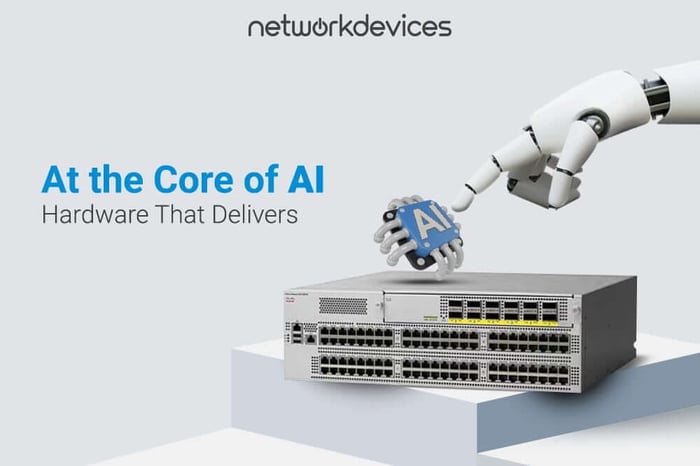
As AI workloads scale, high-end switches are becoming a mission-critical component in AI-centric data centers. Vendors such as NVIDIA, Cisco, Arista, Juniper, and Huawei are pushing the boundaries of networking to support hyperscale AI training, ultra-low-latency inference, and AI-optimized cloud deployments.
Why AI Workloads Require High-End Switches?
AI clusters rely on distributed computing, where multiple GPUs and TPUs work together on massive datasets. This requires a high-speed interconnect fabric that can:
- Reduce Latency: AI model training involves billions of real-time computations; even microsecond delays impact performance.
- Support High Bandwidth: AI training data moves at speeds of 400G to 800G per link, requiring ultra-fast Ethernet or InfiniBand.
- Enable Efficient GPU-to-GPU Communication: Technologies like RDMA over Converged Ethernet (RoCE) optimize network data transfers for AI.
Top Vendors of AI-Centric Network Switches
NVIDIA (Mellanox):
- Spectrum-X and Quantum-2 InfiniBand switches support RoCE and 400Gb/s per port.
- Quantum-2 supports a throughput of 50 billion messages per second.
- Enables high-throughput messaging and NVLink acceleration.
Cisco:
- Nexus 9300 (N9K-C93108TC-FX3P) and 9500 Series support 100G and 400G AI/ML workloads.
- Cisco 8000 Series is 800 G-ready and optimized for hyperscale AI clusters.
Arista Networks:
- 7800R3 and 7500R3 switches deliver RDMA-ready 400G Ethernet fabric.
- Arista EOS enables AI-aware operations in scale-out environments.
Juniper Networks:
- QFX5700 (QFX5700-BASE-AC) and PTX Series support 400G Ethernet for hyperscale data centers.
- Apstra automates AI fabric deployment and telemetry monitoring.
Huawei:
- CloudEngine 16800 supports 800G networking with iLossless AI Fabric.
- CloudFabric AI boosts distributed training with ultra-low latency.
Memory, Storage, and I/O Bottlenecks
As AI models expand, memory throughput and storage access become critical performance constraints.
- HBM3 and GDDR6X deliver ultra-high memory bandwidth.
- NVMe SSDs and AI-optimized storage arrays from VAST Data, Dell EMC, and Pure Storage provide rapid data access.
- NVMe-over-Fabrics (NVMe-oF) reduces latency by directly linking storage to compute nodes.
Together, these innovations ensure that compute engines remain fully fed and unthrottled.
AI-Native Data Centers: Engineered for Intelligence
Traditional data centers are being outpaced by the demands of AI. AI-native data centers are custom-built to support the heat, power, and flexibility needs of AI workloads.
Key characteristics include:
- Liquid Cooling: Supports dense GPU configurations.
- High-power density, with densities reaching up to 100kW per rack: Enables large-scale compute clusters.
- Software-Defined Infrastructure: Allows dynamic resource allocation.
Sustainability: The Paradox of AI Growth
AI hardware is powerful, but it is also energy-hungry. Training GPT-3 reportedly consumed 1.3 GWh, enough to power 120 U.S. homes for a year.
Vendors are tackling this with:
- NVIDIA Grace Hopper Superchips for higher performance per watt.
- Intel Gaudi2 and AMD EPYC 9004 for lower heat output and compute density.
- Renewable energy, AI-driven energy management, and carbon-aware scheduling in data centers.
As sustainability becomes a key performance metric, green AI infrastructure is no longer optional.
Global Race for AI Infrastructure
AI development is increasingly geopolitical. Countries are investing in sovereign AI infrastructure to ensure data control and technological leadership.
Key initiatives include:
- EU’s Gaia-X for data autonomy.
- China’s AI Cloud Sovereignty model.
- U.S. CHIPS Act supports domestic chip manufacturing.
Startups like Cerebras are also innovating, deploying wafer-scale chips with 850,000 AI cores. Meanwhile, AI-as-a-Service platforms are emerging to offer turnkey compute, network, and storage tailored for model development.
Final Thoughts: Infrastructure Is the Differentiator
Advanced AI models may grab the spotlight, but it is the physical foundation beneath them that defines performance, scalability, and value.
To see how AI hardware is revolutionizing network protection and real-time threat response, explore our in-depth guide on AI-powered security appliances.
To lead in AI, organizations must understand and invest in the foundational components that enable it: GPUs, NPUs, fast-switching networks, high-throughput memory, and sustainable data centers. This infrastructure is the real differentiator in the intelligence revolution.